Help on lighting a dinner scene in a dark restaurant?

Slondon, the 575 HMI sounds awesome, but pretty far from my budget- even if I were to rent it.

Erik Olson, I'm digging that idea. Do you think you would be able to go a little more in depth of how I could set that up and where exactly to place all of that equipment. Lets say I were to film in that corner table. I could hang the China balls overhead, and where could I exactly place the fabric? I don't want to block the view of other customers in the background when doing a side profile shot of both individuals
 
Seeing those can lights, I don't think bringing up the practicals levels is going to help with your overall ambient illumination.

Depending on the venue, sometimes there are additional lights that can be varied, to releave some of the 'darkness'. On the other hand some places just have 2 settings, off, and full
on for cleaning the restaurant, and nothing in between...
 
Factor in time and budget. I tend to turn the existing and practical lights off and go from there. Restaurant lighting is sometimes fine, sometimes not. You need an ambient level a couple stops under the principals' key. Get it however you want, but don't let a nice location fall off into black if the action doesn't call for it. After all, you've secured the location because you want to see it.
 
Slondon, the 575 HMI sounds awesome, but pretty far from my budget- even if I were to rent it.

Erik Olson, I'm digging that idea. Do you think you would be able to go a little more in depth of how I could set that up and where exactly to place all of that equipment. Lets say I were to film in that corner table. I could hang the China balls overhead, and where could I exactly place the fabric? I don't want to block the view of other customers in the background when doing a side profile shot of both individuals

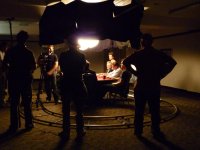
Okay, you can bounce anything off the walls and ceiling. It's a good use for Lowel Totas for example.

In lighting there is never one way to get the light you want, there are always many.

As to the fabric, when you use a China ball the light goes everywhere. The intensity falls off quickly but you still want to direct it so it goes where you want and control it so it doesn't go where you don't, which often means limiting how much hits the walls.

To skirt a China ball you take a piece of Duvetyne, which is heavy but light proof and you wrap it around the lantern completely (it will twist the lantern off balance if not all the way around). I keep separate pieces that are wide enough to wrap around and long enough to hang below the lantern. Some people prefer lighter black fabrics that you can find at a fabric store and 24" black wrap works well. You clothespin the fabric to the top of the lantern or to itself. How far down it hangs affects the spill and directionality. You can picture that in your mind, right? If the fabric hangs below the lantern a few inches the light can only go down, if the fabric hangs down to the bottom or above a little bit, then more light goes to the sides.

The skirt doesn't have to be on the lantern(s) of course. It can be hung from the ceiling, or rigged from stands. I'll try to find some BTS snaps.
 
We have Matthews scissor clips for drop ceilings - great for temporarily hanging small fixtures. They retail for $16 and allow you to safely rig from the drop-ceiling main beams. These, coupled with Ikea med screw base wire and inline dimmers and you're off and running. The commando cloth / duvetyne is an excellent choice for controlling where the light goes. Duvetyne is fire-retardant, which is important. You can staple these goods to 1x3" #2 (or hog-trough / t-whalers, for longer runs) for flagging or use grip clips to the ceiling as in the photo above. It is very common to flag off the upper areas of the walls as above. You want a good ambient level for your shoot-off area though. Try to keep from having more than a couple stops difference between your principal actors and the atmosphere / background players unless you can justify the higher light level on your principals with a practical (like a table lamp).
 
Wow, Eric, you sent me googling :)

Whaler = low- profile stiffeners for steel framed flats – a steel hog trough [1]
hog trough = "angle iron" made of wood. L shaped piece of wood [2]

So a Whaler is used to made the set panels flat and thinner than a hog trough support/framing. The whaler differs from the hog trough use steel/metal not wood that a hog trough use.

sources
[1] Technical design solutions for theatre: the technical brief collection By Don Harvey, Yale School of Drama. Dept. of Technical Design
and Production (page 150) http://books.google.ca/books?id=hQVV...heater&f=false
[2] Scenic design and lighting techniques: a basic guide for theatre
By Chuck B. Gloman, Rob Napoli http://books.google.ca/books?id=9HQR...page&q&f=false (page 179)​
 
As far as the mirrors go, just grab a few cans of dulling spray and spray em all down. It'll make them look like frosted glass. Worked on a feature just recently where we did that and it worked like a charm.
 
T-whalers can also be of wood - commonly #2 pine as 1 x 2; 1 x 3 or 1 x 4. Constructed of two pieces, one is flat and the other runs the length, on center and perpendicular to the flat piece - creating a "T" when viewed from the end. It is designed to keep long runs of Hollywood square flats from becoming wavy, bridging across several flats where they meet. The leg of the "T" is horizontal and parallel to the floor, so you can put drywall screws above and below the leg for added strength.
 
As far as the mirrors go, just grab a few cans of dulling spray and spray em all down. It'll make them look like frosted glass. Worked on a feature just recently where we did that and it worked like a charm.

Did you use actual dulling spray or deodorant or what? Did you have any trouble making the spray smooth?
 
T-whalers can also be of wood - commonly #2 pine as 1 x 2; 1 x 3 or 1 x 4. Constructed of two pieces, one is flat and the other runs the length, on center and perpendicular to the flat piece - creating a "T" when viewed from the end. It is designed to keep long runs of Hollywood square flats from becoming wavy, bridging across several flats where they meet. The leg of the "T" is horizontal and parallel to the floor, so you can put drywall screws above and below the leg for added strength.

An education, thanks, Erik. I don't do a lot of studio work, mostly practical sets.
 
Actual dulling spray. I didn't personally do it, but as long as you keep it a good distance away you can apply even coats.

We also had some really reflective cabinets on that show and we just cut pieces of 251 and applied them with a little soapy water and a squeegee like you would ND gel. That's also another good way to go about it.
 
Back
Top