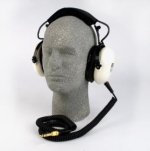
Headphones to monitor audio in loud environments. Please help me

offbeatbryce

Well-known member
I've been struggling with finding a good way to use headphones while filming in super loud environments like Music performances, Protests etc. My camera headphone volume is all the way up and I can hardly hear anything in the headphones as the outside noise is overpowering what I would hear in the headphones. I've tried noise cancel headphones but then certain sounds I'm monitoring are cut out due to the noise cancel phase. Any ideas? I recently filmed a theater performance for a friend. The only spot I could stand was next to a loud speaker and when I came back home most of the sound on the shotgun was distorted but I couldn't have heard it anyway since I was next to the speaker and the volume levels on the camera weren't peaking so I think the issue is the speaker was so close to the camera that it overpowered the mic but didn't show any clipping issues.
 
My camera headphone volume is all the way up ......
Unless you want to get irreparable hearing damage I would immediately stop doing that.

Get high-quality recording equipment, i.e. high-pressure tolerant mics and a recorder with a high dynamic range.

Also before a concert insist on a soundcheck that you can record and playback in a quiet environment outside the stage area, you may have to iterate a few times to get it right.
And get assurance the mixer operator does not change the levels during the concert (taking into account the difference between an empty and full venue).
 
Last edited:
Do you need to listen?

I wear regular 'chainsaw' headphones at gigs - Im usually taking sound off the desk to another device (sound recorder or the desk records onto an SD card)
 
Try some earbuds from Etymotics and the like. They can attenuate the outside by about 35db which is a lot. Not as convenient in some ways as normal headphones but I think they are your only hope in an environment like that
 
I would combine in-ear monitors with hearing protection earmuffs. I actually did this once just playing and I was amazed by how much sound was blocked.

You could also go the weird way of getting in-ear headphones with active noise reduction and combine them with hearing protection earmuffs.

And finally, for the ultimate experiment: active noise reduction in ear monitors under active noise cancellation headphones.
 
All the common OB style camera headsets reduce noise to a safe level (Peltors and the Bose aviation series worn on flight lines) but their audio quality is not wonderful. It's brilliant for hearing the director, but the reduction in volume is centred around comms frequencies - which are mainly speech centred. Music quality is very tricky to assess, and hearing a 50/60hz hum very difficult. They also have another drawback - they clamp your ears like a vice to keep the seal intact. Worst for comfort are the ones worn in motor racing pits, which are the most uncomfortable, even though they are well padded and have nice squishy sealing. For music events, why not try the popular IEM ones worn by the musos? Starting with the Shure 215 and going up in price. The foam buds seal quite well, and you can have custom moulds made to make the seal better, and the audio quality is really good. These can be worn for hours without issue. When in your ears, you can't hear people speaking very well - so the isolation is sufficient.

I'm a bit confused by this.
Also before a concert insist on a soundcheck that you can record and playback in a quiet environment outside the stage area, you may have to iterate a few times to get it right.
And get assurance the mixer operator does not change the levels during the concert (taking into account the difference between an empty and full venue).
Unless contracted to worry about your audio feed, you cannot expect the FOH op to do more than perhaps notice a meter is moving - it's not their primary job, and if you are sharing a master output with the PA the sound level WILL change. If you can get them to give you a mix bus, then levels will be less variable, but unless you are there early enough that won't happen, unless it's in the rider advanced before the show where this bus will be pre-programmed and patched. If you want to be sure, then take your own limiter or use a recorder with one that has one. I have never seen a live music soundcheck stop for the video people - ever! you can record the sound check, but you'll have to go and play it somewhere quiet, and I doubt the band will do the soundcheck again if you got it wrong - UNLESS the recording is for video as primary, and the people as secondary, and this will be contracted. I do video and live audio and I never have enough live stage time to sort the video people out. The prepared ones contact me in advance, and often turn up with a MacBook, which gets a split feed which gives them access to the mics. They sort the sound themselves. If a video guy turns up just before soundcheck and demands special services not planned for, then I am not accommodating if it encroaches on what I'm being paid to do. I'll offer them a rough mix using a couple of busses, and a stereo mix - but in smaller venues, I may not have the bass guitar in the mix because the muso is using a 1000W amp and he's too loud. Same with drums, these may be lower in the mix than the video people want. it's common for a show for say 1000 people to have minimal PA assistance on maybe snare, possibly guitar and bass. The mix will be brass, keys and BV heavy. What comes through the audience's ears can be 75% live and 25% real stage sound, and a stereo output gets just that - so recording the room is vital too. Sound for live music is tailored to the audience. The video may have very different needs. I've had really pi**ed off video people phone me up and yell because in their stereo recording there is no bass guitar and tell me it's my fault. the sound balance was fine - they only recorded part of it. Hence whyI'm happy to give them a USB output and let them record all the mics. If the client is cool with them having it (and some were not), it's OK with me.
 
I've been struggling with finding a good way to use headphones while filming in super loud environments like Music performances, Protests etc. My camera headphone volume is all the way up and I can hardly hear anything in the headphones as the outside noise is overpowering what I would hear in the headphones.

The laws of physics aren't with you on this. If your head is in the sound space, you can only knock down the surrounding noise by something around the mid -30s dB. The reason for this is that your ear canals are not the only way sound reaches your eardrums. Your nasal passages resonate at interesting frequencies. Even your eyes let sound into your skull.

About the best you can practically do are either the previously mentioned Remote Audio HN-7506s, or a good in-ear monitor while adding noise blocking "ear muffs" like the 3M Peltor X5s over your ears. This will not likely be enough for what you want, but it's all the laws of physics are willing to give you. If you've *got* to have more, get your body out of the sound field. It really is the only way.

Your natural inclination (as you've already stated) is to crank your headphone amps all the way up to try to overpower the noise. This is a fool's game, and will almost certainly destroy your hearing. You can not over power noise like this. If the only place you can stand is in front of a speaker, use your brain and decline the job. No job is worth your hearing. They can't pay you enough to make your going deaf worth it.

It's good that you're asking questions like this. If you don't protect your hearing, who will?

Continue your education; learn how much noise exposure (both loudness levels, and duration times) result in permanent hearing loss. OSHA has information. As does AudiologyOnline. As do industry websites like Etymotic. There are of course many other sources; noise and hearing loss have been studied for hundreds of years. Search away.
 
I’ve been using custom molded IEM(soft silicone/rubber/whatever, not hard rigid plastic like the ones singers wear on stage) for well over a decade and in-ear-drivers in what amounted to normal foam plugs, before that. I’ve been shooting racing since the 90’s(NASCAR, NHRA, IRL, IMSA, motorcycles, etc.) and this has been my SOP for hearing protection and monitoring audio. I actually use them everywhere, not just “loud” environments.

The custom IEM’s are going to take you a second or two longer to get in and out vs. headphones, but are going to be much lighter and low-profile to wear, especially if you’re shooting and have the camera on your shoulder. Personally, I’d never shoot with a camera on my shoulder with a headphone covering my right ear(especially a headphone that is capable of properly isolating/blocking extraneous noise). You can’t get your head into the right position and will fatigue your neck quickly. Check into the IEM’s if you’re constantly in loud environments. It only takes about five minutes to get molds of your ears done and the company that I get mine from usually turns them around in 2-3 weeks, depending on how busy they are. I think I even got a pair made in one week before.
 
+1 Remote Audio HN-7506 High Noise Headphones.
Many low budget recorders and mixers have anemic HP amps, only 10 or 20 mW and only go just so loud before they distort. In my experience, 50mW per channel the absolute usable minimum for 'louder the dialog' environments. Sound Devices and Zaxcom HP amps have lots of clean power... and enough to cause hearing damage, so use wisely.
 
Sound Devices and Zaxcom HP amps have lots of clean power... and enough to cause hearing damage, so use wisely.

SD has a note about that in (at least some of) their manuals. And that gets to another reason to use something like the HN-7506: The extra isolation means you're not tempted to crank the headphone amp to get volumes above the environment...

Anyway, let us know what you end up doing and how it works for you...
 
Back
Top