H.266 VVC standard finalized

ahalpert

Major Contributor
I'm sure it will be years before we're using it, but Fraunhofer's next generation compressed video codec was finalized today. Supposedly it will deliver H.265 visual quality with half the data.

The specs according to wikipedia:

"It should support resolutions from 4K to 16K as well as 360° videos. VVC should support YCbCr 4:4:4, 4:2:2 and 4:2:0 with 10 to 16 bits per component, BT.2100 wide color gamut and high dynamic range (HDR) of more than 16 stops (with peak brightness of 1000, 4000 and 10000 nits), auxiliary channels (for depth, transparency, etc.), variable and fractional frame rates from 0 to 120 Hz, scalable video coding for temporal (frame rate), spatial (resolution), SNR, color gamut and dynamic range differences, stereo/multiview coding, panoramic formats, and still picture coding. Encoding complexity of several times (up to ten times) that of HEVC is expected, depending on the quality of the encoding algorithm (which is outside the scope of the standard). The decoding complexity is expected to be about twice that of HEVC."

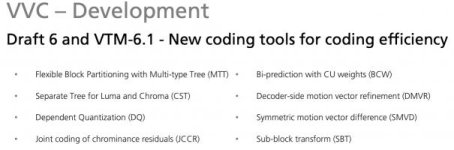
How it's achieved:
Screen Shot 2020-07-06 at 9.02.08 PM.jpg
Screen Shot 2020-07-06 at 9.02.13 PM.jpg

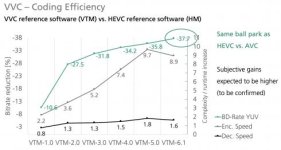
Evolution until final version of bitrate savings and encode/decode complexity relative to H265:
Screen Shot 2020-07-06 at 8.58.36 PM.jpg

So, it looks like it takes almost 10x the processing power to encode but less than twice to decode, relative to H265.
 
Probably going to get tied up in courts for the next decade. H265 was demoed in 2012.
 
If they actually use the scope of it to actually deliver some 12-bit 4:4:4 recording formats, then I'll be interested.

h264 and h265 both have the scope, but have seen practically zero implementation of the higher specs - making them basically redundant for any kind of high-quality mastering. Which is a shame, because accessing the higher compression levels would make those mastering formats so much easier to deal with.
 
Why courts? Patent battles over underlying techniques?

Major patent and royalty battles. On paper, it looks like Fraunhofer's the sole creator but H265 had dozens of companies angling for a payoff (or attempting to avoid the payout). Samsung had H265 in NX-1 back in 2015 - it was one of the major patent litigants - and it still barely available. Off memory, it's 1D X MKIII, C300 MKIII and nothing else (except security cameras, which die for compression). Instead, there's been a ton of proprietary formats from CRL to X-OCN to BMD Raw to ProRes Raw.

And a big licensee are all the streaming services. YouTube is still using VP-9, I believe, with VP-10 being rolled into AV-1 but there doesn't seem to be any camera manufacturers interested in incorporating that. At least, not yet.

More on codecs here.

https://www.androidauthority.com/av1-codec-1113318/
 
That can't be - a quick Google confirms that lumix and fuji cameras shoot H265. Many others as well I believe
 
EVA1, S1/R/H, X-T3, X-T4, all of the ZCAMS (now 6 different models although 3 are pretty much the same one), Canon XF705...plus the handful of the new cameras coming out this summer.

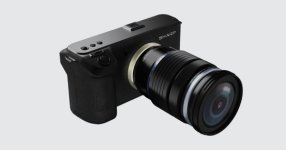
Maybe even Sharp's new 8K camera under development.

SHARP.jpg
 
And loads of phones too. But that's all pretty recent: for the first six or eight years of its life, H.265 wasn't used at all, and one of the big reasons was the licensing mess.
 
EVA1, S1/R/H, X-T3, X-T4, all of the ZCAMS (now 6 different models although 3 are pretty much the same one), Canon XF705...plus the handful of the new cameras coming out this summer.

Maybe even Sharp's new 8K camera under development...

So, with hundreds of different models out since 2015 NX1, about a dozen - plus a bunch of security cameras - and most of those are from the last year and a half. And, as Grug mentioned earlier, there's nothing with the high tier 444 versions. But there are a lot of proprietary 4K compressed Raw codecs. In other words, the research engineers zig, the manufacturers zag.

And AV1, that's supposed be open source that's 30% more efficient than H265, has been out for about a year and a half too.

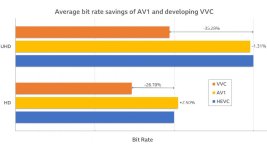
Actually what I'm reading from a BBC article that tested experimental VVC and AV1 against HEVC in late 2019 is that AV1 is on par with HEVC for bitrates. And requires several times the encoding time but decodes marginally faster.

But they also said that it had improved a lot in the year since being released. So when you say it has been "out" for a year and a half, it sounds like it was never finalized.

I suspect we may see it on cameras that try to save money, but... if the processing power is several times that of HEVC, that's a hurdle. Plus, aren't these encoders and decoders built into the hardware on cameras and computers? Meaning that the hardware will probably lag a few years behind the codecs and also that they will probably only build in the machinery for one codec or the other?

"The Alliance of Open Media (AOMedia) developed the royalty-free AV1 in 2018, with video streaming in mind. Our previous testing showed that AV1 performed similar to HEVC although at significantly higher encoding and decoding times. This signifies technology that is much more computationally complex. Since its release in 2018, AOMedia have been further developing AV1 and so part of this current experiment was to see the impact a year of work has had on AV1."

average-savings-chart1920.jpg

https://www.bbc.co.uk/rd/blog/2019-...interesting here is,in the video coding field.
 
But there are a lot of proprietary 4K compressed Raw codecs. In other words, the research engineers zig, the manufacturers zag.

Yes, and they are better. CRL, Blackmagic RAW, ProRes RAW...much easier and nicer to work with then having a computer that's on the verge of melting trying to transcode 4K/60p H.265.
 
But what you lose in computational complexity you gain in data savings. That was always the point of compression.

Plus, the proprietary nature of those raw codecs present similar hurdles to the proprietary nature of hevc
 
If you need to save data for long-form shooting, H.265 isn't the answer either.

Data savings is fine if you need it, but what's the point of saving data if it's a problem later.

Wouldn't you want to rent a few extra cards for $25 instead?
 
I doubt H.265/HEVC is as rare as has been said here. Panasonic's been using it since at least the EVA1, the CX350 has it, even the little CX10 has it, the GH5 has it... Sony is supposed to be developing (or already developed?) a professional format based on it, I think it's called XEVC...
 
Anyone struggling with H265 in post needs to get themself a GPU with H265 Hardware Acceleration - makes all the difference in the world.

My previous Mac Pro 5,1 had a beefy 12GB Titan X in it - couldn't even begin to playback H265 footage. My new 5,1 with a pair of Radeon VIIs in it (which can have hardware acceleration enabled, albeit only for one card at a time) can cut and playback H265 like butter.
 
If you need to save data for long-form shooting, H.265 isn't the answer either.

Data savings is fine if you need it, but what's the point of saving data if it's a problem later.

Wouldn't you want to rent a few extra cards for $25 instead?

No I would rather not rent cards. Plus a lot of stuff I shoot gets transmitted to clients through the cloud. So it's nice to be compact before that.

Depending on the proxy workflow you use, you may not need a lot of data later either (eg if you transcode to ProRes proxy only).

And y'know a lot of times I shoot a lot of b-roll or event stuff, I can afford to edit it in a low-quality preview and color correct looking at a paused full-quality frame.

And if I'm shooting something commercial/narrative/music video then I'm not shooting as much and am happy to work with a less compressed codec with higher IQ.
 
Apple needs to make a laptop with one, ha.

But as mentioned the other day...when you've invested in your machine, it matters less.
 
Back
Top