Guerrila lighting electrical power questons.

David G. Smith

Steak Knife Member
I am continuing to put together a guerilla lighting kit, and am now getting back to the basics. I want to put together some decent basic electrical power distribution gear. I have been shopping around for decent, high quality extension cords and have found them to be surprisingly expensive.

Does anyone know where to buy some good, high quality power extension cords? To start off with I want to pick up four or so 100' 30 amp, black cords. 4 or so 50' 30 amp black cords and a bunch of 25' 20 amp black cords. Anyone know a supplier that doesn't charge an arm and a leg for them? I have been looking around and the most affordable seem to be for use with RV vehicles. Does anyone see any issues with using these types of power cords?

Also, correct me on my math. I figure, on a "Typical" house, with a 100 amp service, there is going to be, at least, 4 15 amp circuits and 2, or so, 20 amp circuits (110 volts). I also figure, I can run 1500 watts off of a 15 amp circuit and 2000 watts off of a 20 amp circuit. So, with my "Typical" house, I should be able to pull about 8500 watts of power (without doing a tie-in directly to the service). Pulling this much power is presupposed upon identifying the individual circuits, running power from them, and only loading them to their capacity. I am I figuring this correctly?

Is it possible to step down power from a 220 volt line to use with 110 volt lights?
 
Last edited:
"Is it possible to step down power from a 220 volt line to use with 110 volt lights?"

Yes.
We used to rent a set-up that allowed us to tie into a stove or dryer plug and have a distro point with several 110 circuits. It was on a plywood board with wheels and breaker panel; not as large as it sounds, and very helpful when we were still using Redheads and Blondes.

Check your local rental houses, rent it - and replicate it. Here in Toronto Whites, P.S. and L.I.F.T. all had them.

G.
 
No 30 Amp rated cord will work in a residential house, without some crazy plug adapters. They've got the special 30A rated connectors on them. Any cord which meets safety standards will have a standard household plug for a 15A cord, a household plug with the horizontal leg for a 20A cord, and the double-angled plug for the 30A cord. Above that, you're really looking at Bates plugs. Overloading a cable with 15A ends is something you need to be careful about, because even if your cable can take it, the wiring in the wall might not be able to, or you might have plug issues (I've melted a 15A plug before, not in a lighting scenario, but it did happen.)

Probably your safest bet is 12 gauge wire. For 50 feet and under, probably up to 100' even, it'll handle 20A of load. Most of the pre-made cords have 15A ends though, and are rated as such. When using these on a 20A circuit, I have pulled a full 20A, but we were watching to make sure no cords or ends were getting warm. 12 gauge stingers are what Filmtools sells, and I figure that if it's good enough for them to sell, it's good enough for my lighting.


I looked more closely at the 30 amp rated cords and see the plug difference. There are a lot of 12ga 15 amp rated stingers available.

2k worth of light pulls right at 16 amps, it scares the sh*t outta me to think about running that through a 15 amp rated cord, over a long cable run (100'), but I have found myself in situations where that is needed, and there has been no money for an electrician and real power distribution. I guess keeping the lights on for short durations, watching the cords for heat build up and keeping the phone number to "nine-one-one" close at hand would work. :shocked:
 
"Is it possible to step down power from a 220 volt line to use with 110 volt lights?"

Yes.
We used to rent a set-up that allowed us to tie into a stove or dryer plug and have a distro point with several 110 circuits. It was on a plywood board with wheels and breaker panel; not as large as it sounds, and very helpful when we were still using Redheads and Blondes.

Check your local rental houses, rent it - and replicate it. Here in Toronto Whites, P.S. and L.I.F.T. all had them.

G.

Do you remember what that gizmo is called? Thanks.
 
I looked more closely at the 30 amp rated cords and see the plug difference. There are a lot of 12ga 15 amp rated stingers available.

2k worth of light pulls right at 16 amps, it scares the sh*t outta me to think about running that through a 15 amp rated cord, over a long cable run (100'), but I have found myself in situations where that is needed, and there has been no money for an electrician and real power distribution. I guess keeping the lights on for short durations, watching the cords for heat build up and keeping the phone number to "nine-one-one" close at hand would work. :shocked:

Take a look at what the cable is rated for. While you might have a problem with ends only being rated for 15A, the 12 gauge cable I made my stingers out of is suitable for somewhere around 25A, if I remember correctly, making the 15A connections the weak link (though I think that even with a 15A plug, you'd probably be okay to run 2k off of it on a 20A circuit - but don't quote me on this! Use your best judgement.).

The best advice (in my opinion) though? Get/learn from a gaffer. I worked with a great one this summer, Kenny, who really did an exceptional job with both gripping and gaffing. He taught me a lot, but most of what he had was the experience to keep a whole crew of people safe, even when running big lights in a non-optimal power situation.
 
Stepping down 240V to 120V

Stepping down 240V to 120V

Is it possible to step down power from a 220 volt line to use with 110 volt lights?

.We used to rent a set-up that allowed us to tie into a stove or dryer plug and have a distro point with several 110 circuits. It was on a plywood board with wheels and breaker panel; not as large as it sounds, and very helpful when we were still using Redheads and Blondes.

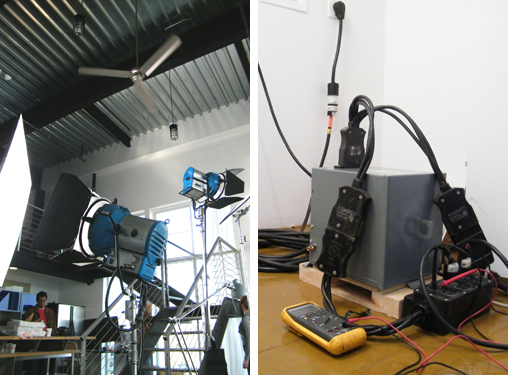
The only safe way to pull power from 240V circuits is to run your lighting load through a 240v-to-120v step down transformer. A transformer converts the 240 volts supplied by these industrial and household 240V receptacles back to 120 volts in a single circuit that is the sum of the two legs of the circuit. For instance, a transformer can make a 60A/120v circuit out of a 30A/240v dryer circuit that is capable of powering bigger lights, like a 5k. What makes it safe to use a step town transformer is that the transformer automatically splits the load of whatever you plug into it evenly over the two legs of the 240V circuit. Where there is no high leg, the loads on each leg of the 240V circuit cancel out and there is no return that would require a separate neutral.

Transformer-Distro_Sam2.jpg

4k & 1.2ks HMI Pars powered from 30A/240V dryer outlet through step-down transformer/distro for Bose still shoot.​

Some Gaffers will advocate the use of a "Splitter Box." You have to be really careful when splitting 240 volt circuits. If the 240 volt circuit is a four wire system (the receptacle has four slots: one for ground, one for neutral, and two for hot), one can use a distro box that splits the two hot circuits as long as it is wired so that each circuit has a ground and neutral.

Where you run into trouble is when the 240V circuit uses a three wire system (the receptacle has three slots: one for ground, and two for hot, and no neutral.) Many older household and industrial 240V receptacles use a three wire system (no neutral) because they were wired for the sole purpose of powering single phase motors or heating elements that draw a perfectly balanced load and return no current. A perfectly balanced load doesn’t require a neutral because the single phase service legs are 180 degrees out of phase and cancel each other out – hence there is no return that would require a separate neutral (a later revision to the NEC required all 240V circuits to include a neutral.)

You run into trouble with this kind of circuit when you start to pull an unbalanced load on your distro. And, where under most production situations you can never perfectly balance your lighting load, the two 120V circuits that make up this 240V circuit will not have 100% phase cancellation and the extra current of the high leg will not have a safe return path because by necessity with a three wire system you have had to bond the ground and the neutral in the splitter box (after all what else can you do with the ground and neutral of your splitter box but to bond them when plugging into a three wire 240V circuit.) Not only is it unsafe, but bonding ground and neutral after the service side of a main service head is a violation of the National Electrical Code (NEC.) To quote Mike Holt, of Mike Holt Enterprises, Inc. (A Leading Electrician Training Program in FL): “The National Electrical Code requires a neutral-to-ground connection to be made at service equipment only and there shall not be any neutral-to-ground connection on the load side of service equipment [250-23(a), 250-24(a)(5)]” (full excerpt is available online at his website)

HD_PP_Demo_Transformer-Distro.jpg


A PFC 2.5 & 1.2 HMI Pars, PFC 800w Joker HMI, Kino Flo Flat Head 80, 2 ParaBeam 400s, and a ParaBeam 200 powered by a modified Honda EU6500is through a 60A Full Power Transformer/Distro
​

Unlike a 240V "Splitter Box," where you have to meticulously balance your load, a transformer greatly simplifies your set electrics by automatically splitting the load. As long as you plug lights in through the transformer, you no longer have to carefully balance the load over the two 120V circuit/legs because the transformer does it for you automatically. If you outfit the transformer with a 60 Bates receptacle, you can use 60A GPC extension cables, 60-to-60 Splitters, and fused 60A GPC-to-Edison Breakouts (snack boxes) to run power around set - breaking out to 20A Edison outlets at convenient points (rather than one central point.) The best part about using a transformer with a 240V receptacle in this fashion is that no matter where in the distribution system you plug in, the transformer automatically balances the additional load, so that you don't have to.

HD_PP_Demo_SetUp_Night.jpg

The PFC 2.5 & 1.2 HMI Pars, PFC 800w Joker HMI, Kino Flo Flat Head 80, 2 ParaBeam 400s, and a ParaBeam 200 of our HD P&P Pkg. powered by our modified Honda EU6500is through our 60A Full Power Transformer/Distro​

I use transformers to power bigger HMIs (2.5-4Kw) in situations where a tie-in is not an option and the budget doesn’t permit for a tow generator. Where the production budget is particularly tight, I use a package consisting of two transformers and a portable generator. I use one transformer to access more power through a 240V circuit on location to run lights inside; while the other I use to bring larger HMIs in the windows from outside. This approach eliminates the need for a dangerous tie-in or expensive tow generators, it also greatly reduces the amount of cable that has to be run.

HD_PP_DemoWS.jpg

Wide Shot of Night exterior scene lit with our HD P&P Pkg.​

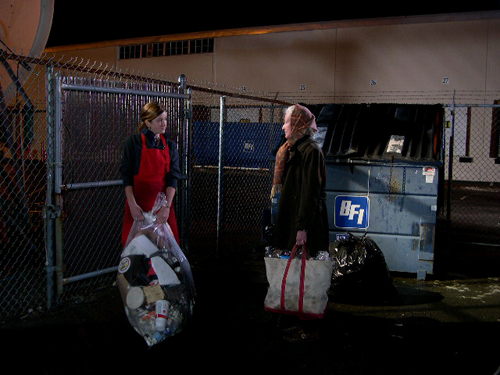
For those who would like to see samples of what can be accomplished with this basic package, I have attached these links to production stills of the PBS and History Channel historical documentaries shot entirely, or in part, with just a couple of transformers and a Honda generator.

The History Channel’s “Unsolved History” episode “Presidential Assassins”

American Experienes Typhoid Mary Biography "The Most Dangerous Women in America"

WGBH’s Ben Franklin Biography “Franklin”

Or, use this link for more details about using step-down transformers on set: . By giving you access to more house power through common 240V house outlets, a transformer can quite often eliminate the need for tie-ins or generators.

- Guy Holt, Gaffer, ScreenLight & Grip, www.screenlightandgrip.com
 
Last edited:
Guy,

That was some response. I have a couple of questions-comments regarding the whole balanced load issue. My background mostly includes marine electrical which includes shore power and generator systems and I have worked on powerhouses up to 7Mw which power small towns.

Let's start with a basic 240vac sub-panel which is nothing more than a leg-leg-neutral-grounded extension cord with some breakers wired to a main panel. Yes it is best to balance the 120vac loads on the sub-panel, but it usually doesn't create any huge problems either (within reason).

I can think up a hundred other examples where (small) unbalanced loads makes no difference. The point is, the larger the power draw, the more this matters. Pulling a extra Kw from one leg of a 50a/ 240 circuit doesn't. There is a perspective to consider for someone wanting to run a 2500 watt light kit.

Best Regards,
Grant
 
Guerrila lighting electrical power questions

Guerrila lighting electrical power questions

I have a couple of questions-comments regarding the whole balanced load issue. ... Let's start with a basic 240vac sub-panel which is nothing more than a leg-leg-neutral-grounded extension cord with some breakers wired to a main panel. Yes it is best to balance the 120vac loads on the sub-panel, but it usually doesn't create any huge problems either (within reason)... Pulling a extra Kw from one leg of a 50a/ 240 circuit doesn't (make a huge difference.)

I agree with Grant that pulling an extra 1000W on one leg of a 4 wire 240V circuit (leg-leg-neutral-ground) doesn't make a huge difference. I said as much in my original post:

If the 240 volt circuit is a four wire system (the receptacle has four slots: one for ground, one for neutral, and two for hot), one can use a distro box that splits the two hot circuits as long as it is wired so that each circuit has a ground and neutral.

To be clear, what I said was that you run into trouble when the 240V circuit uses a three wire system (the receptacle has three slots: one for ground, and two for hot, and no neutral.) You will run into trouble with these more common 240V circuits when you start to pull even a small unbalanced load on your distro because there is no return for current other than the ground because by necessity you have bonded the ground and neutral together (after all what else can you do with the ground and neutral of your splitter box but to bond them when plugging into a three wire 240V circuit.) Under these circumstances you will definitely have current on your ground wire because under most production situations you can never perfectly balance your lighting load over the two 120V circuits that make up this 240V circuit. Where your load is unbalanced, you will not have 100% phase cancellation and the extra current of the high leg will have to return via the ground wire.

I don't believe Grant was suggesting that 1kw on the ground wire is acceptable. Though, there are some gaffers that would argue that it is not such a big deal to carry current on the ground wire. I would argue that it is both unsafe and unwise to carry current on the ground wire. It is unsafe because the ground wire is intended only as a default conduit in the event of equipment failure (which is why it is permissible according to the National Electrical Code (NEC) to use a smaller conductor for the ground wire.) It is unwise because bonding ground and neutral after the service side of a main service head (which is what you have to do with the ground and neutral of a splitter box when plugging into a three wire 240V circuit.) is a violation of the NEC. To quote Mike Holt, of Mike Holt Enterprises, Inc. again: “The National Electrical Code (NEC) requires a neutral-to-ground connection to be made at service equipment only and there shall not be any neutral-to-ground connection on the load side of service equipment [250-23(a), 250-24(a)(5)]” (full excerpt is available online at his website)[/QUOTE] If some one were to fall off a ladder because they took a non-lethal shock because the cable they were handling was carrying current on the ground wire, your liability insurance would be null and void because you were using equipment that need not meet code.

It is also unwise to carry current on the ground wire because it can induce ground loops. It is a given that whenever you carry current on the ground wire there will be a slight difference in the voltage between receptacles in the power distribution system. A ground loop occurs when there is more than one ground connection path between two pieces of equipment and there exists a voltage differential. Under these circumstances, the duplicate ground paths form the equivalent of a loop antenna that very efficiently picks up interference currents. Lead resistance transforms these currents into voltage fluctuations. As a consequence of ground loop induced voltages, the ground reference in the system is no longer a stable potential (a floating ground), so signals ride on the noise. The noise becomes part of the program signal. The result is that the unwanted signal will be amplified until it is audible and clearly undesirable. Whenever you have current on the grounding system as well as the multiple connections between electronic components that is typical of HD production packages, there is the potential for a "ground loop."

Gound_Loop_Interferenc_Video.jpeg

Interference bars caused by current induced on a ground loop by high THD. ​

Small voltage differences just cause noise to be added to the signals. This can cause an audio hum, interference bars to video signals (above), and transmission errors in computer networks. Higher currents can cause more serious problems that can damage equipment like sparking in connections and burned wiring. As more and more electronic components, like lap top computers, hard drives, and HD monitors, are integrated into the typical location HD production package, ground loops become more of a hazard.

wwaveform_pkg_comp_AVR_In.jpg

Left: Conventional generator power w/ THD over 100 percent caused by pkg. of non-PFC Elec. HMI & Kino Ballasts. Right: Same lighting Pkg. but with PFC HMI & Kino Ballasts powered by our modified Honda EU6500is inverter generator. Note the THD is now under 7 percent.​

It is also worth noting that “ground loops” can result from the harmonic currents that non-pfc electronic ballasts (HMI & Kino) throw back into the distribution system. Current on neutral conductors with a high THD value will induce voltage in ground wires greater than the 2 volt maximum stipulated by IEEE Standard 1100-1992 "Recommended Practice for Powering and Grounding Sensitive Electronic Equipment." For instance, there was an episode, recently reported on CML, of a pilot shooting in HD that found they had 50 volts between the shield of the SDI line and ground. In that case the problem was fixed by running a "Drain" wire from the SDI Shield back to the Genny via the electrical lunchbox at the DIT station. For more details on why this is I suggest you read my newsletter article on the use of portable generators in motion picture production. The article is available on our website.

The only safe way to pull power from 240V circuits that meets the requirements of the National Electrical Code, and won't create ground loops, is to run your lighting load through a 240v-to-120v step down transformer. A transformer converts the 240 volts supplied by these industrial and household 240V receptacles back to 120 volts in a single circuit that is the sum of the two legs of the circuit. For instance, a transformer can make a 60A/120v circuit out of a 30A/240v dryer circuit that is capable of powering bigger lights, like a 5k. What makes it safe to use a step town transformer is that the transformer automatically splits the load of whatever you plug into it evenly over the two legs of the 240V circuit so that you have 100 percent phase cancellation. In other words, where there is no high leg, the loads on each leg of the 240V circuit cancel out and there is no return that would require a separate neutral and there is no return current on the ground wire to create ground loops.

In my 20 plus years as a Gaffer I have found the three wire 240V circuits (hot, hot, ground, no neutral) to be much more prevalent and accessible than the four wire systems Grant refers to (usually range plugs with a hot, hot, ground, neutral.) Over the years, I have used a combination of 3 wire/240V wall outlets, step-down transformer/distros, and Honda EU6500is generators without problem on many historical documentaries I have gaffed. For example, I have used this approach repeatedly at a historical mansion in Easton MA called the Ames Estate.

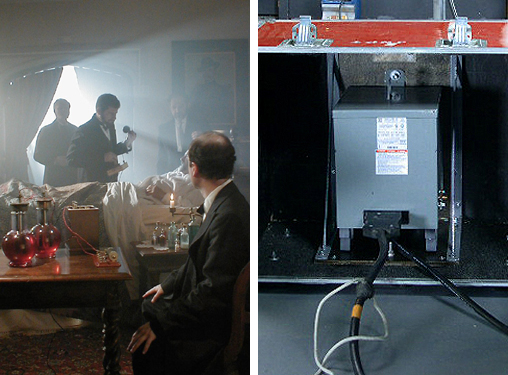
Transformer-Distro_Sam1.jpg

Scene from "Unsolved History" powered from 50A/240V range outlet through step-down transformer/distro at the Ames Estate.​

A popular state fee free location, the Ames Estate, like many historical house/museums, does not permit tie-ins and the electrical wiring in the house is so antiquated that it is unusable. Fortunately, they have a 50A/240 volt circuit in the carriage house for a welder they use to repair the mowers they use at the park. Our standard mode of operation when shooting there is to run 250V extension cable from the welding receptacle to a 60A Full Power Transformer/Distro placed in the entry hall of the house. Using a 60A Siamese at the Transformer/Distro, we then run 60A 6/3 Bates extensions, down to the library, to the second floor, and back to the maid’s pantry. At the end of each run we put another 60A Siamese. A 60A snackbox on one side of the Siamese gives us 20A branch circuits. The other side we leave open for a large HMI or Tungsten Light. Now we can safely plug 1200 & 2500W HMIs, or even a 5k Quartz, into our own distribution anywhere in the house.

tmfilmstrip1lg.jpeg

Typhoid Mary in quarantine on an island in New York's East River. Note the view out the window of the East River shoreline at the turn of the century.​

To maintain continuity between shots on these dramatic historical recreations, we usually bring a 4kw HMI Par in a window on one side of the room as a sun source and a 1200 par through a window on the other side as a northern light source. We usually power both heads off of a Honda EU6500is through a second 60A Full Power Transformer/Distro. Since the Honda EU6500is can be placed right on the lawn, we are saved from running hundreds of feet of feeder back to a tow generator in the drive.

tmfilmstrip2lg.jpeg

(The exterior of the actual location used for the quarantine island. A 30' blowup of a picture of the East River at the turn of the century was rigged outside the windows of a house in Arlington MA.)
​

We have been able to use this same basic distribution package at numerous museums and historical houses throughout New England including Sturbridge Village. Fortunately for us, to make ends meet, many historical houses rent themselves out for events and weddings. For that reason, they usually have at least one updated service with 30 or 50 Amp 240 volt circuit for the warming ovens of caterers. I have included several production stills from these shows. Use this link - http://www.screenlightandgrip.com/html/HDPP_Transformer.html - for more production stills of PBS and History Channel historical documentaries shot entirely, or in part, with our 60A Full Power Transformer/Distro at the Ames Estate.

- Guy Holt, Gaffer, ScreenLight & Grip, Boston
 
Last edited:
Guy,

You are correct. A "hot ground" is not a good thing. I try to keep my socks dry.

Was that an 87a I spied in one of the above photos....great meter.

Best Regards,
Grant
 
nejuicer, Wow, thanks again for the great posts. I have been looking around and there doesn't seem to be a lot of grip/lighting outfits offering the 240 v to 120 volt step down transformer as a power option. Mostly what are offered are tie-in kits and towed generators? Is the set up you have proprietary?

What would the rental rate be for a power distribution set up you described using the step down transformer: "If you outfit the transformer with a 60 Bates receptacle, you can use 60A GPC extension cables, 60-to-60 Splitters, and fused 60A GPC-to-Edison Breakouts (snack boxes) to run power around set - breaking out to 20A Edison outlets at convenient points (rather than one central point.)". I started this thread just looking to upgrade my personal lighting kit, but have just been asked to come up with some numbers for a low budget gig that would probably take a one ton package to light and your set up sounds like a much better way to power it than tie-ins or generators.

Like tomthemacman suggests, I have worked with some very good gaffers, but the problem was, that when I was working with these guys I was also working with some very inexperienced directors and ended up being too busy teaching filmmaking 101 to the directors to work closely with the gaffers to learn power distribution. Of the directors, one guy couldn't understand why we shouldn't move the camera to cover the reverse angle, and then come back to out current set-up to finish the scene, because that is the way he story boarded his script. Anyway, thank you for your posts. I have learned a lot here.
 
Remember MOST household 220 V electric power just consists of two legs of 110V and a ground. You can easily break each leg out. This is not recommended for those who have no understanding of the process. An absolute must have tool is a GOOD muti tester. ALWAYS use your tester to check the actual voltage of any line before making a decision. In commercial buildings it is not uncommon to have 440V three phase. You will have to transform this or you will have major problems.
 
Guerilla lighting electrical power questions

Guerilla lighting electrical power questions

Remember MOST household 220 V electric power just consists of two legs of 110V and a ground. You can easily break each leg out. This is not recommended for those who have no understanding of the process. An absolute must have tool is a GOOD muti tester. ALWAYS use your tester to check the actual voltage of any line before making a decision. In commercial buildings it is not uncommon to have 440V three phase. You will have to transform this or you will have major problems.

Since electricity can be dangerous if mishandled, I think it is important to make absolutely clear why dividing a three wire 220/240 circuit (two 110V legs & a ground) can not be easily done with a "Splitter Box" - even with a multi-meter. For those of you not familiar with "Splitter Boxes" they are a special distro panel that a rental house will make up that is wired to split out the two 120V circuits that make up the 240V outlet. But, you have to be really careful when splitting 240 volt circuits. If the 240V outlet is a 4-wire 50A/240V Range plug (the receptacle has four slots: one for ground, one for neutral, and two for hot), one could use a splitter box to power a 5k as long as it is wired so that each circuit has a ground and neutral. Where you run into trouble is when the 240V circuit uses a three wire system (the receptacle has three slots: one for ground, and two for hot, and no neutral.) Many household and industrial 240V receptacles use a three wire system (no neutral) because they were wired for the sole purpose of powering single phase motors or heating elements that draw a perfectly balanced load and return no current. A perfectly balanced load doesn’t require a neutral because the single phase service legs are 180 degrees out of phase and cancel each other out – hence there is no return that would require a separate neutral.

You run into trouble with this kind of circuit when you start to pull an unbalanced load on your "Splitter Box." And, where under most production situations you can never perfectly balance your lighting load, the two 120V circuits that make up this 240V circuit will not have 100% phase cancellation and the extra current of the high leg will not have a safe return path because by necessity with a three wire system you have had to bond the ground and the neutral in the splitter box (after all what else can you do with the ground and neutral of your splitter box but to bond them when plugging into a three wire 240V circuit.) There are some people that will argue that it is not such a big deal to carry current on the ground wire. I would argue that it is both unsafe and unwise to carry current on the ground wire. It is unsafe because the ground wire is intended only as a default conduit in the event of equipment failure (which is why it is permissible according to the National Electrical Code (NEC) to use a smaller conductor for the ground wire.) It is unwise because bonding ground and neutral after the service side of a main service head (which is what you have to do with the ground and neutral of a splitter box when plugging into a three wire 240V circuit.) is a violation of the NEC. To quote Mike Holt, of Mike Holt Enterprises, Inc. again: “The National Electrical Code (NEC) requires a neutral-to-ground connection to be made at service equipment only and there shall not be any neutral-to-ground connection on the load side of service equipment [250-23(a), 250-24(a)(5)]” (full excerpt is available online at his website) If some one were to fall off a ladder because they took a non-lethal shock because the cable they were handling was carrying current on the ground wire your liability insurance would be null and void because you were using equipment that need not meet code.

The only safe way to pull power from a three wire 240V wall outlet that meets the requirements of the National Electrical Code is to run your lighting load through a 240v-to-120v step down transformer. A transformer converts the 240 volts supplied by these industrial and household 240V receptacles back to 120 volts in a single circuit that is the sum of the two legs of the circuit. For instance, a transformer can make a 60A/120v circuit out of a 30A/240v dryer circuit that is capable of powering bigger lights, like a 5k or 4k HMI. What makes it safe to plug a step town transformer into three wire 240V outlets is that the transformer automatically splits the load of whatever you plug into it evenly over the two legs of the 240V circuit so that you have 100 percent phase cancellation. In other words, where there is no high leg, the loads on each leg of the 240V circuit completely cancel out and there is no return that would require a separate neutral.

It is also worth noting that a 4-wire 240V range plug is about the only common household 240V outlet that you can use to power a 5k with a "Splitter Box." Most other common household 240V outlets, whether they are 3-wire or 4-wire circuits, are rated for only 3OAmps. If you split these circuits you are left with two 30A/120V circuits, neither of which is large enough to power a 5K since it draws 42 Amps. The advantage to using a step-down transformer, like the one we manufacture for our modified Honda EU6500is, is that it converts the 240 volts supplied by the receptacle back to 120 volts in a single circuit that is the sum of the two legs of the 240V circuit (60 Amps) and more than enough to power a 5k or even a 4k HMI. Our 60A Full Power Transformer/Distro can be used on 4-wire 240V circuits as well as 3-wire circuits. And, since it has over current protection built into it, it can be used on both 50A as well as 30A circuits. You can use this link for more details about using step-down transformers on set: . By giving you access to more house power through common 240V house outlets, a transformer can quite often eliminate the need for tie-ins or generators.

- Guy Holt, Gaffer, ScreenLight & Grip, www.screenlightandgrip.com
 
Guerilla lighting electrical power questions

Guerilla lighting electrical power questions

nejuicer, Wow, thanks again for the great posts.... I started this thread just looking to upgrade my personal lighting kit, but have just been asked to come up with some numbers for a low budget gig that would probably take a one ton package to light and your set up sounds like a much better way to power it than tie-ins or generators.

Plugging our 60A Full Power Transformer into an existing 240V outlet is definitely a safer alternative to tieing-in. And, since we in fact developed it to access the enhanced 7500W output of our modified Honda EU6500is generator it offers an alternative to renting a tow generator. Even if we had to ship it to you as a rental, the additional expense would be more than offset by the savings of not having to rent a tow generator with all of its’ hidden costs.

Until we introduced our generator/transformer pkg., to power HMI lights over 1.2kw or Quartz lights over 2kw required a large diesel movie generator. Movie generators are not only expensive to rent, but they come with hidden costs that usually break the budget of independently funded HD projects. Movie generators require special tow equipment not found on Ryder or Penske rental trucks. For that reason, movie generators require that you rent a more expensive grip truck from a lighting and grip rental company in order to tow them. Lighting rental companies will not send out a grip truck without a company driver - further adding to the expense of renting a movie generator (driver rates run about $400/10hrs with overtime after 10hr).

60A_Transformer-Distro_Honda_WebPS.jpg


Our 60A Full Power Transformer/Distro provides 7500 Watts of power in a single 120v circuit from the new Honda EU6500i Generator
​

Even though crystal synced 6500W generators have been an alternative to tow plants for years, they had limited capacity when used with HMIs. The primary factors limiting the use of HMIs on portable crystal synced gas generators has been their inefficient use of power and the harmonic noise they throw back into the power stream. The power waveform below left is typical of what results from the operation of a couple of 1200W HMIs with non power factor corrected ballasts on a conventional crystal synced portable generator. The adverse effects of the harmonic noise exhibited here, can take the form of overheating and failing equipment, efficiency losses, circuit breaker trips, excessive current on the neutral wire, and instability of the generator’s voltage and frequency. For these reasons it has never been possible to operate more than a couple of 1200W HMIs on a conventional 6500W portable gas generator. Harmonic noise of this magnitude can also damage HD digital cinema production equipment, create ground loops, and possibly create radio frequency (RF) interference. The increasing use of personal computers, hard drives, and microprocessor-controlled recording equipment in production has created an unprecedented demand for clean, reliable power on set.

wwaveform_pkg_comp_AVR_In.jpg


Left: Conventional generator power w/ THD over 100 percent caused by pkg. of non-PFC Elec. HMI & Kino Ballasts. Right: Same lighting Pkg. but with PFC HMI & Kino Ballasts powered by our modified Honda EU6500is inverter generator. Note the THD is now under 7 percent.​

Taking advantage of recent technological advances in HMI & Kino ballast design and power generation, we have developed a production package (our HD P&P Pkg.) that creates clean stable set power that is capable of operating larger lights (HMIs up to 6kw or Quartz lights up to 5kw), or more smaller lights, off of portable gas generators than has ever been possible before. For example, the power waveform above on the right, is the same package of HMI lights but with power factor corrected electronic HMI ballasts operating on our modified Honda EU6500is Inverter Generator. As you can see, the difference between the resulting waveforms is startling. Even though we are running the same overall load, the fact that the HMI ballasts in our HD Plug and Play Pkg. are power factor corrected and the power is being generated by our modified Honda EU6500is Inverter Generator, results in virtually no power waveform distortion. For this reason, sensitive electronic production equipment will operate reliably and without damage. And, the generator is capable of operating larger, or more smaller, lights than has ever been possible before on a portable gas generator.

HD_PP_System_Complete_Sm.jpg


The PFC 2.5 & 1.2 HMI Pars, PFC 800w Joker HMI, Kino Flo Flat Head 80, 2 ParaBeam 400s, and a ParaBeam 200 of our HD P&P Pkg. powered by our modified Honda EU6500is through our 60A Full Power Transformer/Distro​

For example, our modified Honda EU6500i Inverter Generator with our 60A Full Power Transformer/Distro is capable of powering the 2.5kw, 1200, & 800 HMI Pars, of our HD Plug and Play Pkg., plus a couple of Kino Flo Parabeam 400s, Parabeam 200s, and a FlatHead 80. Given the light sensitivity of HD Camcorders, this constitutes a complete location lighting package for HD Digital Cinema productions.

By eliminating the need for a tow generator in order to have feature style production capability, our HD P&P Pkg. saves you the expense of not only the generator, but also the added expense of a rental house grip truck and truck driver. So that you can record sound without picking up the noise of a portable generator, we can outfit your production with a custom distribution package that will enable you to run the generator from inside your rental truck while keeping your power plug in points conveniently on set.

Ext_Fuel_Tank_Product_Shot_Sm.jpg


Our 18 gallon Extended Run Fuel Tank​

So that you never have to interrupt shooting to refuel, we have also developed an accessory 18 Gallon Extended Run Fuel Tank. You simply set it and forget it. Our accessory 18 Gallon Extended Run Fuel Tank also eliminates the potential fire hazard in refueling a hot generator. Use this link for details on the safety benefits and operation of our Extended Run Fuel Tank. Use this link - http://www.screenlightandgrip.com/html/HDPP_Transformer.html - for more detailed information on the use of transformers in motion picture production.


- Guy Holt, Gaffer, ScreenLight & Grip, Boston
 
Guerilla lighting electrical questions

Guerilla lighting electrical questions

I have been looking around and there doesn't seem to be a lot of grip/lighting outfits offering the 240 v to 120 volt step down transformer as a power option. Mostly what are offered are tie-in kits and towed generators? Is the set up you have proprietary?

What would the rental rate be for a power distribution set up you described using the step down transformer: "If you outfit the transformer with a 60 Bates receptacle, you can use 60A GPC extension cables, 60-to-60 Splitters, and fused 60A GPC-to-Edison Breakouts (snack boxes) to run power around set - breaking out to 20A Edison outlets at convenient points (rather than one central point.)"

We developed our 60A Full Power Transformer/Distro to access the enhanced 7500W output of our modified Honda EU6500is genertor (introduced Jan 09), so it is relatively new. Since January of this year we have sold a number of these generators with transformer/distros to a number of rental houses and small production companies, but unfortunately none in your area. You should bring it to the attention of your local rental house. I am sure that if they had a customer interested in renting it, they would buy one because the set power issues it addresses have been vexing electricians for years. As I mentioned previously, I wrote an article for our company newsletter that explains the electrical engineering principles behind these issues, and how our new gen-set package resolves them. The article is posted on our website at: http://www.screenlightandgrip.com/html/emailnewsletter_generators.html.

If your local rental house is not interested in purchasing one, we do rent them nationwide. It would probably be inappropriate for me to quote you in the forum. Contact me off list at rentals@screenlightandgrip.com with exactly what you need and for how long. It is expensive to ship both the generator and transformer. To save money you might look into renting a Honda EU6500is locally. Our 60A Transformer/Distro will be compatible with a Honda EU6500is Generator that you pick up locally, but you will not receive the same benefit from that machine as you would with one of the Honda EU6500is Generators that we modify. Our modified Honda EU6500is Generator and Transformer/Distro are designed to provide 7500W in a single circuit.

You can use our 60A Full Power Transformer/Distro with a Honda EU6500is Generator that you pick up locally, but you will only be able to access the power for which the North American model of this generator is configured. Still, there is considerable benefit to having that power available in a single circuit. You will still be able to run bigger lights like a 5k, or more smaller lights, than you could without it. Besides providing more power in a single 120V circuit capable of powering larger lights, our 60A Full Power Transformer/Distro will enable your generator to run more lights than it could without it by splitting the load of whatever you plug into it evenly over the two legs of the generator in a perfectly balanced fashion. Part of the reason, that our modified Honda EU6500is is capable of handling an additional load is because it is a perfectly balanced load. Your own Honda EU6500is, will likewise be capable of handling a greater load when it is perfectly balanced.

Our 60A Full Power Transformer/Distro will also enable you to more fully utilize the continuous rated power capacity of your generator by enabling you to load it more fully. Without our 60A Transformer/Distro you can never fully utilize the available power of a portable generator because the load of a light has to go on one circuit/leg of the generator or the other. For example, when plugging lights into the power outlet panel of a Honda EU6500is Generator, you reach a point where you can't power an additional 1kw light because there is not 8.4 amps available on either one of the factory installed 20A outlets/leg of the generator. With our 60A Full Power Transformer/Distro you can still add that 1kw light because our 60A Full Power Transformer/Distro splits the load evenly over the two legs (4.2A/leg) of the generator. Finally, our 60A Full Power Transformer/Distro greatly simplifies your set electrics regardless what generator it is used with. As long as you plug in through our 60A Full Power Transformer/Distro you no longer have to carefully balance the load over the generator's two 120V circuit/legs. Now that you are able to fully load the generator in a perfectly balanced fashion with the help of our 60A Full Power Transformer/Distro, you are able to power larger lights, or more smaller lights, than you could without it.

Again, the same 60A Full Power Transformer/Distro we manufacture for our modified Honda EU6500is can also be use to access more power on location from common 240v household outlets as well. Our Full Power Transformer/Distro will step down the 240V power of range or dryer outlets to a single 120V circuit capable of powering bigger lights, or more smaller lights, than is possible on the house 120V circuits alone. By giving you access to more house power through common 240V household outlets, our 60A Full Power Transformer/Distro can eliminate the need for dangerous tie-ins or expensive tow generators. Use this link - www.screenlightandgrip.com/html/HDPP_Transformer.html - for more details on using our 60A Full Power Transformer/Distro to access more location power.


- Guy Holt, Gaffer, ScreenLight & Grip, Boston
 
nejuicer, thanks a bunch for your really great info. Your detailed, well-written expertise made it clear that the old 3 wire stove outlet I have access to simply won't work for my needs. Saved me time, agravation, danger, etc. I'll work something else out for my overload needs (probably a cord through my neighbor's window). My needs are minimal, but your posts helped a lot.

This is the most useful board out there. About the fourth time it's been proven so. Thanks again.
 
nejuicer, thanks a bunch for your really great info. Your detailed, well-written expertise made it clear that the old 3 wire stove outlet I have access to simply won't work for my needs. Saved me time, agravation, danger, etc.

Thank you for your kind words. I am glad that my posts about the dangers of using 3-Wire 240V circuits with anything but a step down transformer was of help. One issue I feel has still not been adequately addressed in this thread is the use of Splitter Boxes with 4-Wire 240V Circuits. HeavyG is correct when he stated above:

"Is it possible to step down power from a 220 volt line to use with 110 volt lights?" Yes. We used to rent a set-up that allowed us to tie into a stove or dryer plug and have a distro point with several 110 circuits. It was … very helpful when we were still using Redheads and Blondes…..

But, that was only true when he was “still using Redheads and Blondes.” The custom distribution panels, called “Splitter Boxes,” that rental houses wired to access more 120V power from 240V circuits and the 240V twist-lock receptacle on generators, worked well enough when the lighting load placed on these circuits consisted predominantly of incandescent lights (a linear load.) However, Splitter Boxes are inherently unsuitable to carry a non-linear loads consisting predominantly of non-Power Factor Corrected HMI, Fluorescent, & LED Lights. To understand why this is the case, I would suggest you read the article I wrote on the use of Portable Gas Generators in Motion Picture Production. The article is posted on our website at: http://www.screenlightandgrip.com/html/emailnewsletter_generators.html.

To quickly summarize the article: a "Splitter Box" works around the limitations of a 240V wall receptacle or generator power output panel, and provides additional 120V circuits, by splitting out the two 120V circuits that make up the 240V outlet (see generator wiring schematic below.) For the purpose of this discussion, it is important to understand that Splitter Boxes are wired so that their 120V circuits share in the single ground and neutral of the 240V circuit. Splitter boxes worked well enough back when the load on the 240V circuit consisted of only incandescent lights. As long as you roughly balanced your load between the two legs of the generator, phase cancellation between the legs resulted in the neutral return being the difference between the legs. The problem is that things get a bit more complicated with inductive (magnetic HMI ballasts) and capacitive (electronic HMI, Kino, & CFL ballasts) non-linear lighting loads.

gen_wiring_sch.jpg

Generator Wiring Schematic​

Since non-linear loads cause current and voltage to be out of sync, the phase currents no longer entirely cancel when they return on the neutral. In addition to pulling the voltage and current out of phase, the Switch Mode Power Supplies (SMPSs) of electronic lighting ballasts create harmonic currents that stack on top of one another, creating very high currents returning to the power source on the neutral wire. If the lighting package consists entirely of non-linear light sources without power factor correction, as much as 80 percent of the current will not cancel out between legs, resulting in very high current on the neutral return even when the legs are evenly loaded. For this reason, on their website Kino Flo cautions users that some of their lights “will draw double the current on the neutral from what is being drawn on the two hot legs... it may be necessary to double your neutral run so as not to exceed your cable capacity.” ( FAQ “Why is the neutral drawing more than the hot leg”.)

It is important to appreciate the potential hazard that the harmonic currents generated by SMPS stacking on the neutral can pose. The results of a recent study (illustrated below), showed that the combined effect of the phase shift and harmonics generated by substituting incandescent lamps with an equivalent wattage of CFLs in a house resulted in more than a doubling of the current on the system neutral.

High_Nuetral_Return_CFL.jpg

Substituting a linear load with a equivalent non-linear load in a small single phase distribution system substantially increases the current on the system neutral.​

Since there is no over-current protection on the neutral of a 240V circuit, these currents can lead to overloading of the neutral and potentially a fire like the one that occurred in Vice President Dick Cheney's suite of offices in the historic Eisenhower Executive Office Building next to the White House on December 19, 2007. The cause of the fire that started in an electrical closet on the building's second floor, was found to be caused by an over-loaded neutral wire that resulted from uninformed staff replacing all the incandescent bulbs in the complex with CFLs.

There is no question that we find ourselves in an analogous situation, since light sources that use Switch Mode Power (HMI, Fluorescent, & LED) have almost entirely replaced incandescent lights as the prevalent lighting source in HD Digital Cinema production packages. To make matters worse, the video cameras, field monitors, hard-drives, lap-tops, and battery chargers that make up the typical location production package also use Switch Mode Power Supplies and hence generator their own harmonics. Where just about every piece of production equipment used on set today generates harmonics, the current returned on the neutral system can be quite high. For example, if say a 6500W generator is loaded to its’ continuous load rating of 5500 Watts with a typical digital cinema production package (consisting predominantly of non-linear loads like video cameras, field monitors, battery chargers, lap tops, hard drives, non-PFC HMI, LED, and Fluorescent lighting fixtures), as much as 37 Amps can be returned on the neutral wire even when the legs are perfectly balanced (Apparent Power Load of 5500W/120V= 46A x.8 = 37A.) Since it is nearly impossible to perfectly balance a load on a splitter box (it requires meticulous attention to loads as you plug in) the return of the neutral is likely to be even higher because of an unbalanced load. Since there is no over-current protection on the neutral of a 240V single phase circuit of a generator (see schematic above) or a house, and the nuetral wire used in a 240V receptacle is only rated for 30A, these currents can likewise lead to overloading of the neutral.

In this new world of Switch Mode Power, older power generation and distribution systems, like AVR generators and Splitter Boxes, are simply no longer capable of managing the adverse effects of the harmonics that SMPS generate. The 240V circuits they use were designed, not for harmonic generating non-linear loads, but for single phase linear loads like dryers, ranges, heaters, large motors, and compressors, that draw a perfectly balanced load and return no current on the system neutral. For this reason, the neutral wires of 240V circuits on portable gas generators and in houses are simply not sized to handle the higher return current generated by loads that stack on the neutral rather than cancel out. Regardless, if it’s a 240V circuit in a generator or in a house, splitting a 240V circuit designed to power primarily heating elements and compressors, to instead power field production equipment and motion picture lights is an application for which these circuits were simply not designed.

As I explained in my posts above, the only safe way to pull power from 240V wall outlet (whether a three wire or four wire system) is to run your lighting load through a 240v-to-120v step-down transformer with a high K-rating. A transformer converts the 240 volts supplied by these industrial and household 240V receptacles back to 120 volts in a single circuit that is the sum of the two legs of the circuit. For instance, a transformer can make a 60A/120v circuit out of a 30A/240v dryer circuit that is capable of powering bigger lights, like a 5k or 4k HMI. What makes it safe to plug a step town transformer into 240V outlets is that the transformer automatically splits the load of whatever you plug into it evenly over the two legs of the 240V circuit so that you have 100 percent phase cancellation on the generator neutral (primary side); while the neutral wire on the load side of a K-rated transformer (the secondary side) is typically sized to handle higher than normal neutral returns.

Besides providing effective management of the higher neutral return currents generated by SMPS, a transformer/distro system offers a number of other benefits (covered above) that Splitter Boxes do not. Use this link for more details about using step-down transformers on set: . By giving you access to more house power through common 240V house outlets, a transformer can quite often eliminate the need for tie-ins or generators.


- Guy Holt, Gaffer, ScreenLight & Grip, Boston, MA
 
Back
Top