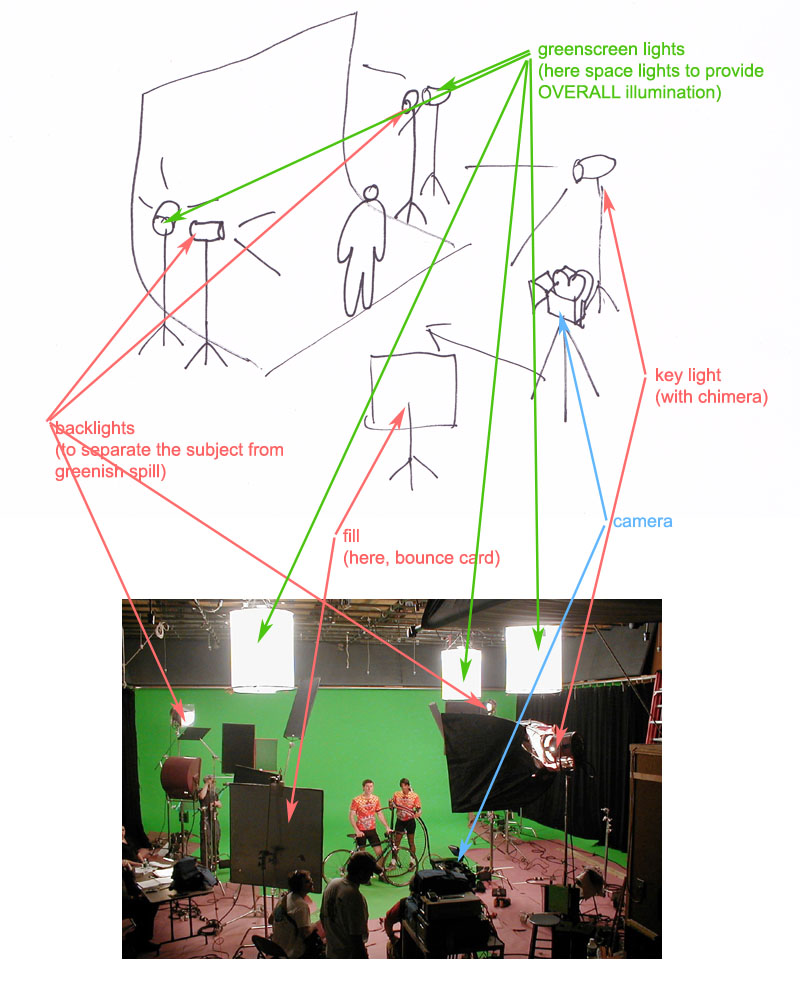
Green screen lighting suggestion

cheapass

Active member
I teach a few classes on film and video production at a local community college and have gotten them to swing the budget for a bit of lighting to improve on their green screen. Until now they had been using an unlit wall painted green and had a couple of totas for key and fill. Since they finally got around to buying a half decent prosumer camera in the Panny AG-HMC80 and I convinced them to throw a Blackmagic Intensity into an old Mac Pro, we're somewhat in business finally to do moderately nice 4:2:2 acquisition.

My only criteria from the higher ups for purchasing were that the equipment had to come from B&H and the total couldn't exceed $2k. Unfortunately, this means that I can't get a couple of kinos with all necessary bulbs and grip gear as I'd like. I need to get a gear list by tomorrow and am thinking of settling on a single 4bank kino with bulbs and ceiling mount for now, and using the totas to key then swinging for the second kino kit next round of purchasing to bump the totas down to back and fill. This is a class with very low experience students, but I want them to learn the right way instead of on garbage equipment.

My only personal criteria is that the equipment has to be of sufficient quality to actually make the purchase worthwhile, but I don't think B&H carries too too much junk these days.

Thanks for any suggestions. I need to put in the requests tomorrow.
 
You could go oldschool and get some Mole Zips or other tungsten soft lights. Not the greatest, but cheaper and of quality...

I would worry about not getting enough throw out of the single kino, but I don't know how large or small your screen is.
 
Until now they had been using an unlit wall painted green and had a couple of totas for key and fill.

What kind of clearance do you have in the studio. The way this is done professionally is to use a couple of space lights between your talent and the green screen wall. When positioned in the "sweet spot", the space lights will light the back wall and floor out to the talent evenly. They will also serve as soft back edge lights which will help you pull a clean key.

chromakey4lg.jpeg

6kw space lights lighting our 40x60 chroma key stage​

As you can see by the picture above, the nice thing about space lights is that a single fixture fills multiple functions and so reduces the number of kinos you need - in the end it is a lot cheaper approach to lighting for Chroma Key.

chromakey3lg.jpeg

6kw space lights lighting our 40x60 chroma key stage​

What size space light you use will be determined by the studio size and clearance. These are not something you are likely to find at B&H. I can help you out if you can get around that requirement.

- Guy Holt, Gaffer, ScreenLight & Grip, Lighting Rental & Sales in Boston.
 
Thanks for the input guys, particularly Guy for the pics and detail. I have to admit we're a far smaller operation since the room I have to work with doesn't have a seemless and is more suited to cowboy framing for webcast type stuff. The room we have to work with is about 14' x 14' and I have to share it with some other gear. I'll take a good hard look at the room tomorrow and take pics of the final product when it all goes in. Thanks again.
 
I have to admit we're a far smaller operation since the room I have to work with doesn't have a seemless and is more suited to cowboy framing for webcast type stuff.

You can take this same approach with anything from a 100W Chinese Lantern to a 12kw space light, it doesn't have to be the 6kw space lights in the pictures I posted. If you can tell me what clearance you have and the type of ceiling (plaster, drop, open framing) I can help you with the right size fixture.

- Guy Holt, Gaffer, ScreenLight & Grip, Lighting Rental & Sales in Boston
 
Since you mentioned you were wanting to move up from a DIY setup... but just for laughs, I decided to put my 'setup'...

attachment.php


Resulting key:
attachment.php


And processed and composited image.

attachment.php


All these were stills from the video... using a Sony Handy Cam, at 1080i...

Were I to setup a more permanent studio setup, I'd work in getting the background 'really even'... and of course, probably spend for the official Green paint, or back drop...

One thing that I think 'worked' was the fact that the Handy Cam had deep DoF, and so the woman was in pretty 'sharp' focus, and there was no real movement, so again 'blur' was
not an issue for the keying, and potential resulting fringing...
 
You guys all kick ass. This is the equipment list I came up with for the first round of purchasing. It comes to $1950 after the educational discount. I decided to build a kino into the budget because I really want them to start using better gear in general and these budgets are always like use it or lose it. Also those impact lights seem to be nicely reviewed for what they are. I'm going to temporarily c-stand the kino to blast out the shadows on the screen and use the impact lights as keys. I'll repurpose the Totas we have to fill once I get them fixed up. Once I can get a better idea of what's in the ceiling I can order a few more grip parts and permanently hang the kino and purchase a second one for key and interview. The school really liked the idea of cold lights for safety since a lot of people have access to the gear that probably shouldn't. The program coordinator even got burned on the Totas a couple of times. :/

http://www.bhphotovideo.com/wl/3EB96BB16A

Anyway, what do you guys think?
 
i really don't think spending $1k on one light out of $2k budget is a wise idea. Why don't you simply pre-rig the totas on the grid to light the greenscreen and be done with it?

Then all you need is 3 lights (2 for back light and 1 for key).
 
There's no grid or I'd definitely do it. The room wasn't really built as a studio, it's secondary usage. I'll have to look above the drop ceiling and see if I can rig something with the Totas and whether it violates any weird code.
 
Last edited:
Check out Richard's lights at coollights.biz before you jump in on a kino. I love Flous for GS work especially when there is no grid or low ceiling height.
 
Hi guys,

I am a beginning documentary maker with a very very tight budget. This is my first post but I've already spend hours on this forum reading all your wonderful advices. So thanks to all!

Now I have a question that is worthy to ask (I hope). I would like to setup my future interviews like in this example:

http://www.youtube.com/watch?v=OH9IhsXYraQ

I assume this is filmed with a chromakey (or is a black background?) in a dark room and my guess (/hope) is that you would only need three lights: two to light the background and one to light the interviewee. Is that correct?

If it is, would three of these (cheap) lights be sufficiënt to have that kind of effect (or maybe a slightly cheaper looking version)

Jinbei DG800 800W Halogen (http://www.fotokonijnenberg.nl/product/1326323/jinbei-continu-lamp-800watt-halogeen.html)

I only have a budget of approximatly $ 500, so if these can't do the job I guess I have to let this go for now.

I hope this question isn't too stupid. If it is, please be gentle on me. :)

Greetings,

Nils

PS: sorry for my poor English
 
I didn't see anyone mention this, so here is a tip. The HMC80 has a wave form monitor available on the flip out. When setting up your screen, adjust your lights with the WFM before you light your talent. As you move your lights around the hot spots will become immediately apparent and you can just nail the exposure. It make the whole screen lighting absolute cake.

Grant
 
I've lit plenty of 10x10 green screens with twin tube biax flos (a joy), open-faced lights with gels & diffusion (not bad) or a combo of both.

I've got a 20' screen job coming up at a location. I did some tests with what I have lying around, and in addition to pro lights, I found a line of 6 home depot clamp lights on the ceiling with 45 watt spiral flos (the kind they sell for photography, not something from the corner store - close to 200 watt equivalent each) and some white mesh really helped smooth things out. I also made some curved board reflectors for my china sockets and stuck those big 80-watt flo tubes in 'em.

I'm lucky enough to be able to throw some "junk" into my setups when needed and have clients just assume I know what I'm doing I suppose. (I'm not a cheap skate, I'm up to about 8 different kino-style fixtures and dozens of fresnels & mole open-faced stuff... but soft white light is soft white light. Sometimes the more sources you can get on a big green screen, the easier it is).
 
Back
Top