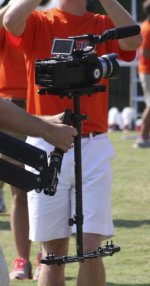
Glidecam HD4000

LFXdan

Member
So I bought a Glidecam in the hopes I could get some nice smooth shots. After 2 solid days trying to set the thing up all I get is a really slow pendelum effect as soon as I start walking. Anyone have any tips? I've watched all of the setup videos out there, it's balanced in the horizontal and it takes 2.5-3 seconds to drop in the vertical so it SHOULD be fine. Yet it's pretty much unusable as the camera just swings forward and aft when walking (don't even try running). I've got 3 weights each side, tried 4 and also 2 an 1 and they make it worse.

I am pretty sure this thing is withcraft and am contemplating sending it back and getting something like an electronic gimbal.

All the best,

Dan
 
Not sure what that means. I've follwed the setup, followed videos and it just rocks forwards and backwards really, really slowly. Once you stop it settles into a perfectly balanced position again.
 
are you using it with a vest and arm? From my experience the HD 4000 is getting soon too heavy for non-athletic average people as I am. Having used a HD 1000 with a GH2 before it seemed more easy to balance with the heavier system to me. What you need is first of all is practice, secondly practice and then also practice. Could you show a picture of your set up?

Regarding the brushless gimbal systems keep in mind that most affordable systems are limited to 2 kgs / 4.4 lbs which covers a FS700 only quite naked with a pancake lens.
 
Last edited:
Practice will only make it better, also what happens when holding it you push the whole unit outwards from your body in a fast back and forth motion? Does it stay upwards and doesn't move? If it moves, then you aren't balance correctly.
 
Thanks guys. I've got a smaller glidecam for my DSLR which works flawlessly. I'm into the gym so I cna hold it ok but even I do feel how heavy it is! Not using the vest or arm but that could be an idea!!

I will probably go down the gimbal route as I am actually making something myself anyway as I'm into RC and aerial videography and it's all the same stuff really.

Thanks for the tips though. Appreciated.

Dan
 
from my experience: don't put additional load on top of the camera as monitor or audio stuff. Keep the center of mass as low as possible. Anything on top will complicate balancing. (that's why I asked for a picture of your set up)
 
Last edited:
Ah right. Sorry, I haven't worked with a Glidecam so I was unsure of the sort of system it was.

Okay, the suggestion above around not over loading the camera is probably your firsts place to go.

You want to counter balance the camera so that you keep the post as short as you can (if it is an adjustable post) and the gimble is as close to the camera sled (when the drop time is set right!) as possible. The more distance there is between the gimbal and the other centres of gravity, the more likely it is that one of them will swing when you move - that's just the nature of a fulcrum! If you're gimbal is halfway down your post you need to add more weight to the bottom, or lose some weight on he camera. Getting a vest and arm will also help!

Setting Dynamic balance might also help a little too: basically this means that the monitor, camera and counterweights are positioned such that, when the whole unit rotates, their masses counteract each other so the rig spins in line. You can sort of rough it in by shifting the centre of balance directly over the gimble (so it will balance at 90deg) then adjust the monitor, weights and cameras so that everything stays 'flat' i.e. the camera lies perfectly straight in line with the floor and the rig doesn't rotate round so the monitor or back of the camera roll towards the floor). If it does adjust the monitor towards or away from the post so it balances. Then reset your drop to 3sec and balance.

However, what you're finding is that it's more difficult working with a heavier rig. The heavier the rig, the heavier the bottom of the sled needs to be to counter the camera, which means the more momentum it has, so the more the bottom of the sled is left behind when you move the unit forward from the gimbal...
 
not sure how similar glidecam is to the flycam 5000 but what i do is match the wight on the bottom as close as i can with the top works great
 
I had both. Here's a saying that means buying cheap means buying twice. Glidecam is way better and much more easy to balance than Flycam.
 
Well I removed the top handle and mic so it can't be any lighter than it is. Besides, this thing is meant to be good for upto 10lbs and I'm just over half that. Not sure what to do tbh, I was really looking forward to using it but after today I am exhausted and I just can't get anything good out of it. Having looked at the Flycam that's only a third the price........ouch.
 
If you got it balance right then the problem is you need more practice, don't forget to hold the bar beneath the gimbal with the other hand to guide it.
 
I use a Glidecam 4000 HD regularly with my work, and it works great with a FS700. Actually, coming from an EX1R, I was able to dramatically reduce the weight of the whole rig as the FS700 in its simplest form is 2-3 lbs lighter.

Learning to balance a Glidecam (or other stabilizer) is just a long learning process. It takes time to get the "feeling" of a balanced system... something I can't explain well via writing on a forum unfortunately.

Here's a picture of my rig, which you can see how I have the weights distributed and how I have my camera configured up top. This seems very well balanced and has served me very well.

IMG_1398.jpg

Also, in case you're interested in the results from this rig, here's a project I used the Glidecam on significantly: http://www.brazzellvideo.com/2012/12/auburn-band-2012-highlight-video/

Feel free to contact me with any specific questions. As someone who thoroughly enjoys his Glidecam rig, I'd hate for someone else to miss out on the fun.
 
It's too heavy to hand-hold, that's for sure. I started out with the Smooth Shooter, which only has one spring arm and served me well for a while. After I got used to it, I eventually got the upgrade kit to turn the Smooth Shooter into the X-10 system. Both are great, but the X-10 provides a lot of finer control as well as an extra layer of shock absorption from your body movement.
 
I think the vest is a must if you need to do really long shots for things like events or what not, like what Brazzam is doing (great shots BTW).

I don't work in events and all my shots tend to be with talent staged in a controlled environment, so the shots are usually fairly quick. I can hold the Glidecam for about 1 minute before it becomes a problem, which is usually more than long enough to get the shot.

The vest is very expensive and unless you are a real Steadycam op, it's a big investment. If you just use it for a shot here and there, it's way cheaper and faster to just hand hold it. If you plan out the shot (like I always do) and you are in decent shape, you should have no problem holding it up to 1 minute.


Since I've started to work on some larger projects, I always tell the producers: if you just need a Glidecam shot here and there, I can do it. If you need the camera to live on a Steadycam for most of the day, you need to hire a real Steadycam Op.
 
Last edited:
Back
Top