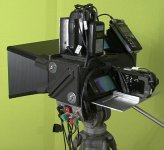
GH1 Stereoscopic Rig Collaboration

Here NEW DIY 3D RIG
This 3D beam-splitter based rig is DIY production, so you can adjust what you want with tuning up by your self. This min-sized ultra-light 3D rig is the world’s most affordable beam-splitter 3D rig system. This 3D rig can help you create amazing 3D images, while maintaining viewer comfort.
Feature
- Top-grade 50/50 beam-splitter glass
- Manually adjust convergence by guide screw
- DSLR cameras, as wall as, compact HD cameras & camcorders
- X Y Z axis adjustable plate.
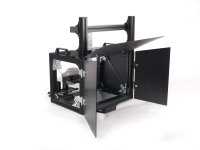
3DRIG.jpg
http://3deyes2010.blogspot.com/
priced at only $1,500 + S&H
 
Awesome. How's your GH1 rig working out now that it's used in anger? Are you finding the sync reliable over all shots?

It's working amazingly well. The 3D quality is just spectacular. Certainly as good as anything we're seeing from SI-2K or EX3 rigs. The sync is far better than the Red One footage that we have. We rarely have takes that are long enough to really tax the sync - but - we haven't had a single sync error in the field. There are a couple of shooters here who are up to speed on the rig and LOVE it. We just finished an effects sequence with the live-action footage being contributed by the Gh1 rig. The post required a huge amount of spatial and color mucking about - and the Gh1 footage held up spectacularly.

If we could get our hands on more hackable GH1's with sequential serial numbers, we'd build more 3D rigs right now.

Of course, the "nice to have" feature list is pretty long. Independent manual iris, focus and zoom gets damn cumbersome. You need a checklist before every shoot - and the added 3D complexity (interaxial separation, tow-angle, mirror glare, beamsplitter barn-doors, etc...) all add up to a LOT of preflight.
 
Sounds really good. If the GH2 works the same, then the footage will be mind-blowing.

But yeah, I haven't even got my rig yet (I'm still shooting 3D with an HV20 + Nuview attachment), but I'm already troubled by not being able to sync camera params automatically. It'd be such a simple thing to do in software (at least when it doesn't have to be real-time) but we still have no access to custom programming beyond an undocumented hack. I can't wait for cameras to open up to custom 'apps' just like iPhones have.
 
First off...Great Thread! I just read it from start to finish. David, the elephant footage looked great.
I have been working on a DIY beamsplitter rig for two Canon HF S200s. I chose these because they can work in native 24fps (23.976fps), they have LANC jacks, and record in a high bitrate AVCHD...and they are affordable for a beginning foray in to 3D. For sync I am using a LANC Shepherd.
The cameras have a sync drift of about 1ms offset for every 132s of real time. This is quite large, and I wish I had cameras that were closer in serial number to minimise this drift, but I do not. As it is I get acceptable offest (my self imposed limit is 0.42ms for fast motion) for about 55 seconds. This is fine for my purposes.
Now to my theory on your 30% failure rate when using non-manual lenses...
In testing my setup with the LANC Shepherd, I decided to use the offset start method for my cameras. By starting the cameras with offset I could have them drift from acceptably out of sync into perfect sync and then up to acceptably out of sync again. This gave me 110 seconds of acceptable sync. Great in theory, but I was getting results that were perfectly in sync or out of sync by multiples of 8.34ms.
Now some video and LANC background...
As we all know, NTSC video is based on a frame rate of 29.97fps. The LANC protocol in NTSC uses two telegrams per frame or 59.94 telegrams per second. This translates to one telegram per every 16.68ms. With the introduction of 23.976fps recording, there needed to be a smaller sync pulse standard that could be common to both 23.976 and 29.97. That pulse rate is half of the telegram rate or one pulse every 8.34ms, but the LANC protocol, and (most likely) the protocol of cameras based on NTSC are not set up for that.
I realized that when the cameras start at the same time I get perfect sync in 23.976fps, but when using the LANC Shepherd in the delayed offset mode, I get errors in multiples of 8.34ms. This is because when in offset mode the jury rigged polling on the 16.68ms pulse could be off by multiples of the 8.34ms needed for accuracy. The LANC Shepherd does not always start the two cameras on the same overall jury rigged cadence needed for perfect sync. (I am sorry I can't explain this very well, but trust me that this is the case in my situation.)
Now to your situation David...
At first I thought your problem was in your SDPT start switch being not quite simultaneous with its signals to the two cameras . If they hit the jury rigged cadence at different times, you could get a mis-sync in multiples of 8.34ms. Luckily for you, this is not the case.
Since you are getting errors with non-manual lenses , my guess is that focusing commands are queued up with the recording command. In other words, the recording commands to each cameras are delayed in their implementation at different rates causing the mismatch in sync.

Are your sync errors of the 8.34ms or multiple variety? If not, it was an interesting theory.
Here is a picture of my DIY rig.
01.BackLt copy.jpg
 
I've got two GH2 bodies on order, but waiting for stock. The upside to that is that they'll (hopefully) be from the same batch with close serial nos...
 
Powering Options:

Powering Options:

Well, I'm still waiting on my GH2 bodies to come in stock, so I though I'd start researching the supporting hardware.

Let's start with powering options:

I can't find any warnings of switching external power to bodies switched to ON in the PAL GH2 manual (unless I missed it, check here, search for 'dmcgh2').

I'm building an ultra-portable rig. I will be using two small 12V portable monitors with a half-mirror, as a 3D preview monitor, so it makes sense to use one big-ass 12V Lithium-ion battery to power everything. These look promising, they include charging circuits and just need DC power (using standard connectors). All kinds of mah ratings are available, big ones include 4500mah, 6800mah, 9800mah:

12v-re-battery-6800.jpg


Note how these cased versions have an on/off switch, avoiding the need for another switch. Plus easy to swap out on-the-fly.


You can also buy uncased versions for similar prices (but no real point AFAIKS, more vulnerable too):

9800mah

BAT1-2.jpg


The GH2 bodies use 7.2V 1200mah batteries, but 'external' power (eg. AC) actually requires ~8.5V, or the camera will reject it as 'not compatible' (3rd-party battery detection rather than a real requirement).

From the manual, GH2 bodies draw max 3.4W (405ma @ 8.4V):

Code:
DC 8.4V
  3.4 W (When recording with LCD Monitor)
        (When the 14–140 mm/F4.0–5.8 lens supplied in DMC-GH2H is used)
  3.2 W (When recording with LCD Monitor)
        (When the 14–42 mm/F3.5–5.6 lens supplied in DMC-GH2K is used)
  2.6 W (When playing back with LCD Monitor)
        (When the 14–140 mm/F4.0–5.8 lens supplied in DMC-GH2H is used)
  2.5 W (When playing back with LCD Monitor)
        (When the 14–42 mm/F3.5–5.6 lens supplied in DMC-GH2K is used)
Some people say that their battery drains much quicker with IOS enabled, so I assume the figures above include it, and the draw is actually less without.

(update): HOWEVER, Panny AC adapters are rated 1.2A, so there may be moments (eg. during boot) where they need more juice!

So we need a switching regulator that can drop 12V down to the required 8.5V. This module seems perfect, cheap on Ebay, requires minimal additional parts (just two capacitors & a resistor to set the output voltage) and is high efficiency (~90-96%):

R5457861-06.jpg


I'm no expert on these, does it look good to you? (Datasheet) Is it OK to power two bodies from a single unit? Will the 'soft' powerup feature affect anything negatively?


Annoyingly, the bodies require a DC coupler (DMW-DCC8, battery-shaped dummy with DC lead) to feed them with external power. Haven't found any cheap knockoffs yet (probably will be out soon):

dmw-dcc8ww.jpg


This setup should be an elegant, cheap & lightweight solution that runs everything for quite a few hours.


If you just want to power the bodies, you can use 8.4V Nimh battery packs directly (commonly used for remote control cars), they're all over Ebay. But they are most likely heavier & larger than the Li-on packs (but those don't seem to exist in 8.4V) and require an extra charger:


Thoughts?
 
Last edited:
I need your advice on splitting prebuilt remotes.

I'll be shooting stills as well as video, and want to do 3D timelapses too - so a cheap pre-built intervalometer trigger like this one would be perfect... but is there a safe way to split the controlling signal to two bodies?

(I could make my own mcu-based one, but doing a user-interface/display for it is just too much work).
 
Because the GH1 remote uses variable resistance on the remote lines to signal a trigger release - you can't just simply Y this cable. I'm afraid a custom circuit is in order. Doesn't necessarily need to be micro-controller based... could just slave two solid-state switches to an off-the-shelf intervalometer and stir in the proper resistors.
 
Because the GH1 remote uses variable resistance on the remote lines to signal a trigger release - you can't just simply Y this cable.

Sure I know.

I'm afraid a custom circuit is in order. Doesn't necessarily need to be micro-controller based... could just slave two solid-state switches to an off-the-shelf intervalometer and stir in the proper resistors.

Right, so I'd need to find the trigger signals, and work from there. I don't know anything about solid-state switches - is there a chance that the switches already in the meter can actually switch more than one path, so I could just hack into them?

Also, does the GH allow simultaneous use of an external mic and a remote?
 
Also, does the GH allow simultaneous use of an external mic and a remote?

Seems not, from the GH2 manual:

"The remote shutter cannot be used while the stereo microphone (DMW-MS1; optional) is in use."

That's actually a major problem for me. Well I guess that with the current sync-trick, there's no need to trigger video recording externally. Of course if a hack ever allows capture timer resets, I'm screwed. Vitaliy actually added that request to his current GH2 hack list (hey it's even first : ).

Another option may be to put a hardware switch between mic & remote, so that you can switch in the mic after recording has started. Any idea if that'll work?


EDIT
: Actually it may not be a technical limitation at all, but rather that Panny don't provide a breakout cable so that both can be connected simultaneously. David, I know you made breakout cables, have you tried using both mic & remote?
 
Last edited:
Actually it may not be a technical limitation at all, but rather that Panny don't provide a breakout cable so that both can be connected simultaneously. David, I know you made breakout cables, have you tried using both mic & remote?

I've never tried it, but, several sources say the tip and second conductor on the jack are for mic input. I know for sure that the 3rd and 4th contacts are the remote lines - so - you should be golden on separating remote signaling and mic input.
 
If you just want to power the bodies[/U], you can use 8.4V Nimh battery packs directly (commonly used for remote control cars), they're all over Ebay. But they are most likely heavier & larger than the Li-on packs (but those don't seem to exist in 8.4V)

These are exactly the batts I'm using for my Gh1 rig... they last FOREVER on a charge.
 
I've never tried it, but, several sources say the tip and second conductor on the jack are for mic input. I know for sure that the 3rd and 4th contacts are the remote lines - so - you should be golden on separating remote signaling and mic input.

Great, I'll report back when I've tried it.
 
Well still no GH2 bodies, so here are my Monitoring Options:

- AV (composite) -:

No go - from the GH2 manual:

* The viewfinder cannot be displayed when connected with a AV cable.
• AV output is disabled when recording.
• Output from the HDMI mini cable has priority when both AV cable and HDMI mini cable are connected.


- HDMI - things to know:

• Output from the HDMI mini cable has priority when both AV cable and HDMI mini cable are connected.
• The connection with the USB connection cable will take priority when you connect the USB connection cable simultaneously with the HDMI mini cable.
• During [24P CINEMA] and [VARIABLE MOVIE MODE] playback, please set [HDMI MODE] to [AUTO]. For settings other than [AUTO], it cannot output at 24 frames/second.
* With HDMI output, you can monitor full high-definition quality (1920k1080 pixels) AVCHD motion pictures on the TV while recording.
• Some functions are unavailable during monitoring.
(???)
• Audio is not output from the TV. (???)

*new*: apparently, ETC (1:1 cropping) mode and 720p recording are NOT available when something is connected to HDMI! :crybaby:


- Cables -


I will use a simple side-by-side rig for most shots, so getting a right-angle mini-HDMI cable is important to minimize the gap between bodies:
- 1.5m (they also have 0.4m)


- Screens -

A few interesting options:

- cheap 7"-9" 800x480 HDMI monitors (eg. Lilliput).
Plus: readily available, by all acounts just enough res to pull focus (but not ideal).
Neg: often lousy image quality (doesn't matter if you only care about framing & focus).


- Cheap Leadstar 10" 1024x600 HDMI screen (actually a media player with HDMI & VGA input functionality):

TV102.jpg


Plus: Cheap (~$130US shipped), thin & light, good resolution, good for others to view, built-in battery (reported ~2 hours, can run off 12V too).
Neg: English version with matte panel out of stock right now, too big for portable/handheld, issues with some cams (GH2 works, GH1 doesn't).


- same Chinese manufacturer has shown interest in producing a better version of it for video monitoring (see link above) - but no ETA (may be some time).

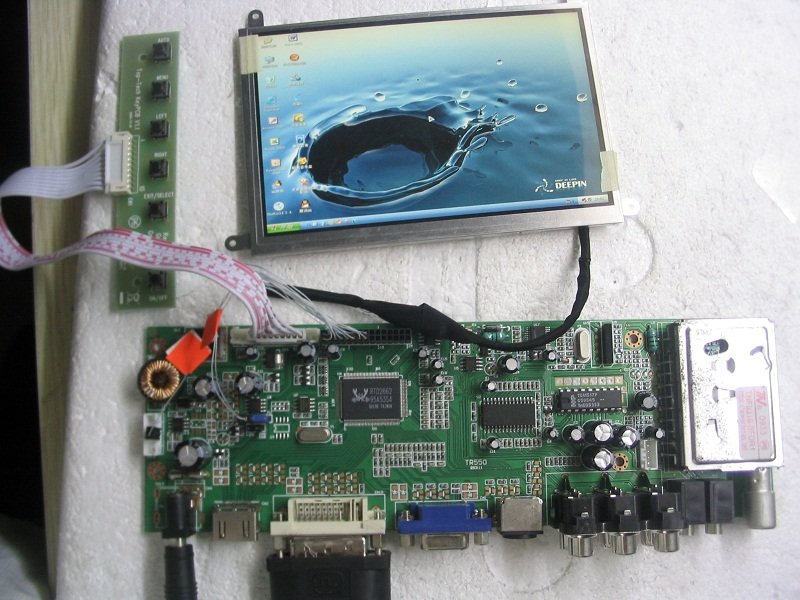
- affordable 5.6" 720p (1280x800 16:10) panel in kit form! (new datasheet):


HV056WX1_100_LCD_Module.jpg


This is apparently the same panel used by the SmallHD monitor.

Plus: small enough for portable/handheld rig, true 720p, fairly bright, LED backlit (light, thin & and long life)
Neg: may have glossy panel, only 18bit colour depth (262k colours) - but controller might dither that like most low-end LCD monitors.


Only two controllers known to work, one small but VGA only (no good AFAIKS), the other supports HDMI (with HDCP) (pictured), but is a huge board as it also supports 6 other inputs types - useless for a portable rig.

I'm really interested in finding a small HDMI controller compatible with this panel. I will use two screens with a half-silvered mirror inbetween, as a 3D preview monitor (for viewing with passive polarized glasses). That requires that one screen (or the controller) has a vertical or horizontal flipping/mirroring option.


Anybody interested? For the cost it's the only small high-res game in town.


EDIT
: added newer datasheet.
 
Last edited:
I've never tried it, but, several sources say the tip and second conductor on the jack are for mic input. I know for sure that the 3rd and 4th contacts are the remote lines - so - you should be golden on separating remote signaling and mic input.

But thinking about it, they both will share the same ground (stereo mic = 2 poles + ground). Will that work (is it even safe to try)?
 
But thinking about it, they both will share the same ground (stereo mic = 2 poles + ground). Will that work (is it even safe to try)?

I already gang that ground (for my shutter release). I have also ganged the negative DC lines, camera USB GND lines and camera composite video GND lines from two GH1s many times. Never been a problem.
 
I already gang that ground (for my shutter release). I have also ganged the negative DC lines, camera USB GND lines and camera composite video GND lines from two GH1s many times. Never been a problem.

I'm assuming that pole 4 (ground) is used for detecting the variable resistance from the shutter - so I can't see how it can be shared with the mic:

Poles 1,2, 4 = stereo mic + ground
Pole 3 = shutter current -> pole 4 (resistance detection)
 
I assume (yeah... I know what assuming does) that it works like this:

tip - R stereo +
pad 2 - L stereo +
pad 3 - remote resistance
pad 4 - ground
 
But the current that goes through the resistors in the remote has to come from a pole, and be measured at another pole, doesn't it? So doesn't that mean 3 = current to remote >> 4 = ground (where resistance is measured)?
 
But the current that goes through the resistors in the remote has to come from a pole, and be measured at another pole, doesn't it? So doesn't that mean 3 = current to remote >> 4 = ground (where resistance is measured)?

Resistance is measured between pad 3 and ground by the supply of a small current that flows between those two pins.
 
Back
Top