colebennett
Active member
Will check out the book. What about LED makes them bad on skin tone? Are they still bad even if you gel them down to the color temp of tungsten, or is it the actual difference in light type between LED and tungsten?
I concur on the suggestion to buy that book. I'm half way through it now and it's chocked full of technique and information on lighting equipment available, and what to do with it.
It actually answers your question about LED lighting.
I'll do my best to recap, without digging back through the book. I'm by no means a tech brain, so I'll give you the readers digest version:
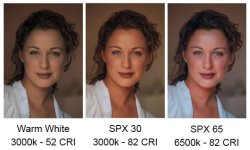
In the 1930's there was a now widely accepted standard established for a specific light's ability to render colour. It was established on a scale from 1-100, and is referred to as the Color Rendering Index (CRI). A light that has a high CRI (80+) is considered capable of rendering colour very well. A light that has a lower CRI (60-) will start to fail at properly illuminating certain colours in the spectrum.
As far as I understand (someone correct me if I'm wrong!), an LED unit that has a bit of a green tint (that is the general complaint) is due to the fact that that unit is weaker in the Red and Blue channel - causing a spike of green. Some (especially older) fluorescents have this same issue. It can be corrected by adding a little magenta to the light with a filter.
Tungsten lights are weak in the blue channel, which is okay if you're shooting balanced for tungsten lighting. But if you're trying to balance to daylight - you'll slap a CTB (blue) gel onto the light and now your Tungsten (which is weak on the blue channel) is trying to force all it's energy through that channel, cutting the intensity of the light drastically.
Neither of these things are directly related to what works best for skin, but knowing the basics of how light and colour operate will help you figure out solutions for different skin tones.
I decided to buy two books the other day, to dig in and learn about lighting for cinema (I'm a photographer by trade): Lighting for Film and Television, Talks with Hollywood's Cinematographers and Gaffers. And Set Lighting Technicians Handbook (Both recommended by other users here). I'm not finished reading the second one yet (It's basically a text book - over 500 pages). But I'm definitely a lot more informed on what's available to film makers, and how they're used in real life application - as well as the strengths and weaknesses of different technology.
The first book does touch on photographing different skin types - it's really informative.
- Cole
Last edited: