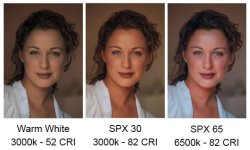
Getting The Best Skin Tone

Will check out the book. What about LED makes them bad on skin tone? Are they still bad even if you gel them down to the color temp of tungsten, or is it the actual difference in light type between LED and tungsten?

I concur on the suggestion to buy that book. I'm half way through it now and it's chocked full of technique and information on lighting equipment available, and what to do with it.

It actually answers your question about LED lighting.

I'll do my best to recap, without digging back through the book. I'm by no means a tech brain, so I'll give you the readers digest version:

In the 1930's there was a now widely accepted standard established for a specific light's ability to render colour. It was established on a scale from 1-100, and is referred to as the Color Rendering Index (CRI). A light that has a high CRI (80+) is considered capable of rendering colour very well. A light that has a lower CRI (60-) will start to fail at properly illuminating certain colours in the spectrum.

As far as I understand (someone correct me if I'm wrong!), an LED unit that has a bit of a green tint (that is the general complaint) is due to the fact that that unit is weaker in the Red and Blue channel - causing a spike of green. Some (especially older) fluorescents have this same issue. It can be corrected by adding a little magenta to the light with a filter.

Tungsten lights are weak in the blue channel, which is okay if you're shooting balanced for tungsten lighting. But if you're trying to balance to daylight - you'll slap a CTB (blue) gel onto the light and now your Tungsten (which is weak on the blue channel) is trying to force all it's energy through that channel, cutting the intensity of the light drastically.

Neither of these things are directly related to what works best for skin, but knowing the basics of how light and colour operate will help you figure out solutions for different skin tones.

I decided to buy two books the other day, to dig in and learn about lighting for cinema (I'm a photographer by trade): Lighting for Film and Television, Talks with Hollywood's Cinematographers and Gaffers. And Set Lighting Technicians Handbook (Both recommended by other users here). I'm not finished reading the second one yet (It's basically a text book - over 500 pages). But I'm definitely a lot more informed on what's available to film makers, and how they're used in real life application - as well as the strengths and weaknesses of different technology.

The first book does touch on photographing different skin types - it's really informative.

- Cole
 
Last edited:
I think people are slightly misundersatnding filtration and illumination

I think I have my head round it

Lets say we come from Mars (people probably think that I do)

As a Martian grey skin, (444444) is seen as pleasant, but the teenagers have grey skin (444444) with blue blodges (444466), now if we illuminate them with a -22 blue filter (or a 999977 light) the blue blodges will render dark the filter creating a transform from 444466 to 444444 - perfect Martian skin

Trouble is the blue ugly fruit in the shot have gone from thier ideal colour of 000088 to 000066 when we filtered out 22 blue

in post we add 000022 to all values of blue above 000044, so the ugly fruit goes back from 000066 to 000088 value that it should have been, but the skin (and filtered blodges) stay at 444444 because we were only adding blue at values above 444444

the blodgy teenage martian is rendered with perfect martian skin (444444) , and ugly fruit is back to the perfect 000088 too.. the martian rock that was 444466, has gone the wrong colour, 444444, but we are not looking at the rock, we are being wowed by the face..

magic

And why Led always look crap even with filtration becuause if the illumiation is wrong no amount of filtration can bring it back..

for example if you had an LED that emmited 000099 (green) you can filter out the green by adding a 0000 -99 filter, but you get a light emmiting 000000, you can never pump missing spectra in using a filter!

and why the best way to illuminate skin is with an uncorrected tungsten light and a blue filter on the lens which filters the light reflecting off the face, not the light hitting it

S

*BTW this is my colour scale
00-00-00 = black
99-00-00 = red
00-00-99 = blue
99-99-99 = white

mars.jpg
 
Last edited:
A few things I want to throw in:

1. You cant filter (gel) int what is not there. So you cant filter in something in a gap between two spikes.

2. CRI is not what it seems to be (see my previous post here)

colortempskintone.jpg

3. Efficiency probably is not what you think.
Halogen High Voltage: CRI 98 - 20 Lumen/Watt
HMI: CRI 96 - 80 Lumen/Watt
Household/Office Flourecent Tube: CRI 75 - 100 Lumen/Watt
Kino Flo: CRI 93 - 80 Lumen/Watt
Metall Halide Tungsten Discharge: CRI 96 - 80 Lumen/Watt
Typical White Phosphor LED: CRI 75 - 60 Lumen/Watt
 
to be honest the figures mean nothing

every light is different and every skin is different

use the softest source possible and on daylight sources i add LEE 188 COSMETIC HIGHLIGHT

cheers
 
The figures mean nothing to the end user. The comsmetic highlight filter would have used figures to develop it using exactly the numerical strategy I laid out

A rough concept of the theory will enable people to understand why a low CRI or LED cant be corrected as simply summarised by frank..

'filtration cannot add'

S
 
Tungsten lights are weak in the blue channel, which is okay if you're shooting balanced for tungsten lighting. But if you're trying to balance to daylight - you'll slap a CTB (blue) gel onto the light and now your Tungsten (which is weak on the blue channel) is trying to force all it's energy through that channel, cutting the intensity of the light drastically.

The 'light' doesn't 'force all its energy through that [blue] channel'...

The Tungsten light emits light across the visible spectrum. Filters have a 'pass' band, and a 'stop band', but there is no sharp cutoff between the two, so there will be attenuation (loss/lower intensity...) across the band, just more attenuation in the 'stop band', than in the 'pass band'.

Also visible light filters are often named for their 'pass band', such as 'red' filter has a 'pass band' in the red region of the spectrum, and its 'stop band' is in the blue...

Then you have a UV filter... which is named for the 'stop band'... but who needs consistency... in the case of visible light filters the 'color' of the filter that the human sees, is the 'pass band' of the filter... most people only feel the effects of UV on their eyes and skin... and not the actual UV 'rays'... then there's InfraRed... which humans don't 'see' either... but anyway...

Photographers may not think of 'filters' in this way, but I find it easier to visualize what happens to the spectrum when using the filter...
 
The figures mean nothing to the end user. The comsmetic highlight filter would have used figures to develop it using exactly the numerical strategy I laid out

A rough concept of the theory will enable people to understand why a low CRI or LED cant be corrected as simply summarised by frank..

'filtration cannot add'

S

In the extreme... think of a set illuminated with a Sodium Vapor lamp CRI around 20 and below... or your local parking lot with older high pressure Sodium Vapor.... Sodium Vapor lamps emit an almost mono-chromatic light (and when 'properly construct' do emit a very narrow band of 'yellow'... for some value of 'proper'...).

No amount of 'red', or 'blue' filtration will 'bring up the reds and blues in a scene'... On the other hand Sodium Vapor was used to exploit a curious 'hole' in the sensitivity spectrum of color negative film of the 50's and 60's, that allowed for a chroma key technique used by Disney for many of the animations and live action fx compositing... it was also used by Hitchcock in "The Birds"(1963)... to composite the birds in flight with the human talent and set locations. The process involved illuminating the subject with both visible and Sodium Vapor light, then with a beam splitter send the beams to a color negative, and to a B&W film negative that was specifically sensitive to the Sodium Vapor spectrum. Actors in front of a 'white screen' would have the traveling matte generated by the B&W image, because they would essentially be silhouetted against the 'yellow screen'...

This would make some child a nice science fair exhibit... well I think it might... if RGB sensors have a similar sort of 'hole'...
 
I didnt know about Disney, but I did know that identification of a vehicle under SV lighting became an issue in the Yorkshire Ripper enquiry !

S
 
Really enjoying the discussion going on here. I'm learning a lot of things and reinforcing some others. In regards to photos of what I like in skintone, here's a couple grabs from Avengers and Inception off of YouTube clips. I realize the compression and format and such aren't ideal, but you can still get a feel for what I like. Bah, sorry about the YouTube overlay in the first pic :P


inception2.jpginception1.jpgrdj.jpg

What I tend to like in skintones (and general look to the image) is a lot of color. I like skintones that appear vibrant, but not necessarily technicolor-knock-your-socks-off vibrant. As a whole, I liked the skintones in the entire Avengers movie. In general, I don't like desaturation, I really like colors that feel true and vibrant. Thoughts on these?
 
Those skin tones would be described as "naturalistic".

Nothing too complicated in lighting those and I would suggest they are basically tungsten source with diffusion... lit in a basic classical manner. (Key , back and fill).

Simple grade and cc added in post.
 
Those skin tones would be described as "naturalistic".

Nothing too complicated in lighting those and I would suggest they are basically tungsten source with diffusion... lit in a basic classical manner. (Key , back and fill).

Simple grade and cc added in post.

HMI, more likely. Seeing as at least the first shot is on location with large windows.
The last one is so flat it could be anything large enough: either HMIs through (or bounced at) big sheets, or lots of flos.
 
Yes, HMI, chimera, distant source, kinoflo = soft / natural skin tone like the youtube examples, but not a cheap light setup
 
The last one is so flat it could be anything large enough: either HMIs through (or bounced at) big sheets, or lots of flos.

The last one is hard lit ( fresnel)...see the hard sharp shadows in the collar and the tie.

Then his face is hard filled ( overly so). See the small fresnel spot in his eyes. The light is at eye height level and just to camera left.

Maybe the fresnels had trace / diff on the barn doors though.
 
View attachment 56909

What I tend to like in skintones (and general look to the image) is a lot of color. I like skintones that appear vibrant, but not necessarily technicolor-knock-your-socks-off vibrant. As a whole, I liked the skintones in the entire Avengers movie. In general, I don't like desaturation, I really like colors that feel true and vibrant. Thoughts on these?

The "Avengers"(2012) article in the June American Cinematographer has some 'clues' about how much lighting was used. Here's the 'online' free portion of the article. The hardcopy has diagrams.

http://www.theasc.com/ac_magazine/June2012/TheAvengers/page2.php

In a word... tons of lights...
 
The last one is hard lit ( fresnel)...see the hard sharp shadows in the collar and the tie.

Then his face is hard filled ( overly so). See the small fresnel spot in his eyes. The light is at eye height level and just to camera left.

Maybe the fresnels had trace / diff on the barn doors though.

How did they avoid awful shadows on the face by using such harsh light?
 
The last one is hard lit ( fresnel)...see the hard sharp shadows in the collar and the tie.

Then his face is hard filled ( overly so). See the small fresnel spot in his eyes. The light is at eye height level and just to camera left.

Maybe the fresnels had trace / diff on the barn doors though.

In the 'film'... the shot is taken from the bridge of a flying craft, and as I recall the 'apparent/diegetic' light is dominated by the large expansive window to the outside world. The bridge interior is lit with much more 'soft' light.
 
Back
Top