CharlesPapert
Director of Photography
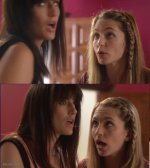
Just wrapped season one of a new half-hour comedy for MTV called "Mary + Jane", about the adventures of two weed-dealing young women set in the trendy Silver Lake neighborhood of Los Angeles. Having worked almost exclusively with Alexas for the past four years, I had assumed to use the same for this show.
I attended a demo of the Varicam LT in February and started to get intrigued about the dual native ISO's of the Varicams and how they might have an interesting application for us. I knew the show would be shot largely handheld and Steadicam, and assumed we would do a certain amount of night exteriors on city streets. In the past I've done a little shooting with the C300 at the ISO 3200-6400 range on smaller projects, and have been interested in "going there" on higher profile scenarios. I also wanted to explore a 4K-capable camera that was approved by entities such as Netflix that mandate full 4K acquisition (eliminating the Amira) so I'd be ready when and if that call came.
When I learned that the stage we were shooting on had some power issues and it would be beneficial to keep the the size of the lighting package small, I started to think about the possibility of shooting at a (relatively) high ISO and cutting the wattage in half or greater. I did some tests with the V35 and learned that while there was a certain amount of noise at the native 5000 ISO, you could all but eliminate (essentially matching the native 800) when you dialed that down to 2000. This does shift the dynamic range downwards so you lose some highlight latitude while gaining it in the shadows, but since we were on stage I had complete control over highlights anyway. Our primary standing set was the girl's apartment, which included a 40 foot translight of a neighborhood view. One of the concerns from the executive producers was that the apartment look like we shot on location as much as possible, so I needed to duplicate the look of hot California sunshine pouring in. Normally I would do so with 10K's in the grid, but thanks to the ISO 2000 setting I could drop down to 5K's (and gain a little extra level on top, always helpful). When each instrument is effectively knocked down to one half its power, the cost of the package really benefits (and with it, heat and power draw). Finally, our LED units such as Litemats, Cineos and Quasar tubes could effectively become twice as powerful. The plan worked beautifully; the images were clean, the sets were comfortable and there was no compromise of any kind.
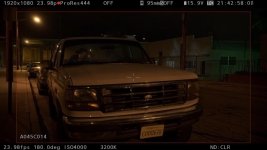
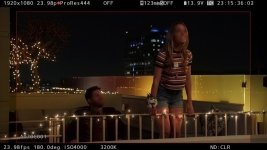
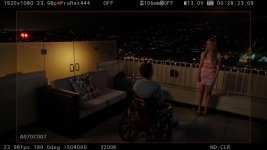
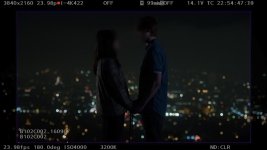
We shot for a few days on nearby city streets that were lit by sodium vapor lighting. I went up to 4000 and sometimes 5000 ISO, and was always impressed by the results. I used some supplemental lighting like an LED ball on a pole for walk-and-talks and the odd fill light, but all of the background was lit by the existing streetlights. The only real issue to contend with was controlling the streetlights behind camera, that tended to cast boom shadows and/or appear unflattering on the actors. The grips came to the rescue with various solids and diffusion up to 12x20 to regulate the front light and all was well. We also shot on the rooftop of a hotel, looking out to a fairly low level of industrial and residential streets, and the high ISO made these darker neighborhoods pop out, and even provided some level in nearly-black skies.
Outside of the high ISO, I found the images from the V35 quite pleasing. Skin tones felt natural, highlight rolloff was good and general color rendition presented no surprises. We used the 4K capability in a number of instances where blowups were a possibility, always a helpful asset.
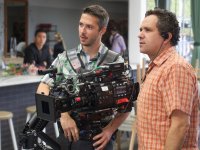
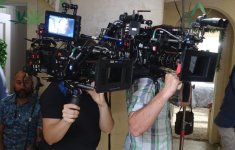
While I would have liked to have given my operators the bantam weight of the LT, we couldn't quite swing it in time for the start of production so they muscled it through with V35's instead. I was actually surprised to learn that the V35 is actually 2-3 lbs less than a comparably equipped Alexa (it appears bulkier due to the dockable back) and they never hit a fatigue point that I was aware of. We always had the option of a "bobblehead", a customized unit with four heavy-duty springs and a variably inflated ball that duplicates the look of handheld while the camera is mounted on the dolly. The assistants arranged their build so that all accessories lived on the camera full-time, so conversions from studio to handheld to Steadicam were done in record time. We shot entirely on zooms for speed, and my usual stop was a T4 for interiors unless there was a specific reason to stop up or down.
The show premieres in August on MTV. The scripts were great, the actors were charming and hilarious and I think it will be a good show. We certainly had fun making it.
Selected components of the camera package:
Arri Alura 15.5-45
Arri Alura 30-80
Arri Alura 45-250
Cabrio 19-90
Zeiss 70-200
Preston FIZ systems
Teradek 2000's
Cinetapes
Glimmerglass 1/2-2
Black Diffusion FX 1/2-2
Low Contrast 1-2
Hollywood Blackmagic 1/2-2
I attended a demo of the Varicam LT in February and started to get intrigued about the dual native ISO's of the Varicams and how they might have an interesting application for us. I knew the show would be shot largely handheld and Steadicam, and assumed we would do a certain amount of night exteriors on city streets. In the past I've done a little shooting with the C300 at the ISO 3200-6400 range on smaller projects, and have been interested in "going there" on higher profile scenarios. I also wanted to explore a 4K-capable camera that was approved by entities such as Netflix that mandate full 4K acquisition (eliminating the Amira) so I'd be ready when and if that call came.
When I learned that the stage we were shooting on had some power issues and it would be beneficial to keep the the size of the lighting package small, I started to think about the possibility of shooting at a (relatively) high ISO and cutting the wattage in half or greater. I did some tests with the V35 and learned that while there was a certain amount of noise at the native 5000 ISO, you could all but eliminate (essentially matching the native 800) when you dialed that down to 2000. This does shift the dynamic range downwards so you lose some highlight latitude while gaining it in the shadows, but since we were on stage I had complete control over highlights anyway. Our primary standing set was the girl's apartment, which included a 40 foot translight of a neighborhood view. One of the concerns from the executive producers was that the apartment look like we shot on location as much as possible, so I needed to duplicate the look of hot California sunshine pouring in. Normally I would do so with 10K's in the grid, but thanks to the ISO 2000 setting I could drop down to 5K's (and gain a little extra level on top, always helpful). When each instrument is effectively knocked down to one half its power, the cost of the package really benefits (and with it, heat and power draw). Finally, our LED units such as Litemats, Cineos and Quasar tubes could effectively become twice as powerful. The plan worked beautifully; the images were clean, the sets were comfortable and there was no compromise of any kind.
We shot for a few days on nearby city streets that were lit by sodium vapor lighting. I went up to 4000 and sometimes 5000 ISO, and was always impressed by the results. I used some supplemental lighting like an LED ball on a pole for walk-and-talks and the odd fill light, but all of the background was lit by the existing streetlights. The only real issue to contend with was controlling the streetlights behind camera, that tended to cast boom shadows and/or appear unflattering on the actors. The grips came to the rescue with various solids and diffusion up to 12x20 to regulate the front light and all was well. We also shot on the rooftop of a hotel, looking out to a fairly low level of industrial and residential streets, and the high ISO made these darker neighborhoods pop out, and even provided some level in nearly-black skies.
Outside of the high ISO, I found the images from the V35 quite pleasing. Skin tones felt natural, highlight rolloff was good and general color rendition presented no surprises. We used the 4K capability in a number of instances where blowups were a possibility, always a helpful asset.
While I would have liked to have given my operators the bantam weight of the LT, we couldn't quite swing it in time for the start of production so they muscled it through with V35's instead. I was actually surprised to learn that the V35 is actually 2-3 lbs less than a comparably equipped Alexa (it appears bulkier due to the dockable back) and they never hit a fatigue point that I was aware of. We always had the option of a "bobblehead", a customized unit with four heavy-duty springs and a variably inflated ball that duplicates the look of handheld while the camera is mounted on the dolly. The assistants arranged their build so that all accessories lived on the camera full-time, so conversions from studio to handheld to Steadicam were done in record time. We shot entirely on zooms for speed, and my usual stop was a T4 for interiors unless there was a specific reason to stop up or down.
The show premieres in August on MTV. The scripts were great, the actors were charming and hilarious and I think it will be a good show. We certainly had fun making it.
Selected components of the camera package:
Arri Alura 15.5-45
Arri Alura 30-80
Arri Alura 45-250
Cabrio 19-90
Zeiss 70-200
Preston FIZ systems
Teradek 2000's
Cinetapes
Glimmerglass 1/2-2
Black Diffusion FX 1/2-2
Low Contrast 1-2
Hollywood Blackmagic 1/2-2
Last edited: