Getting high dynamic range

Blade Borge

Well-known member
I want to get high dynamic range, but these cameras like Blackmagic and others that use ProRes are intimidating. I'd love more dynamic range, but without starting with a murky, desaturated image in post. I don't really trust my color correction skills and would like a camera with high dynamic range right out of the camera. What you see is what you get. Is this wishful thinking or is it possible?
 
How much DR do you need, and how much more are you going to get with a LOG profile? Choose your shots carefully and light them where needed and you won't need a million stops of DR. It's nice to have of course, but we didn't always have it shooting video and somehow we got by.
 
What are you shooting that you feel you need 14+ stops?

And what kind of budget do you have to work with?
 

Attachments

  • latitude.jpg
    latitude.jpg
    20.5 KB · Views: 0
The output on screen is only about 7 stops - ie your screen can only show 7 stops

so to 'fit' 14 stops of image into 7 stops of screen the image must have contrast reduced by 50%

ergo any WDR camera has a murky desaturated image!
 
The output on screen is only about 7 stops - ie your screen can only show 7 stops

so to 'fit' 14 stops of image into 7 stops of screen the image must have contrast reduced by 50%

ergo any WDR camera has a murky desaturated image!

I think he's talking about murky desaturated footage.

If you're shooting a compressed format (DSLR h264, AVCHD, etc)... Dial down sat. & contrast a hair maybe, but whatever you take out of 420 8 bit footage is very hard to put back in. I try to get close to my final "vision" or whatever you want to call it.

If you're shooting raw or shooting real, true, honest 422 via HDMI (and most "clean HDMI out" cameras are putting out 420 I understand) then yeah, go as log as you can.

DR in most modern cameras popular here is adequate if you know the limitations. The main thing you need to watch for is the extremes - highlight rolloff and plugged shadows. If the data's gone, it's gone, esp. with highlights. And trying to lift shadows is noise city. So lighting and light control is a big issue, and there are millions of words here and across the web about dealing with lighting.

Even with an Alexa, DR is much more about skill than bits. A raw camera will give you a lot more options and leeway, but learn to get good shots on in 8 bit and it's a skill you'll always rely on.
 
Any camera that records a lot of DR will look flat and dull before grading. It's what happens if you record 13 stops of DR and display them in a screen that usually has just 9 or 10.
 
to 'fit' 14 stops of image into 7 stops of screen the image must have contrast reduced by 50%
Isn't that what S curves are for? The mid has high contrast. The lows and highs have low contrast. A smooth highlight roll-off, like what film gives us, eats three or four f-stops, I think.
 
You'd be surprised how much DR you get out of an iPhone with some strategic lighting. The biggest budgets with the best cameras/film stock use lights. Trying to get the maximum out of the shadows as well as the highlights your best bet is a good lighting scheme.
 
Isn't that what S curves are for? The mid has high contrast. The lows and highs have low contrast. A smooth highlight roll-off, like what film gives us, eats three or four f-stops, I think.

To some extent - but to me flattened shadows and highs (esp highs) scream video (different from film rolloff) - Film - once coloured - is rarely muddy - most stuff in the cinema has great saturation et all - becuase the colourist has taken those 14 stops and worked them into the available space..

IMO you cannot have WideDR image collection that does not need compressing in the grade..

S
 
You'd be surprised how much DR you get out of an iPhone with some strategic lighting. The biggest budgets with the best cameras/film stock use lights. Trying to get the maximum out of the shadows as well as the highlights your best bet is a good lighting scheme.


well, i mean, the iphone's DR is what it is. if you're suggesting you can use lights to brighten up shadows if you don't have the DR to get them, then yeah... but that's kind of a different discussion.
 
well, i mean, the iphone's DR is what it is. if you're suggesting you can use lights to brighten up shadows if you don't have the DR to get them, then yeah... but that's kind of a different discussion.

"getting high dynamic range" is the OPs title. I just suggested using some Lights, it doesn't matter what camera system you're on if you need to extend the DR light the set or at least the shadow area.
 
"getting high dynamic range" is the OPs title. I just suggested using some Lights, it doesn't matter what camera system you're on if you need to extend the DR light the set or at least the shadow area.

No, 'getting high dynamic range', means at this point getting a high end Red or Alexa camera. Since I don't have the means to use either, I don't know the exact actual effective achievable DR of either camera, but I'm pretty sure they are both greater than the average DSLR...

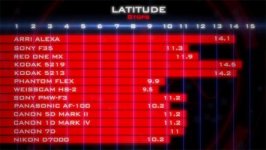
From the charge posted above, only the Alexa had 14+ stops, and appeared to be equivalent to the Kodak Film samples. But that may be an old slide.

As for using 'lights' to 'boost shadows' or the like... well that's not 'high dynamic range', but flattening the existing contrast of the scene to fit in the available DR of the camera at hand.

Some cameras, perhaps more and more, are offering a 'log' representation of the image values. This has the effect that scenes with wide contrast range can be represented.
 
No, 'getting high dynamic range', means at this point getting a high end Red or Alexa camera. Since I don't have the means to use either, I don't know the exact actual effective achievable DR of either camera, but I'm pretty sure they are both greater than the average DSLR...

Yes of course but the way I understand the OPs question is he doesn't want to use a "cinema" camera with a log profile. If you want an easier workflow with blackmagic pricing get a dslr with an already baked in image and I don't care what anyone says if you cant afford a red, alexa or top end Sony and you need to extend the DR in a scene with a 7,8,9,10 stop camera add some lights.
 
No, 'getting high dynamic range', means at this point getting a high end Red or Alexa camera. Since I don't have the means to use either, I don't know the exact actual effective achievable DR of either camera, but I'm pretty sure they are both greater than the average DSLR...

...if you cant afford a red, alexa or top end Sony and you need to extend the DR in a scene with a 7,8,9,10 stop camera add some lights.

You can get a lot of DR affordably with the Blackmagic cameras. This does put you in a raw workflow though.

But I agree about lighting to a great extent. Say I have an outdoor scene with a hazy sky. I have soft shadows and don't need rags to make the talent pretty. However, the sky is so bright that to hold any sky detail, I have to stop down, and now talent and shadows are too dark. I might be able to just shoot away with a BM camera. With, say, a DSLR I need to pump 3 stops of light into mids and shadows. That's often more than reflectors can provide.

If it's full sun, it's even worse, since I need an overhead to tame the harshness which kills another 1-2 stops.

But even shooting raw, you should still try to get your exposure values as close as possible to what an average final grade would be. High DR matters in shooting and editing. Your final edit won't have 14 stops after all. People were getting complex scenes completely in camera before there was digital anything. They did it by getting their scene levels squeezed into whatever DR their medium (in the old days, film) was capable of.

I think the OP needs to rethink what his question really means. Your goal is to get a balanced final look/grade/scene with the tools at hand. Raw or high DR certainly makes it easier.
 

"As for dynamic range, saying the BMPCC is a 13 stop camera is a bit of a stretch. I’m seeing 12 stops at 800ASA, and 12.5-13 stops at 1600ASA depending on what you consider useable. I’m going to say it has a bit less usable DR than the Canon C300 / C100 due to a noisier image particularly at 1600ASA which makes shadow detail less recoverable on the BMPCC. The Canons measure 12-12.5 stops at most ISO settings over 800ISO using an external ProresHQ recorder. (Canon uses ISO, Blackmagic uses ASA, Arri uses EI, whatever…) The Arri Alexa has over 14 stops usable according to my chart for comparison. Amazing performance on the BMPCC for a $1k camera body though, that’s still a ton of dynamic range.

In RAW mode, the sensor’s DR appears to be exactly the same as is visible using Prores / film mode, but the payoff obviously is you will be able to adjust the image further than in Prores mode before bad things happen. I used Davinci Resolve 10 to export the stills from the original camera CinemaDNG file in case you’re wondering. I won’t be shooting RAW anytime soon as it’s not worth the minimal benefit I am seeing."

-Corey Robson

http://www.coreyrobson.com/post/67647671217/bmpcc-vs-man-with-charts
 
But even shooting raw, you should still try to get your exposure values as close as possible to what an average final grade would be. High DR matters in shooting and editing. Your final edit won't have 14 stops after all. People were getting complex scenes completely in camera before there was digital anything. They did it by getting their scene levels squeezed into whatever DR their medium (in the old days, film) was capable of.

The Zone System had classically 10 'stops/zones', with 'pure white' and 'pure black' leaves only 8 stops for 'grey values in between'... From my use of the system for stills, I was using about 7 stops.

This was determined by many tests to find the various thresholds from 'pure black', just able to distinguish 'black from grey', and 'textured 'grey', and on the high side from pure white down to 'textured' light grey, etc.

Where wide dynamic range assists, is in the case of the bright sunny day, and talent set in 'shadows', where the dynamic range of the scene exceeds the presentation medium, print paper in the olden days for stills, projection prints for olden days movie film, or now a range of presentation devices from phones to theater projection equipment... all of which have less dynamic range than 8-9 stops at the most, and often, depending on device and viewing conditions, much less.
 
"As for dynamic range, saying the BMPCC is a 13 stop camera is a bit of a stretch. I’m seeing 12 stops at 800ASA, and 12.5-13 stops at 1600ASA depending on what you consider useable. I’m going to say it has a bit less usable DR than the Canon C300 / C100 due to a noisier image particularly at 1600ASA which makes shadow detail less recoverable on the BMPCC.


I had a discussion with the lead tech guy for Black Magic Cameras, and he stated the philosophy was to use post denoising tools, which are much better than what can be put into a 'small' camera.

It would be nice if they hooked up with a denoising software company and supplied a basic app/plugin to deal with noise... sort of like in the olden days when one bought a scanner one often got a copy of Photoshop...
 
I had a discussion with the lead tech guy for Black Magic Cameras, and he stated the philosophy was to use post denoising tools, which are much better than what can be put into a 'small' camera.

It would be nice if they hooked up with a denoising software company and supplied a basic app/plugin to deal with noise... sort of like in the olden days when one bought a scanner one often got a copy of Photoshop...

They did bundle full version of DaVinci Resolve with their camera, there's denoise module built-in.
 
Back
Top