Future CPU market?

firehawk

Veteran
So it seems AMD has shaken things up a bit with their latest Ryzen Threadrippers.
Charts with results like this seem to be common.
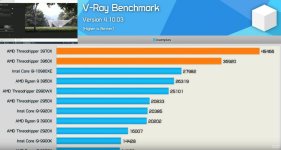
image_54028.jpg
And the 64 core 3990x is to be even hotter.
Such performance boosts are welcome for us in video and 3D.
How will this new leap affect the market, though?
Will Intel and AMD fight it out and these crazy fast CPUs become the norm with prices dropping or will the market be split between these fast ones and the more normal offerings so the prices remain in tiers as they are?
Thoughts?
 
https://www.cpubenchmark.net/high_end_cpus.html

IIRC, the Athlon based system I bought in 2001 registered at about 100. That was one time before this that AMD got a leg up on Intel. But now Intel seems to be struggling with the 7 nM process, promising only to launch them by 2021. By that time, AMD should be out with its 5 nM chips. 8K HEVC seems to be just around the corner.
 
I would like to learn and understand better how and why technology keeps improving every year in the way that it does. How one day people create something better and faster that they couldn't the year before.

What exactly happens in physics, in the universe that chips and hardware are slightly improved in 2021 or 2022 vs 2020. It's interesting.
 
It is nice to see AMD find success with their design. They are getting good performance with less energy/heat. Intel is stuck in a rut and can not get out of it. The recent Intel 18 core chip can keep pace with the new AMD chips (when overclocked) but at twice the energy consumption. Intel always had a leg up in the video world with special instruction sets that made the software run better. Looks like their day in the sun is over for a while. The real pain is coming in the next generation where AMD will probably mop the floor. But, Intel will be back.

For us in the video world, GPU use what is keeping it interesting. CPU alone can not keep up with the pace of resolution change.
 
How will this new leap affect the market, though? Will Intel and AMD fight it out and these crazy fast CPUs become the norm with prices dropping or will the market be split between these fast ones and the more normal offerings so the prices remain in tiers as they are? Thoughts?

Intel sat on their hands over the last 10 years because they thought that they were in the "catbird seat" and that nobody would ever be able to touch their greatness.

So while Intel was busy congratulating itself about how great it was... AMD was working on a new type of CPU architecture that would allow them to surpass Intel at all levels if they could pull it off. ( i.e. Infinity Fabric and Chiplets )

Flash-forward 10 years and AMD is now the front runner, and they have no desire to ever take the backseat to Intel ever again...
 
This is interesting. All my computers since 1990 are Intel and all still work. I need a new one for 3D and looks like it will be AMD which seems strange.
 
Intel will be fine... they had a change in leadership and tried to throw in everything with their first 10nm build, rather than follow their proven iterative process and this cost them. But they will be back, similar to what happen in 2005 when AMD pulled ahead. Intels 10nm chip is equivalent to AMDs 7nm, it is a difference in measuring technique.

A number of industry experts think that it could take Intel 5 - 10 years to catch up with AMD if they can. AMD is rolling out new CPUs every year now, so Intel doesn't just have to catch up with last year's AMD chips, they have to catch up with this year's AMD chips. And so far it looks like Intel has nothing to compete with AMDs Infinity fabric and Chiplet designs, so AMD can keep adding more cores that are fabbed as tiny little CPUs instead of large monolithic silicon that has much lower yields than the chiplet design does.

CPU Yields.jpg
 
Last week's GPU's rating compilation, if anyone's interested.

https://www.tomshardware.com/reviews/gpu-hierarchy,4388.html

And this is about hardware, software and all the toys in the world.

https://www.insider.com/pixars-animation-evolved-toy-story-2019-6

An excerpt I found the most interesting,

Narrator: According to producer Jonas Rivera, if they had to today, they could render "Toy Story" faster than you could watch the entire movie. However, the complexity of "Toy Story 4" means it can take 60 to 160 hours to render one frame.

So, based on the "what is good enough?" theory, how soon will we see the CGI films that are done in a week or two?
 
Nice! Im curious to see that. I know nvidia is rumored with a GTX 3080 this year too. Might finally be time to upgrade the 1080 TI later this year.

Some of the YouTube tech-heads are already predicting that Big Navi might outperform the GTX 3080 when it's released.

Things are getting exciting again!!!
 
Very exciting. Though if AMD's gpu can only tie with 3080 TI I'd go Nvidia just because they are more established in the industry.

You do realize that AMD bought out ATI many years ago to start their GPU division, so AMD also goes back a very long way, back to the time when nVidia was caught cooking their GPU drivers to produce higher scores on 3D benchmarks.
 
These are interesting times. I only remember AMD giving Intel a serious run for their money (once?) before, (nearly 2 decades ago?)
The new AMD video cards also sound interesting.
And that is what I was trying to get at in the OP, what will happen? The competition heats up, performance increases....and prices drop?
 
An average PC price now is ~ $670 ... I remember back in 1986-87, "average" was $3,500 and that was without an onscreen user interface. That was my first time in the electronic retail.

Of course, the TV pricing was almost as bad. In 1989, a 35" Mitsubishi CRT TV was almost $3,000, as was its 50" Rear Projection. In 1998, 46" Philips flat screen (plasma) was $14,000 and even that was only SD.

And cameras were just getting onto a digital side.
 
So, in response, it's all getting biggest, faster, cheaper much like in cameras, which are basically a sensor inside a microform computer anyway. More pixels, higher bit rate codecs, faster media, et cetera, et cetera....
 
It’s also nice to know that there is an immense amount of room for software optimization moving forward.

But how do you convince software companies to invest the money in rewriting their software to take advantage of 16 / 32 / 64 CPU cores ?

I edit with Vegas Pro which has some multiprocessor optimizations, but most of the plug-ins still won't recognize more than one core, so editing can be super fast but rendering gets bogged down from all these inefficient plug-ins.
 
......Adobe's subscription service is the biggest rip off ever because few people would have upgraded over the last couple years if they were following their old upgrade model, so the only incentive for Adobe is losing subscribers at this point.....
Problem is all those locked in to Adobe subscription have an incentive to keep making payments else be cut off. It's not easy when posting jobs each week (and with lots of previous projects through the years) to jump to another post software. Adobe knows this.

It would be great if someone started utilizing all the potential in our multi-core multi-thread CPUs and GPUs. Post would be so much smoother/better! :)
 
Back
Top