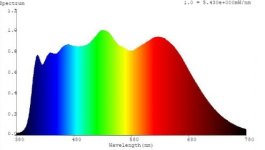
Full spectrum LED Light Bulb with CRI of 98

marvinhello

Well-known member
So I recently got my hands on a very unique product developed by a tech firm based in Beijing, it's a standard A19 light bulb boasting full spectrum light output with Colour Rendition Index as high as 98 (typical value not less than 97).
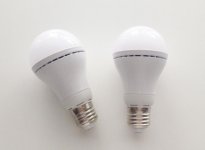
IMG_5488_1024x1024.jpg

I had a chat with the R&D team and they told me they did not design this product with film/video in mind, however from my observation it can meet a number of the most critical requirements for professional productions. I would imagine using them with these socket adapters and softboxes:
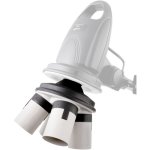
IMG_311234.jpg

The light bulb comes in two colour temperature variations, 3200k/5000k, providing 300lm brightness with 6W power draw, and compatible with 100-240V AC.

Here is the lab test report for light quality, notice all the "R" values, the closer to 100 the better.
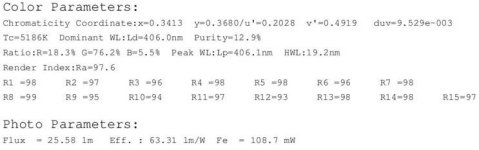
20140424133857.jpg

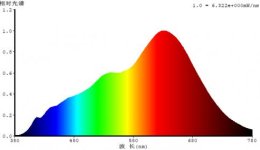
Below is the spectrum graph for 3200k version:
3200k.jpg

and 5000k version:

5000.jpg

I'd say it's fairly close to incandescent light source such as tungsten or the sun! They even implemented a very clever design to remove the usual blue spike associated with LED technology.

What's your view on this? I've already started using them in the studio and replaced all fluorescent bulbs with these new LEDs, the light quality and colour rendition is definitely a huge step up.
 
If it's real, this is huge. Genuinely huge. If we can get all of the low power draw benefits of LED without the inherent spectral weakness of discontinuous light sources like fluorescents, HMIs and conventional LEDs - then the colour accuracy we're getting on modern sets could improve tremendously - no more issues with capturing iffy skin tones if not using tungsten or real daylight.

This is a big deal.

Do you have any links you could share?

Cheers

Yes it's real, they showed me all the readings from standard colour probe and various metering devices. very impressive.

Sorry but there's no link, currently this product is not available for retail to the general public.
 
Last edited:
At 300 lm... they have about 5.6x to go to get to the nominal 1700 lm for a 100W Tungsten @ 120V equivalent...

Why do they have to compete with Tungsten on light intensity? With modern ultra high sensitivity cameras (Canon C-series, Sony F5/55/65, RED DRAGON), light is mostly an image shaping tool, rather than simply providing exposure.

Like I've said this light bulb was not designed for film/video, so nothing to blame :)
 
For a led that outputs 300 lumens at a 6W draw that ain't too efficient as leds go. That is only 50 lumens per watt, still a better than the filament but where is the real advantage considering you still have to plug it in the wall.? then why not use the filament since you are using the umbilical cord ? I would really say WOW if that efficiency factor would at least double to 100 lumens per watt at the 6 watt or 10 watt level, this way a 50 watt draw from common 14.4 V DC batteries delivering 5000 lumens ( 300 w bulb ) can become very interesting and open up many possibilities. A high CRI number in leds by itself is not the holy grail but teaming it with a high lumen to watt ratio as well as a high power rating ( much more than 6W ) will surely start to change views about the leds' shortcomings.
 
Can it be dimmed by a standard line level dimmer? And does it flicker when it does so at standard shooting speeds?
 
The spectrum graphs are beautiful. If these are correct, the 5000K version would be perfect for color correction work.
 
For an LED that outputs 300 lumens at a 6W draw that ain't too efficient as LEDs go. That is only 50 lumens per watt...

Yes. This is "standard" behavior -- as you try to nail down the spikes, you give up efficiency. This is true of all discharge type lighting, from LED to fluorescent to HMI. If you want really efficient lighting, you have to take some spikes. If you want a nice smooth response curve, you have to give up some efficiency to get it. The "trick" is to find the "sweet spot" between the magnitude of the spikes and efficiency.
 
On looking at that bulb, and the efficiency of it, would it not have been a better idea and more efficient at that by using the remote phosphor design ? I mean, 50 lm/w can easily be beat by the RP and be also capable of being battery powered if need be. Wonder what it is intended for and at what is the retail cost. Phasing out the good ol' tungsten filament forces us to make decisions on what to choose next when the viable options become available. wether it is led, RP or perhaps the LEP. An interesting read on RP is here:http://www.ledsmagazine.com/article...tractive-light-output-from-led-lamps-mag.html
Philips has already a great RP bulb available, just if the cost can be a bit lower. http://www.extremetech.com/electron...d-bulb-a19-led-is-prettier-and-more-efficient
What is really needed is a 100 watt bulb equivalent drawing 20 watts with 90+ CRI in temperatures from 2700K to 5500K choices. Without the cord.

The bulb is not available for retail but I was told the bulk price is less than $30 each, currently their clients are high end galleries/museums and interestingly, hospitals.
 
The bulb is not available for retail but I was told the bulk price is less than $30 each, currently their clients are high end galleries/museums and interestingly, hospitals.

Hospitals aren't such a weird candidate. Studies on the health benefits of natural light and good light quality could certainly push Hospital lighting specifications towards full-spectrum bulbs I think.
 
True that. I've lost all energy as soon as I get home for the last couple of years. It's recently occurred to me that it's since about the same time I switched to CFL once they took domestic tungsten off the shelves. I live in a house built in the 40s and it gets very little natural light even in the day. Can't wait to move into my new house once it's built. I have to have LED lights there as they are marketing the estate as an eco-village. I'll be interested to know when these become commercially available because it sounds like they might be the silver bullet.
 
Back
Top