
Navigation
Install the app
How to install the app on iOS
Follow along with the video below to see how to install our site as a web app on your home screen.
Note: This feature may not be available in some browsers.
More options
You are using an out of date browser. It may not display this or other websites correctly.
You should upgrade or use an alternative browser.
You should upgrade or use an alternative browser.
full frame colors
- Thread starter ralfmouth
- Start date
I never realized that. Thanks. So differences are probably in the codec or what not.No, sensor size has no influence on colors. But a different manufacturer certainly will influence color rendition, and no single manufacturer makes both m4/3 and fullframe video cameras, so there you go.
An argument i read a lot is that the reduced noise of FF increases color purity / vibrancy.
This sounds like a good point but only at higher iso. (Ken Rockwell 5d vs d200 below).
The FF looks a little more vibrant to me here, but i would say its more exposed.


it's not a sensor size thing, but a camera model thing (except most Canons have nearly the same colors)
Yes i think its the shallow dof that is attracting me, not the colors.

AdvanTech
Well-known member
Are full frame colors different? People argue this way and that, and no one seems sure.
I'd like to invest in micro 4/3 but this color issue keeps gravitating me back to full frame.
Please help me decide! Thanks. The saturaton looks more natural to me.
Sensor size has nothing to do with it. You must just like the colors from a certain manufacturer (plural?) that also makes full frame cameras.
Bump!
My new idea is that large sensors have better saturation since greater light sensitivity allows for stronger (purer) color filters.
More filtration= less light, and crop sensors may use less filtration in order to compete in low light performance.
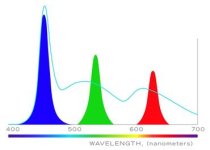
I'm thinking a color purity graph between full-frame and crop sensor might look something like this:
http://www.cnet.com/news/what-are-quantum-dots-and-how-could-they-help-your-next-tv/
Where the blue curve would represent a crop sensor's approximation (due to weak filtering) of full frame color distribution.
The Curve's broad peaks would allow color contamination in the rgb channels and subsequently de-satruation.
Don't know about you, but comparing clips from the GH4 & BlackMagic to full frame usually looks something like this:
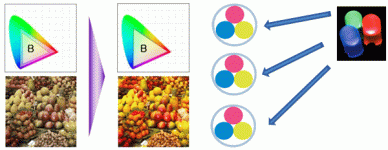
Btw these images are taken from another context to illustrate the idea.
What's more I don't think the difference would really be correct-able in post.
Increasing saturation usually clips information (or does it) assuming exposure was correct.
for reference: http://photo.net/canon-eos-digital-camera-forum/00YLBc
My new idea is that large sensors have better saturation since greater light sensitivity allows for stronger (purer) color filters.
More filtration= less light, and crop sensors may use less filtration in order to compete in low light performance.
I'm thinking a color purity graph between full-frame and crop sensor might look something like this:
http://www.cnet.com/news/what-are-quantum-dots-and-how-could-they-help-your-next-tv/
Where the blue curve would represent a crop sensor's approximation (due to weak filtering) of full frame color distribution.
The Curve's broad peaks would allow color contamination in the rgb channels and subsequently de-satruation.
Don't know about you, but comparing clips from the GH4 & BlackMagic to full frame usually looks something like this:
Btw these images are taken from another context to illustrate the idea.
What's more I don't think the difference would really be correct-able in post.
Increasing saturation usually clips information (or does it) assuming exposure was correct.
for reference: http://photo.net/canon-eos-digital-camera-forum/00YLBc

Samuel H
Major Contributor
That could happen, except, it usually doesn't: I haven't seen any evidence that any manufacturer uses a stronger color filter array on bigger sensors. Well, maybe one case: I think the uglier colors of the 1DmkIV with respect to the 5D2 were due to a weaker CFA to allow for better lowlight capabilities. But that's not a rule, that's a very specific camera.
That could happen, except, it usually doesn't: I haven't seen any evidence that any manufacturer uses a stronger color filter array on bigger sensors. Well, maybe one case: I think the uglier colors of the 1DmkIV with respect to the 5D2 were due to a weaker CFA to allow for better lowlight capabilities. But that's not a rule, that's a very specific camera.
Ok I think I'll drop this.
The colors in this video look equal to any full frame to me honestly.
http://vimeo.com/91507722
But thank you for confirming it could happen.