
Alan Nogues
Member
So... This is going to be my personal review of the not quite so new Sony FS700.
Numerous reviews have been made since its original release in 2012. I am not going to repeat what others said about this lovely camera. This review will put the Sony in perspective for potential wildlife filmmaking. This has been my choice when I started production for a 4X52' nature serie almost ayear back.
Now, being on the verge to release the first volume, I felt it might be helpful to others to share my thoughts.
But really, I don't pretend this cam to be THE professional choice... at all... Many established pros found the raw workflow with RED ONE / EPIC / SCARLET to be the best choice in Super35 sized sensor. Others found this format was not workable for wildlife because of data management, shallow DOF and long lenses reach, so they choosed 2/3 sensor with still lenses and/ or B4 lenses. After all, it is all very subjective.
So far for me, why super35 ? Shallow DOF, creamy bokeh, the ability to make your subject instantly pop-up was my main priority. I knew it was going to be painful though with focus tracking, and long lenses options. And really, focus is challenging (especially when you work both on Nikon and Canon lenses, it drives you nuts)
But, I questioned myself : AVCHD ? Why the hell Sony decided to put such an apparently « weak » codec in such a gorgeous package? That was my initial thoughts. If I can share with you something that I find now important... When you shoot everyday for a year on a single 52min doc, you end up with 100h of rush, or at least that is what happened to me. I've heard stories of wildlife film makers ending up with 120TB of raw data fora 52min.
For my project, I got a little 1TB AVCHD files. This is cost effective really, and easy to backup and edit... But well, I am not talking about grading...
Now, for the quality... I think images are gorgeous. It is 8bit, yes. But my naked eyes see lovely dynamic range (cinegammas 4!), superb color rendition, 50p motion clarity, smooth highlight roll off, extreme low light sensivity with low noise up to ISO 3200.
Here is an example of a sequence mainlyshot between ISO 1600, ISO 3200 and ISO 6400 (except for the landscapes introduction which was ISO 640) This is about the Kagu, an endangered flightless bird in New Caledonia.
https://vimeo.com/68891562
Many broadcast channels are OK with the FS700 picture quality. Stock footage websites gladly take it too. I have not had any problems to sell my stuff because of the codec. The thing is, a good sensor, with AVCHD on board coupled with Cinegammas is something well thought for quality / size ratio. I think this is the most cost effective codec on the market. Just grab a cheap 32gbSD and you good to go.
Now the real cons for me with this codec are the following : don't push up too badly the postprocessing, you have some nice little cosy room to grade, but depending on the look you want to achieve, noise starts to appear and footage can fall apart in some situations...
Also, there is that 8 bit banding. I film alot of birds in extreme contrast situations (+90° tilt anglein the canopy) and despite the nice roll off between shadows and highlights, banding shows up quite often with fine detailed subjects(feathers, branches etc...) This is an ugly thing. I simply avoid these situations now. It is not making my life easier, depending onwhich birds I am filming (some of them just like to be high in the trees, I have to find sweet spots to lower my tilt angle and avoid high contrast)
Apart from that, yes the codec islimited with color grading, but it is not that bad.
You are just a little more cautious when shooting. Every shoot needs to be extremly well lit (and consistently). I wished Sony would have done something more realistic concerning that upgrade. Just an SLOG2 10bit out on ext. recorder and this camera would have been fabulous... But this is another topic...
Super slow motion now. That was one ofthe reason I choosed this cam. Like most people I guess. Of course, I use slow motion alot... But not from what I thought it would be worth in the first place... I filmed lizards, birds, and small mamals in 240fps. At the end of the day, when I look at all my SSM stuff, I realize it is hard to shoot in that mode properly. I shot this doco in rainforests with low ambiant light ; at f/2,8 I can barely get a 1/215[SUP]th[/SUP] shutter speed, and at this shutter, motion clarity is not good... I found I needed at least a shutter of 1/600[SUP]th[/SUP]with an aperture of f/8 to get decent DOF and detailed motion. I can't afford to put 2K HMI's in the forest like... well, like Peter Jackson did for Lord of the rings
In fact, SSM helped me shooting landscapes and plants especially. The thing is this frame rate (when played back in 24p) cancels all vibrations, so I can shoot handeld beautiful travelings over plants and other little flowers... If you are cautious, your camera moves can really be nice.
I won't debate too much on picture qual at high frame rates. 240Fps shows less details, more aliasing, more noise. But at the end of the day, it is still beautiful, here is an example of SSM handeld traveling over a ferntree.
https://vimeo.com/68891564
The real deal with the high frame ratesis the fonction : END TRIGGER. Animals are not talents. You don't know when they are going to move, when they are going to do something interesting etc. The function END TRIGGER is a godsend because the camera continuously buffs, and this allow you to wait the behavior you are looking for in super slow motion. When the animal does something interesting, you just have to push REC, and what you were exactly looking for has been now recorded. With RED, I think you don't have this option...
Super slow motion leads you to another important thing in wildlife film making, as to know battery life...With the FS700, you need 2 batteries for a whole day of shooting with plenty of slow motion. Another cost effective strategy. REDs are known to be nasty power suckers with expensive proprietary redvolts.
Now, ergonomics...
This is something that has been debated over and over. This black box looks awkward at first glance. In fact,I am a huge fan of it Once you get used to it, you understand how powerful and modular this cam can be. Every left pannel buttons canbe assigned to whatever you like (zebras, peaking, markers, ISO, WB,last scene etc), controls begin to feel more natural. I use a Kinoteknic EVF for focusing with FS700 internal peaking and thatcannot be better. There is no latency and resolution is plenty enough to focus accurately. Also the side hand grip which allows you to control REC button and expended focus is sooo handy when properly relocated (close to your tripod pan bar is a must). No ergonomic fiasco at all. It is just very well designed. It allows you to be fast and instinctive in the field.

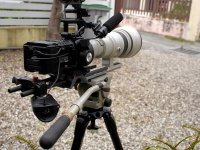

Now, what are the options with telephotos ? I personnaly work with beautiful Nikon 50 300 f4.5 and hefty Canon 400mm 2.8 (with TC X1.4 or X2) Max reach will be 800mm at 5.6. This is plenty... at least for me. Next problem is weight... At longest lens settings, my set up weights 15kg. Not very mobile, this is the real trade off perhaps. Or... as Sabsayachi Patra says, just hire Arnold Schwarzenegger for a day or two in order to relax / and or just go to some serious gym sessions before breaking your back...At least the full set up fits in my backpack for some sympathic if not painful daywalks...
Of course I have not been commisionned by Sony to write this. This is the sum of some 10 months field experience in rough conditions (did I mention the camera is pretty resistant to water drops and dirt etc..?) and the final thoughts ofan (almost) happy custommer (Sony if you're listining, give us 10bits over HDSDI please...)
Hope you enjoyed reading,
Alan
Numerous reviews have been made since its original release in 2012. I am not going to repeat what others said about this lovely camera. This review will put the Sony in perspective for potential wildlife filmmaking. This has been my choice when I started production for a 4X52' nature serie almost ayear back.
Now, being on the verge to release the first volume, I felt it might be helpful to others to share my thoughts.
But really, I don't pretend this cam to be THE professional choice... at all... Many established pros found the raw workflow with RED ONE / EPIC / SCARLET to be the best choice in Super35 sized sensor. Others found this format was not workable for wildlife because of data management, shallow DOF and long lenses reach, so they choosed 2/3 sensor with still lenses and/ or B4 lenses. After all, it is all very subjective.
So far for me, why super35 ? Shallow DOF, creamy bokeh, the ability to make your subject instantly pop-up was my main priority. I knew it was going to be painful though with focus tracking, and long lenses options. And really, focus is challenging (especially when you work both on Nikon and Canon lenses, it drives you nuts)
But, I questioned myself : AVCHD ? Why the hell Sony decided to put such an apparently « weak » codec in such a gorgeous package? That was my initial thoughts. If I can share with you something that I find now important... When you shoot everyday for a year on a single 52min doc, you end up with 100h of rush, or at least that is what happened to me. I've heard stories of wildlife film makers ending up with 120TB of raw data fora 52min.
For my project, I got a little 1TB AVCHD files. This is cost effective really, and easy to backup and edit... But well, I am not talking about grading...
Now, for the quality... I think images are gorgeous. It is 8bit, yes. But my naked eyes see lovely dynamic range (cinegammas 4!), superb color rendition, 50p motion clarity, smooth highlight roll off, extreme low light sensivity with low noise up to ISO 3200.
Here is an example of a sequence mainlyshot between ISO 1600, ISO 3200 and ISO 6400 (except for the landscapes introduction which was ISO 640) This is about the Kagu, an endangered flightless bird in New Caledonia.
https://vimeo.com/68891562
Many broadcast channels are OK with the FS700 picture quality. Stock footage websites gladly take it too. I have not had any problems to sell my stuff because of the codec. The thing is, a good sensor, with AVCHD on board coupled with Cinegammas is something well thought for quality / size ratio. I think this is the most cost effective codec on the market. Just grab a cheap 32gbSD and you good to go.
Now the real cons for me with this codec are the following : don't push up too badly the postprocessing, you have some nice little cosy room to grade, but depending on the look you want to achieve, noise starts to appear and footage can fall apart in some situations...
Also, there is that 8 bit banding. I film alot of birds in extreme contrast situations (+90° tilt anglein the canopy) and despite the nice roll off between shadows and highlights, banding shows up quite often with fine detailed subjects(feathers, branches etc...) This is an ugly thing. I simply avoid these situations now. It is not making my life easier, depending onwhich birds I am filming (some of them just like to be high in the trees, I have to find sweet spots to lower my tilt angle and avoid high contrast)
Apart from that, yes the codec islimited with color grading, but it is not that bad.
You are just a little more cautious when shooting. Every shoot needs to be extremly well lit (and consistently). I wished Sony would have done something more realistic concerning that upgrade. Just an SLOG2 10bit out on ext. recorder and this camera would have been fabulous... But this is another topic...
Super slow motion now. That was one ofthe reason I choosed this cam. Like most people I guess. Of course, I use slow motion alot... But not from what I thought it would be worth in the first place... I filmed lizards, birds, and small mamals in 240fps. At the end of the day, when I look at all my SSM stuff, I realize it is hard to shoot in that mode properly. I shot this doco in rainforests with low ambiant light ; at f/2,8 I can barely get a 1/215[SUP]th[/SUP] shutter speed, and at this shutter, motion clarity is not good... I found I needed at least a shutter of 1/600[SUP]th[/SUP]with an aperture of f/8 to get decent DOF and detailed motion. I can't afford to put 2K HMI's in the forest like... well, like Peter Jackson did for Lord of the rings
In fact, SSM helped me shooting landscapes and plants especially. The thing is this frame rate (when played back in 24p) cancels all vibrations, so I can shoot handeld beautiful travelings over plants and other little flowers... If you are cautious, your camera moves can really be nice.
I won't debate too much on picture qual at high frame rates. 240Fps shows less details, more aliasing, more noise. But at the end of the day, it is still beautiful, here is an example of SSM handeld traveling over a ferntree.
https://vimeo.com/68891564
The real deal with the high frame ratesis the fonction : END TRIGGER. Animals are not talents. You don't know when they are going to move, when they are going to do something interesting etc. The function END TRIGGER is a godsend because the camera continuously buffs, and this allow you to wait the behavior you are looking for in super slow motion. When the animal does something interesting, you just have to push REC, and what you were exactly looking for has been now recorded. With RED, I think you don't have this option...
Super slow motion leads you to another important thing in wildlife film making, as to know battery life...With the FS700, you need 2 batteries for a whole day of shooting with plenty of slow motion. Another cost effective strategy. REDs are known to be nasty power suckers with expensive proprietary redvolts.
Now, ergonomics...
This is something that has been debated over and over. This black box looks awkward at first glance. In fact,I am a huge fan of it
Once you get used to it, you understand how powerful and modular this cam can be. Every left pannel buttons canbe assigned to whatever you like (zebras, peaking, markers, ISO, WB,last scene etc), controls begin to feel more natural. I use a Kinoteknic EVF for focusing with FS700 internal peaking and thatcannot be better. There is no latency and resolution is plenty enough to focus accurately. Also the side hand grip which allows you to control REC button and expended focus is sooo handy when properly relocated (close to your tripod pan bar is a must). No ergonomic fiasco at all. It is just very well designed. It allows you to be fast and instinctive in the field.Now, what are the options with telephotos ? I personnaly work with beautiful Nikon 50 300 f4.5 and hefty Canon 400mm 2.8 (with TC X1.4 or X2) Max reach will be 800mm at 5.6. This is plenty... at least for me. Next problem is weight... At longest lens settings, my set up weights 15kg. Not very mobile, this is the real trade off perhaps. Or... as Sabsayachi Patra says, just hire Arnold Schwarzenegger for a day or two in order to relax / and or just go to some serious gym sessions before breaking your back...At least the full set up fits in my backpack for some sympathic if not painful daywalks...
Of course I have not been commisionned by Sony to write this. This is the sum of some 10 months field experience in rough conditions (did I mention the camera is pretty resistant to water drops and dirt etc..?) and the final thoughts ofan (almost) happy custommer (Sony if you're listining, give us 10bits over HDSDI please...)
Hope you enjoyed reading,
Alan
Last edited:


