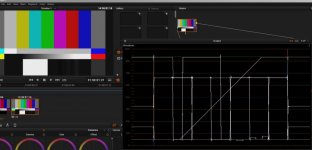
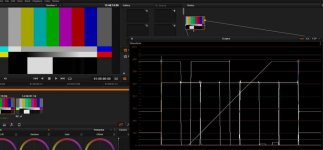
FS700 Colorbars recorded on O7Q and Pix240

cuervo

Veteran
Well this seems to be a chronic subject. I'm assuming CD has set the black pedestal and ranges according to some schema, but, here goes anyway....

I generated color bars in my FS700 whilst recording HD (note NOT RAW) out the SDI port to -a)a Sound Devices Pix240 in DNxHD; and -b) an O7Q in .dpx. Then imported each stream to Davinci Resolve for analysis.

First off, if left to Resolve's AUTO levels mode, the files were each scaled differently; and off the scopes. Therefore, both files were both set to DATA LEVEL (0-1023). This keeps Resolve from scaling the color ranges.

The results are a little mystifying. Attached are screen grabs of the WFM for each. The Pix240 records the full range of the colorbars, from super black to hi range.The nominal range is 64-940, but the pluge bar below 64 is also shown and recorded as superblack. The O7Q does two things, it clips the superblack pluge; and it has reset the range of the image to something like 0-900.
The first screengrab is the Pix240, the second is the O7Q.

As I said earlier, even if I leave LEVELS set to VIDEO, the same anomalous WFM result.
I repeated the import of each file into After Effects and looked at the WFM in Synthetic Aperture with the same result as Resolve.
ummm...Is this by design, or by default?
 

Attachments
  • O7Q.jpg
    O7Q.jpg
    49.5 KB · Views: 0
  • pix240.jpg
    pix240.jpg
    50 KB · Views: 0
Last edited:
Could it be the mapping to the resolve 10bit data levels wfm? Since its 8bit .dnxhd vs 12bit .dng u are comparing here.
 
"Could it be the mapping to the resolve 10bit data levels wfm? Since its 8bit .dnxhd vs 12bit .dng u are comparing here. "
​


sorry, I corrected the O7Q file type to the correct 8 bit dpx, not dng. The Fs700 won't send colorbars out the SDI port in RAW mode.
 
Last edited:
hmmm. i also detected some strange things related to exposing (some other thread in here) where i said u have to hit a virtually 125% ire to get it in resolve before 109 clipping. (rating the cam at 800iso). I thought it was only raw related (where a bug fixe should come in the february update) ... but when its also in the .dpx its strange ...
 
Have you tried opening the dpx in photoshop just to check Resolve isn't making assumptions about the file and truncating?

Mitch, it would be nice within the O7Q to perhaps be able to see absolute data values instead of % in some of the tools. The waveform is 0% to 109% which i understand in the context of video work but for monitoring RAW i don't quite understand the relationship. whether 109% is 100% 4096 RAW.

cheers
Paul
 
Paul,

Yeah, I looked at it in Photoshop. The superblacks are being clipped off. There's no way to recover them by raising the offset.
 
So in the real world, does this have a big impact on image? Obviously you want to gather as much information as possible, I'm just wondering if the other benefits of the 7Q's RAW outweigh the super blacks clipping (my only recorder is the 7Q)
 
It's more than just losing the detail in the shadows. The vectorscope is funky, too, i.e. the colors aren't right. I am somewhat of a perfectionist. If nothing else, I think it's important to understand what's going on. A professional piece of hardware has to be accountable. There's no excuse for any other performance. It's not like this is something I bought at Target.

The practical perspective is that I don't really care about dpx. It's way too big file size to be very useful, and it's still 8-bit for the FS700. But, I have to ask what the implications are to the way RAW dng has been implemented. Since I can't run colorbars out to RAW, I have no real way to check it.
 
Last edited:
It's more than just losing the detail in the shadows. The vectorscope is funky, too, i.e. the colors aren't right. I am somewhat of a perfectionist. If nothing else, I think it's important to understand what's going on. A professional piece of hardware has to be accountable. There's no excuse for any other performance. It's not like this is something I bought at Target.

+1 in terms of just knowing exactly what's going on with the signal, although CD are a lot more forthcoming than any other similar company.

RAW is new territory for us both in terms of what the 700 is actually pushing out and also in terms of how the O7Q is dealing with it. The fact that it appears that the 700 is pushing out an elevated black level is unusual IMHO and i'd love to understand why. I'd love to see a simple RAW dump of the values (a direct DPX of the linear RAW would be ideal, without any luma rescaling or anything). The cDNG format is obfuscating the data because of how it works and you need to run it through an unknown black box process to get the full data out (i.e Resolve).

It's just knowledge, it pays to understand what the camera is doing in any given situation

cheers
Paul
 
The fact that it appears that the 700 is pushing out an elevated black level is unusual IMHO and i'd love to understand why.

I thought the original post was indicating that the 7Q is clipping the black levels, but the Pix240 isn't. So it wouldn't be that the FS700 is pushing out elevated black levels but rather the 7Q isn't capturing the full range. Is this right or am I missing something?
 
you got it right, Josh, for the 8-bit HD .dpx recording. The 10 bit RAW .dng is a different animal. Right now, the "black" level with .dng seems to be around 20% IRE. And the conjecture is that this is what's coming out of the FS700. That says nothing about how the O7Q is recording super-blacks, however, or if it even is. All I can say is that the FS700 is sending out the right signal level in HD mode; and the O7Q is clipping.
 
Back
Top