FS7: FS7 and PL mount - E-mount strong enough?

frnkensteining

frnkensteining

I don't know about other rigs but the tilts rig has an adapter support built in. And every adapter I own (5 of them) has a lens support socket. Within reason it shouldn't be a problem with any but the heaviest cinema lenses.
That's what I mean- now you need to rig up the support for the adapter in addition to the support for the camera and the lens.
All because of poor engineering...
There is no question you can work around it- the question is wheather you should...
 
That's what I mean- now you need to rig up the support for the adapter in addition to the support for the camera and the lens.
All because of poor engineering...
There is no question you can work around it- the question is wheather you should...

Wow, the answer is pretty complicated. I've run many Finite Element Analyses(FEA) on overly constrained optical systems(statically indeterminate). With the camera fixed to the baseplate/rods, and the lens fixed to the camera; and, then fixed to a support system, you now have an overly constrained optical system. Obviously, for R&G, there aren't many options, once the lens mount is designed. It is possible to crank down on that lens support enough to distort the lens mount. Maybe I'm nit-picking, here, but, after spending thousands on quality glass, the level of performance is affected by these issues. Of course, with inexpensive optics and hardware, none of this matters, anyway.

A properly engineered lens support system should include flexures (calibrated spring constant support) allowing a DOF in the proper load paths. I don't know of ANY lens supports that incorporate this feature, leaving things up to the calibrated fingers of the DP.
 
Last edited:
That's what I mean- now you need to rig up the support for the adapter in addition to the support for the camera and the lens.
All because of poor engineering...
There is no question you can work around it- the question is wheather you should...

For the tilta the support is built in and not something separate to rig. When I'm using my Zeiss PL primes the adapter is just part of the camera and no need for lends support.

The advantage to the e mount is you can use nearly any lens intended for s35.
 
Don't get me wrong- I totally understand the economics/advantage of legacy peripherals: alpha lenses (with Sony's own adapter), e-mount lenses, interchangeability across the product lines, common communication protocols. Maybe it was the correct business decision, albeit still poor engineering solution- utter compromise IMO...
 
Ill buy that . Very attractive but inherently unstable. Screwed if you do screwed if you don't. The budget solution and I'm stuck with it. Add to that how many of us are shooting cine style with DSLR glass. Its amazing it looks as good as it does and we don't get screwed more often.

I guess that's what I'm selling though!
 
Sony FZ mount is designed for adapters:
Big, strong, locking tightly.
That's why I made adapters for it.
FS7 is a sizeable camera with flimsy spring pressure based mount. That mount was designed for small 1lb or so cameras. It's a perfect mount for DSLR size and weight cameras- especially mirrorless - even lighter.
You combine this mount with sizeable camera like the FS7 and there is focus trouble looming.
Another words:
Small camera+ flimsy pressure based mount = OK
Video sized camera with flimsy pressure based mount- not OK. IMO it's a poor engineering decision from Sony.
But who am I to judge- they sell like hot cakes ;-)))


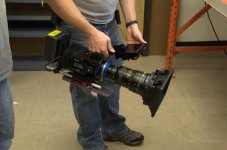
I think the answer to the OP is- ALWAYS use lens support when possible.

Probably not the type of answer sought, so I will say that myself and many others are using EF glass up to the 70-200 on the Fs7 without any problems. As far as PL mount glass, it depends on how beefy and how long the lens. A DP rouge PL is going to be less worrisome on e-mount than is a Cabrio PL.

Zeiss CP2 with PL adapter on e-mount is likely not as problematic as if Schneider Xenar III PL on e-mount.
 
Of course a PL adapter must be supported on an E-Mount. The question is how is it supported.


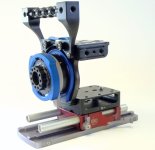
Without rails, I would recommend something like Wooden Camera's PL Mount Pro + their Top Plate. The PL adapter has a ring that attaches to the top plate, providing extra support for the mount.

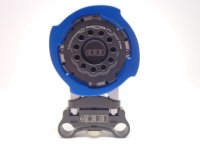
I built an PL mount with support in 2010 called the Double Mount which concentrically supported the PL mount and transferred the stresses to brackets on the top and bottom of the camera. It took some time to get it installed and adjusted in a way that applied equal support around the mount so it did was planar and rigid. It was not cheap, but it was very robust and accurate while still being able to swap it out for other mounts. We had an additional design that was Canon on one side and Nikon on the other with control electronics. It was a market test on the FS100 at the time and the market said very loudly - "I want cheap stuff, not this crazy engineered properly stuff". So I stopped.

thanks everyone. Looks like the Wooden Camera setup is the way to go, although it does add $800-900 to the cost of the camera

2010 - concentrically supported E to PL mount.
hams7ztbefszbbqxmsrj9xuofzz3kkmv.jpg

Look mom....no iris rods!
v176xncpjn4wdexrfl1ikxxbsin4wufr.jpg

Anyway...we continued to make PL Adaptors with double supported 15mm brackets. in my opinion, supporting a PL from iris rods is a compromise. First, because the iris rods do a terrible job of providing support when they have follow focus and matte-box pulling and pushing the rods all over the place. All that energy gets pushed into the mount creating optical issues and/or damage. I put some effort into making the 'best' iris rob support for our PL mounts by putting two adjustable supports in addition to the tie-down screw. This prevents most of the torsional forces from being transferred to the E-Mount as well as lateral (left/right) support. Still not ideal, but it is WAY better than a single point support. I also have centering jacks on the mount itself to give the user the ability to match the mount center to the optical center of the imager. No other mount bothered or even knew that was a needed feature - especially for zoom lenses.

q750mim6tybjo3n1yb25jamdulpf6pkx.jpg

As a few have already stated. PL Mounts and the usual PL lenses mating to a small and flimsy camera is not a trivial task. PL mounts should not be considered an "accessory" but rather a critical component of the system. The mechanics are (or should be) complex and the manufacturing is a total pain in the butt. I was the one personally machining these things to flatness of about .0002" - 2 ten thousandths of an inch. That is a different thing than just putting a block into a CNC machine and pushing the GO button. MANY (MOST) of the mounts I have seen in the wild are not great. So why bother with a $60k lens and put it on a geometrically random mount?
 
Last edited:
Thank you for bringing up the CineLock story. :cry:
The real name is "The Wedgie" but it was shut down by marketing.

Somehow, I need to turn nuts into cash. Have not figured that out yet.
 
Greetings from Brittany !

I have a dumb "FS7/E-Mount/strong enough" question :

- What about the native heavy E-Mount PZ 28-135 mm ? Any risk with this kit lens ?

Thanks for sharing your light with me.
 
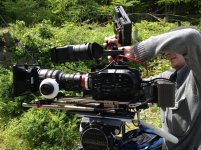
Wooden camera PL mount, 19mm studio rods on FS7 and Canon 17-120. Don't know how long it would survive but considering the lifespan of cameras these days...

Carlos designed a great PL mount for the FS100, but it was an inexpensive camera to begin with, and most owners' accessory budgets were set accordingly.
 

Attachments

  • FS7.jpg
    FS7.jpg
    186.2 KB · Views: 0
Thanks Nsoltz,

But doubt still exists, when Lucas Kao writes (not alone on internet) :
if you are thinking of putting modern cine lens like Cooke, Arri Master Prime, or lens heavier than 1kg would definitely suggest using lens support or lens adapter with build in support.
PZ 28-135 = 1,215 Kg.
 
Last edited:
Thanks Nsoltz,

But doubt still exists, when Lucas Kao writes (not alone on internet) :

PZ 28-135 = 1,215 Kg.

Given that the PZ 28-135 is sold as a kit lens for this camera, Sony must be confident the mount can support it. Otherwise, the risk of warranty claims and even after warranty "not fit for use" claims would be too great. That said, the 28-135 does come with a collar and support bracket, so it is entirely possible to support it if you so wish.

I have the 28-135, and the mount seems firm. It also seems firm when using Arri Ultra Primes, but I definitely wouldn't put PL zooms on without a support bracket.
 
The kit lens is fairly lightweight and relatively even weight distribution. I would guess that Sony is confident that the static weight is ok while the camera is operated on a tripod. If it were my money on the line, I would figure out a way to support it to better deal with all the inevitable bumps and bruises from regular use. Just because Sony makes the lens, does not mean it is strong enough for every scenario.

In general, PL mount lenses are far heavier and most of the weight is at the front end furthest away from the mount. The PL adapter pushes is even further way from the mount. As the mass gets further from the mount, the pressure to hold it together ends up on only two (tiny) screws on the top of the E-mount ring. The bottom of the mount is under compression since gravity is trying to peel the mount off the camera - not pulling it straight out. The same is true for the lens itself.
 
And of course everything you read on the internet is correct.
Since monkeys can paint some pipe dreams on a wall, i don't give a crap about human truth, Ned.
Except when the truth could compromise my projects.

Thanks everyone ! For your prompt and exhaustive suggestions.
Time to study now.

Best regards.
 
So let me get this straight... this implies that the FS7 lense mount is NOT solid milled magnesium like earlier cameras, but of PLASTIC that flexes?
 
The lens support could be as solid as they come, but if the weight of a lens is heavy enough and the lens is long enough to cantilever it out from the mount, then the frame of the camera itself can have flex. And if that happens then the lens position relative to the sensor will shift.

I honestly have not followed this thread much, but having worked in this business for nearly 30 years as a DP, as a guy at a rental house, as a guy at a sales facility, and as a manufacturer I can tell you that if you are smart you should solidly support a PL lens mount. That means a plate of solid metal that goes under the camera and connects both to it and the lens mount directly or to the lens mount via a front rod bracket. By giving multiple points of solid connection the flex is eliminated from any lens one might deem handhold-able. If the lens is designed to have support, then support the damn thing, because an engineer knows more than you do about physics and stress.

This is not complicated. You can try to make it seem like it is and you can try to argue it, but you are wrong.
 
Back
Top