Freefly Systems Camera Launch | Wednesday, October 7th @ 10 am

Don't provide your food/beverage guy lighting advice if tens of thousands is the number you've calculated.

That's literal, right?

I think you're mixing up literal and exact. It would literally cost him tens of thousands. How much exactly?

Well, he's got several arri L5s that draw 115w and he's lighting 2000 ISO 13 stops of DR at 1/480. (He also has other panels and fresnels.)

Let's assume hes going to 960fps on an ISO 250 camera with 11 stops DR. His key needs to be 5 stops brighter.

Assuming a consistent lumens/watt across lights, he needs a 3680w LED (or to move into flicker-free HMIs).

The biggest LED B&H sells I believe is the mole Richardson 1600w tener for $10k, not even bright enough to match his exposure settings. Four of those is $40k.

Meanwhile, his fill needs to come up by 7 stops due to lower DR, so I think that even his most powerful lights would be inadequate for fill and need to be replaced.

Long story short - just because you can afford the camera doesn't mean you can afford the lights if you want to light something cool. Sam said he used 6000w of LEDs with the phantom.
 
Doesn't that just prove my point about the lower standards for sports highlights? And aren't they shooting rec709?

My GH5 has about 10 stops and I shot some sports and plenty of reflective things. My only issues were skies, clouds, sun, windows. Everything else was ok

It's not low(er) standards. It's the reality of the situation. They could be shooting with 16 real stops of DR and still not cover a lot of real life stadium situations. I've been shooting sports my entire career. There are situations that the human eye struggles with, much less a video camera.
 
It's not low(er) standards. It's the reality of the situation. They could be shooting with 16 real stops of DR and still not cover a lot of real life stadium situations. I've been shooting sports my entire career. There are situations that the human eye struggles with, much less a video camera.

I dont mean lower standards in a negative way. I just mean that they're not going to be able to even out the lighting levels, so they accept the contrast. Nobody turns off their set because of blown highlights in the outfield. So, I feel like the sports slow mo camera could get away with lower DR than the food/beverage camera which will really want to have everything balanced. You can light in tabletop what you cant light in a stadium, but it costs
 
Long story short - just because you can afford the camera doesn't mean you can afford the lights if you want to light something cool. Sam said he used 6000w of LEDs with the phantom.

...
When I shot with that I had 600w of LED within 40cm of the subject.

I think at 1500FPS world the tech does not allow you to be a chooser - you take the ISO and DR you can get :)

Unless it was a typo.
 
Unless it was a typo.

My bad. I dont think this guy lights that close. The inverse square law will give you deadly falloff on a set a couple feet wide. Plus his modifiers eat a lot. Obviously, you can shoot food/beverage with the camera. But the guy I work with would need to put at least $60k into lights to replicate what he's doing right now, and he isn't even that high end. He definitely uses more than 600w of LEDs to shoot 240fps
 
Last edited:

That's kind of my point...you can light a tiny flat surface stylelessly at ISO 800 wide open. And that's what we'll be seeing a lot of.

Standard food/beverage is like a frying pan with ingredients around it and you need enough DOF to focus from one end of the pan to the other. I'm sure people can be creative and do cool things with low powered lights, but they'll never get real food/beverage gigs
 
Your point is to debate just to debate because you're bored.

If I tell you my favorite food is pizza you'll tell me it's hamburgers.

___

You talk numbers and theories and hypothetical situations without ever experiencing.

There are very powerful lights out there for no more than a few thousand dollars in which you could use with 480fps and the lower ISO at smaller apertures.

You may need to spend a bit more, sure...but your thought-process for the budget is outrageous.
 
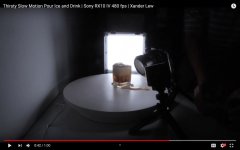
1400fps and lights what appear to be 5-10 feet away...yeah, they'll need some power.

(The champagne setting changes its light set up.)

Plus, a piece of content like this from a studio is going to have the works and not dinky LED lights that will not impress anyone.
 
I guess my question is who has the budgets for someone to shoot super slow motion of their food or beverage but then their product doesn't actually look that good because the shooter didnt bring a lot of lighting control to it? Who's going to pay good money for that? They have high standards. (And a food stylist is $1k+/day anyway). And if you get a low budget client to hire you like this then is it a win? and if you can afford to light and style it properly, maybe you could have afforded a phantom rental in the first place?

Another way to put it, somewhat simplistically, is let's assume that you have adequate lighting for ISO 800 T4 1/50 with lights at 10 feet. Now you want to move to ISO 250 T8 or 11 1/2000 with lights at 5 feet. How much will it cost you? You need to scale your key up like 6.5 stops
 
Last edited:
I guess my question is who has the budgets for someone to shoot super slow motion of their food or beverage but then their product doesn't actually look that good because the shooter didnt bring a lot of lighting control to it? Who's going to pay good money for that? They have high standards. (And a food stylist is $1k+/day anyway). And if you get a low budget client to hire you like this then is it a win?

It doesn't have to be either/or. Tasty (studio from link) might have their phantom, then add 8x waves for cheaper multi cam.
 
Yous guys should not be talking about shooting food and beverages.

You should be eating and drinking more.

PS. I am hungry.
 
It doesn't have to be either/or. Tasty (studio from link) might have their phantom, then add 8x waves for cheaper multi cam.

That would make a lot of sense, but it doesn't solve the "I bought a wave, now I'm a food and beverage photographer" problem

The guy I work with said one client tried to undercut him and hired a young shooter for a fraction of the price. But his **** was all out of focus supposedly (inadequate DOF?) So they came back to him in the end. Even if it had worked out for that young gun, he wouldn't have been getting the good money that lures people to that field

Are we sure that's a real problem?
 
Alapert

Bascially you have made a good point - that lights can get (super) costly for this camera or the phantom.

A typical owner op who bought this would basically be able to do midday stuff or bottles CU stuff. Maybe not the greatest business offer.

One operator I saw testing his stuff by shooting 100 FPS at 2000shutter (on a DSLR) to previs his HFR work before the expensive rental camera arrived.

I was shooting brown fizzy liquid for a big company yesterday at 25p on a BM 4k maybe 400ISO and my 'puny' $4000 of light (600w in total) got very thin once bounced

Im gonna buy that 200w godox which will give me a bargain lift or lumens!

S
 
My anquantance who sells IDT hfr cameras also sells lights.. stadium LEDs.

Thier lumen per $ is far better but they are pretty green makeing them challenging for cinematography. The largest market for IDT is destructive testing where a green cast is no problem.
 
Wildlife probably between those two categories.

In certain situations and in some forests I can make it work. Since late 2012 when I first picked up a C300, we have been spoilt with high ISOs and I don't often go down to ISO 250. May be at times one can't use the 180 deg shutter. In rainforests the light is generally low. However, in other ecosystems like deserts and mangrove swamps when we roam around the entire day, I can find use cases. One can also make some creative uses. Indiefilms will put this to use. There are lot of nonsense soaps in TV, and they need to stretch it to fill the episode. I am sure those guys will use this camera as well.

The lockdown in 2020 has made us do video calls in much lower resolutions. So guess some people would automatically be comfortable using lower quality footage. So those who can't afford Phantom can definitely use this one. I think this is a good start by Freefly guys and hopefully they will improve upon this offerings. I wish them all the best.
 
Back
Top