Found 2 fantastic examples of the F23 in a feature film setting

Mike Krumlauf

Award Winning Filmmaker
Thanks to the cinematographers database, I tracked down two films which were shot completely on an F23 and I'm honestly surprised by the results. Trying to track down making of materials with no luck on both pictures but here are the trailers.


I haven’t seen the movies, but I will search them and check them out. Difficult to judge from some of these trailers. Sometimes they’re cut before final grading...

Let me know if you watch them. I’m curious.
 
I watched Kill the Irishman on Netflix Saturday morning and I enjoyed it. An indie Goodfellas.. as in it had a major Goodfellas vibe but wasnt nearly as good. Cinematography was solid though. The only thing that made it look like video at times was the depth of field
 
"The only thing that made it look like video at times was the depth of field"

-You have answered the F23/F35 debate for yourself.
 
"The only thing that made it look like video at times was the depth of field"

-You have answered the F23/F35 debate for yourself.

I wasnt trying to answer that with this thread lol. F23 has DOF close to 16mm and F35 has 35 dof. One is not always better than the other.
 
I wasnt trying to answer that with this thread lol. F23 has DOF close to 16mm and F35 has 35 dof. One is not always better than the other.

16mm always had the grainy look associated with it, which we used to work hard to overcome back in the day--now I am seeing a small but notable percentage of filmmakers embracing it (and often preferring it to 35mm) for just that reason. However, 2/3" video didn't really have much sex appeal visually. We were often trying to shoot long lens to throw the background out however we could.

It's interesting to think about Panavision's mid-80's attempt to make a cinematic 2/3" camera with the Panacam. Too far ahead of its time--the weak link was the analog tubes.
 
16mm always had the grainy look associated with it, which we used to work hard to overcome back in the day--now I am seeing a small but notable percentage of filmmakers embracing it (and often preferring it to 35mm) for just that reason. However, 2/3" video didn't really have much sex appeal visually. We were often trying to shoot long lens to throw the background out however we could.

It's interesting to think about Panavision's mid-80's attempt to make a cinematic 2/3" camera with the Panacam. Too far ahead of its time--the weak link was the analog tubes.

The Panacam! I remember seeing a PDF about it awhile back. The thing had an optical viewfinder which I thought was interesting, but, I believe it still just ran at 60i correct? The first 24p camera was the F900 which Panavision modified for themselves, the HD900F which I owned for a short time. The image was near the same as a stock F900 but man those external modifications really beefed up the camera. Their handle felt a lot more solid than sonys.

I wonder if Panavision has one of those PanaCams on display at their Woodland Hills office, or if they just pretend it never happened. lol I havent even been able to find anything shot on it.
 
I wonder if Panavision has one of those PanaCams on display at their Woodland Hills office, or if they just pretend it never happened. lol I havent even been able to find anything shot on it.

They do have one in their lineup of cameras that are out on display. But you aren't wrong about their philosophy, there have been a few things from their history that some there have pretended never happened, like the Panaglide, their knockoff of the Steadicam.
 
I wasnt trying to answer that with this thread lol. F23 has DOF close to 16mm and F35 has 35 dof. One is not always better than the other.

F23 DOF is not that close to Super 16mm, mainly because the prism on all B4 sensors is limited to f1.45 or T1.6. So, right off the bat, that limits how fast you can go.

In Super 16mm terms (comparing the same aspect ratio), it's like only shooting as fast as T2.1. That's about a 1.3 stop difference from T1.3

In F35 terms, it's like being able to only open up as fast as T4.

In fact, technically, F23 DOF is closer to unmodified Super 8mm than it is to Super 16mm.

F23 sensor size: 11mm (9.59mm x 5.39mm)
S16mm size (16x9): 14.36mm (12.52mm x 7.04mm)
S8mm size (16x9): 6.64mm (5.79mm x 3.26mm)

While Super 8mm is much smaller than the F23, it can use faster optics. The Canon 310 XL, for instance, has a f1.0 3x zoom lens.

f1.0 x 1.45 equals f1.45 (about 1.07 stops difference). So, an f1.0 lens on the 6.64mm size film of Super 8mm would have the same DOF as a f1.45 lens would on a 9.63mm piece of film (6.64mm x 1.45).

11mm / 9.63mm = F23 is 1.14x bigger than S8mm
14.36mm / 11mm = S16mm is 1.31x bigger than F23

So, the F23 is closer to Super 8mm film than Super 16mm film. And that math is taking into consideration the use of a f1.45 lens on Super 16mm.

If, instead, you were using a f1.2 lens on Super 16mm, that would have the same DOF as a f1.45 lens would on a 17.38mm piece of film. (f1.2 x 1.21 equals f1.45 - about .55 stops difference. 14.36mm x 1.21 = 17.38mm)

17.38mm / 11mm = S16mm is 1.58x bigger

So, the F23 looks 1.14x larger in size than Super 8mm film, but Super 16mm looks 1.58x larger in size than the F23. That's a big difference.

F23 is definitely limited in DOF.
 
"One is not always better than the other."

Agree to disagree, the high end of cinema cameras would disagree with you also. Larger Sensors produce more pleasing images.
 
They do have one in their lineup of cameras that are out on display. But you aren't wrong about their philosophy, there have been a few things from their history that some there have pretended never happened, like the Panaglide, their knockoff of the Steadicam.

Stumbled across some Panaglide test footage a few months ago. Definitely a different look. More "floaty", which from what I gather, was one of the complaints. But the camera/sled had some pluses...
 
Part of the reason for the look was simply that operators were less experienced back then--you didn't have many 10-15 yr Steadicam veterans in the 80's when it was most used! It wasn't great mechanically--the arm and vest were terrible (so most operators used their Steadicam ones, which were thankfully compatible) and the gimbal wasn't great. But it had internal cabling, a 24v battery and a streamlined design.

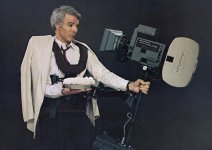
The story behind the Panaglide is certainly an embarrassing piece of Panavision's history--you can read about it here. The pictures in that article are of the original model, this is one of the better ones of the later model ones although the monitor had been removed for the photo session (promo shot for The Jerk):

the jerksmall.jpg
 
"One is not always better than the other."

Agree to disagree, the high end of cinema cameras would disagree with you also. Larger Sensors produce more pleasing images.

That is a purely subjective statement there... I find beauty in all forms of capture. There are Mini DV films from 2002 like Personal Velocity I still think is beautiful.
 
Well I wasnt trying to make this thread a place to just crap on the f23 and call it useless which it seems some of you are doing. I feel we should celebrate all ways to capture an image as I feel everything from super8 to mini dv to alexa lf can make a beautiful image in the right hands. I dont really agree how some people here have an ego to **** on the f23 and then praise the f35. Really? You know if a client wanted to do something experimental with a PD150, i'd be game for it, ready for the challenge going back to my roots from the early 00s. We need to celebrate each others gear and love of the process of filming instead of downplaying how someone might work or what they shoot with. My 16mm DOF statement comes from a madrid of DOPs i've talked to over the years both in the US and UK that compare 2/3" to 16mm as the closest film format in terms of FOV. I know a few people still working full time in the 2/3 space for music videos and such.
 
I really enjoyed Kill the Irishman. Hadn't the foggiest idea it was shot digitally (which feels surprising given it was on a 2/3" sensor). Evidently they handled it really well.
 
"One is not always better than the other."

Agree to disagree, the high end of cinema cameras would disagree with you also. Larger Sensors produce more pleasing images.

I would disagree to that blanket statement. Larger sensors can and often do produce more pleasing images, but they don't inherently do that. They are, of course, part of a chain of elements that contribute to the image. What if the very pleasing lens I want to use just won't cover the Alexa 65 or the LF? On top of that, he was mainly talking about DOF, and yes, you may want an entire project to be deep DOF.

Well I wasnt trying to make this thread a place to just crap on the f23 and call it useless which it seems some of you are doing. ... My 16mm DOF statement comes from a madrid of DOPs i've talked to over the years both in the US and UK that compare 2/3" to 16mm as the closest film format in terms of FOV. I know a few people still working full time in the 2/3 space for music videos and such.

I'm sorry - I realize I was too terse in what I wrote previously. I myself wasn't trying to call the F23 useless - I just wanted to back up why DOF was/is such a huge issue on it. I've actually wanted to own one for a while now, but DOF is one of its biggest limitations.

I have a bunch of B4 lenses (including the Fujinon HAE 5-15mm T1.6) and have done the math so many times about DOF and have seen mathematically that it is not that close to S16 at all. You just can't escape that (unless you want to shoot with a DOF adapter - kidding). The DOF difference between the F23 and S16 is actually greater than the difference between the F35 and the Alexa LF, for instance.

I've thought about buying some Digiprimes (since I currently have 3 B4 adapters), but it just doesn't make sense to me to have prime lenses that start at f5.6 in full frame terms. That is really limiting.

However, to me one of the appeals of the F23 is that the dichroic filters on the prism are gathering a much wider (and more accurate) gamut of color than the filters on a bayer pattern sensors can let in. That is one of the things it most likely still does better than current cameras.

Also, any negativity towards the F23 (at least from me) is regarding the device itself, not your choice to own one. We've all seen folks make amazing works with imperfect tools, because it was the right one for the job or the right one for them, or because no tool is perfect. :)
 
f/5.6 in full-frame terms is f/4 in S35mm terms, and that's a space I live in DoF-wise all the time. I don't think that's too limiting to be honest (and perhaps explains how some of these 2/3" films got away without feeling noticeably deep-DoF, they were probably shot mostly wide-open).
 
We've all seen folks make amazing works with imperfect tools, because it was the right one for the job or the right one for them, or because no tool is perfect. :)

Absolutely. I mean I understand that back in the hay day of digital when things were first starting, filmmakers had no choice to use DV or 2/3' like the F900 either because they could not afford film or in the digital world thats all they had, but, I feel like some of those films really stuck out in a good way and had a personality all their own where as now, digital is as good if not in some ways better than film with modern cameras and everything is starting to look the same in a way. The FOV is the same, color, etc, etc.. the smaller sensors really did and do have their own unique look which can complement some projects very well compared to 35mm fov. I think one of the best examples was this little indie film with Don Cheadle called Manic. Came out in 2001 I believe. It was shot on PAL Sony PD150s and the immediacy and grit of DV really complimented the narrative very well. 35mm or even F900 would have been too proper for such material. The same time, a film like Tadpole with John Ritter looked downright horrible but was shot on the PD150 for budget reasons as it was part of the InDigEnt pipeline. That company would later go on to make amazing looking DV films like Personal Velocity and November. I believe Personal Velocity won best cinematography at sundance and that was PAL PD150 as well transferred to film for projection. Hell I think blair witch project is a good example of low res video (Hi8) used well too. At the end of the day, if you are trying to tell a story, the story is what matters most and the camera in the digital world is just as important of a pick as film stock is in the film world. Every digital camera has their own film stock if you will, its own set of tools to help you reach your endgame. Its up to the filmmaker to pick whats best.
 
Back
Top