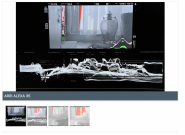
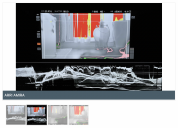
First pics and leaked specs of Arri's new Alexa 35

Well I will break down and be the first to say it.... but I was hoping for larger improvements.

Dynamic Range increase is great in any camera, but how much highlight recovery is necessary on top of an Alexa Mini or Mini LF? Consider Arri's use case, which is typically large production jobs with a gaffer or two and ample access to lighting / grip. I really see highlight recovery and maximum dynamic range only being beneficial on run and gun solo style shoots (think event coverage or cheaply produced docs) where you can't shape light, which is kind of the opposite of arri's typical use case.

I was also kind of wishing for maybe a global shutter, with the creation of an all new sensor but wasn't banking on it. I really see global shutter as superior to rolling shutter but I understand there are constraints with both, but that is something I absolutely adore about my RED komodo.

Frame rates are also not impressive as much as they were teased. 75 fps at 4.6k full height and 120fps max (even at 2k) it appears. The original Alexa mini even shot 200fps, but maybe we will see a HFR license released or this increased via a firmware update at a later time.

In comparison, my RED Gemini shoots 96fps at 5k full height and 120fps at 5k (2.4:1), tall S35 sensor great for anamorphic, dual ISO (lowlight performance), better data rates (RED wavelet compression), and is almost 4 years old now and going for about 15k for a kit, which is an absolute steal compared to a few years ago. You can even pick up a brand new V-Raptor (8k/120) with large format sensor and very clean shadow performance all in a small little package for sub 35k for a kit. The competition is getting pretty stinking good and we know a black magic 8k updated pocket or box camera is right around the corner as well.

Now we are all aware image quality is not directly proportionate to resolution, frame rates, etc. but I am curious on what the pricing will be for this new Alexa mini 2, because with competitors cameras becoming much cheaper and pushing the limits on resolution, frame rates, and slowly increasing their dynamic range and with the popularity of the original Alexa Mini, which will most likely get you very close to the image fidelity and color signature of this new 4.6k mini..... I am just not sure how much interest there will be to owner/operators like myself. If anything I would think the original Alexa Mini would become an absolute bargain after this release as they are already breaking the 40k mark and I have seen kits going for 35k.

To be honest, I know my expectations were probably too high, but I really was hoping for a 6k arri sensor... I guess I will just have to wait for a few more years, or for whatever the Alexa Mini LF will become in its next iteration.

Another consideration is the transition from gold mount / v-mount to b-mount. Many owner/operators would have to unload all of their investment in batteries in order to transition to the new 24v design. This could add considerable cost for those who have significant investment in batteries and chargers that they have acquired over years of production, which will not interface with this new cam. The newer media (codex cards) are not cheap either. MVf-1 vs MVf-2 viewfinder is an increased cost as well. So in order to transition from the original mini to the updated mini, these components will all add significant cost just to get an extra 2 stops DR (is this even usable) and a slight bump in resolution.

The most interesting takeaway from all of this is that Arri still believes in S35 and 4k resolution being "good enough" for even the best, which is a breath of fresh air with all the popularity and "fan-boyism" for large format and high-res acquisition (RED cough cough) in a world where most people watch video streams on iPhones or 1080p tv's.

Good to know that s35 and low-res will live on for at least a few more years.
On the contrary, resolution and frame rate are pillars of image quality, alongside bit depth, color gamut and dynamic range.
 
And then the next thing is the workflow over the image quality, if the image quality is "good enough". And then one wonders in the "consumer cameras" have a better workflow, which can save a lot of man-hours on the set.

Pretty sure you have it backwards
 
Another consideration is the transition from gold mount / v-mount to b-mount. Many owner/operators would have to unload all of their investment in batteries in order to transition to the new 24v design. This could add considerable cost for those who have significant investment in batteries and chargers that they have acquired over years of production, which will not interface with this new cam.

Can't you still use gold mount batteries with an adapter?
 
I don't mean A7SIII but something like FX-9 and C500 MKII types.

Ah. It's not my area of expertise, but I recall folks like Brawley saying that the comprehensive ecosystem of arri and arri-compatible accessories does wonders for the workflow. Especially since the gear is durable and widely-known to assistants. So it's important the camera be able to slot in to that toolset

But if you're talking about specific features that can be found on other cameras, I'm sure there are some that alexa-users miss. But they're not as important as the aforementioned ecosystem or the general reliability of the camera

as far as image quality being "good enough," I'm guessing that you have to get at least as good as the new arri before further marginal improvements go unnoticed or unappreciated. I mean, fs7/a7siii/fx3 is "good enough" for what I do, but only because it's held to a lower standard than a streaming drama...
 
, I just don't think 99% of ordinary people watching films will even notice an increase of 1.5-2 stops of DR, or even care about slightly more blue recovered in the sky, or slightly more amber in a flame.

People feel the difference even if they don't consciously notice why or understand anything about the underlying technique and technology. We would be better off debating what we find pretty or artistically appropriate for a project imo. If we can't discern a difference then it's moot
 
People feel the difference even if they don't consciously notice why or understand anything about the underlying technique and technology. We would be better off debating what we find pretty or artistically appropriate for a project imo. If we can't discern a difference then it's moot

highlight handling isnt really unconsious. my FS100 put cyan or orange rings around specular highlights that my mother would spot and ask about.. not a camera nerd thing.

as CP says until we can compete with the sun with fill lighting (mini nuclear giga watt lights?) there will always be huge contrast ratios to deal with.
. Assuming the Alexa 35 has 8.5 stops of highlight latitude, a key light metered at 400 lux would cause the camera to clip out at 400x2^8.5= 144,815 lux. That is above the brightest sunlight (120,000 lux). The camera should be able to hold highlights(windows) even with low levels of indoor lighting
 
Ah. It's not my area of expertise, but I recall folks like Brawley saying that the comprehensive ecosystem of arri and arri-compatible accessories does wonders for the workflow. Especially since the gear is durable and widely-known to assistants. So it's important the camera be able to slot in to that toolset

But if you're talking about specific features that can be found on other cameras, I'm sure there are some that alexa-users miss. But they're not as important as the aforementioned ecosystem or the general reliability of the camera

as far as image quality being "good enough," I'm guessing that you have to get at least as good as the new arri before further marginal improvements go unnoticed or unappreciated. I mean, fs7/a7siii/fx3 is "good enough" for what I do, but only because it's held to a lower standard than a streaming drama...

Of course and that's why Alexa has been so dominant in high end production. And why this will be headed straight for it.

However, no all production is high end. People have managed to work around some limitations and avoid others. And their YouTube videos are getting better and better.
 
I've gotta say that I'm excited for the new Alexa 35 even if I never get to use it. I'm excited just as a viewer. I've never felt that the Alexa looks as good in daylight exteriors as film does, particularly the colors of the sky. Maybe it pertains more to color depth or some intrinsic difference of the photochemical medium. But I'm excited for the improvement in image quality that I anticipate seeing in movies and shows that use the new camera
 
i cant see what hes doing here?

anyway it should be hello shadows.

get a windo with skysrapers outside, then a model inside at maybe 40 degrees to said window

expose the skyskrapers just below clip

dodge up the face (in post) to normal skin level

inspect face for noise.

testing cameras is simple yet most dont know how to do it. esp cineD and Mathew Dullard.

whats the value in filming a net curtain? net curtains are what you throw in shot when you want to hide blown windows. the fact he seems to recover the grey curtians so they look grey is.. well.. pointless - you can make any clip go grey in post
 
I believe he matches exposure for 18% gray on both cameras at the same ISO. and yes there is also hello shadows
 
shooting for 18% grey isnt really how it is done. one should stop down to clip.

and all of theses xyla charts (or net curtins) are shi_t because there is no consideration of colour fidelity or tonal (luminance) sensitivity..

better to take a gretag card into daylight and shoot it a t2 (then 10stop ND f16) and then try to bring it down in post and look at the colour accuracy. same at the shadow end.

to be fair looing at the wfm one can see the new camera has a flatter profile. but the flat tops of the wfm could be clipping image breakup or showing the curtains as a light grey it is not clear which.

ps.. im sure it is a great camera
 
Looks like three main packages: ~$75K to ~$77K. Of course that’s not including any media or batteries.
 
"The new ALEXA 35 is like a film lab inside a digital camera. A film lab is an alchemy of permutations: chemicals, water, temperature, light and human temperament. ALEXA 35 offers many hitherto unobtainable digital possibilities that are reminiscent of an analog film process: textures, contrast, grain, sharpness. The digital camera is no longer just a lens onto which you put all kinds of different lenses to achieve unique looks. Now this Super35 camera itself returns as an instigator of looks, along with your good looks created by lighting, lenses, composition, art, planning and happy accidents."

https://www.fdtimes.com/pdfs/free/115FDTimes-June2022-2.04-150.pdf
 
Back
Top