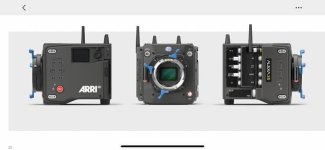
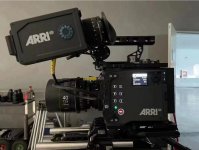
First pics and leaked specs of Arri's new Alexa 35

d shay

Member
ARRI Camera Systems welcomes its brand new 4.6K Super 35 camera. Join our online keynote presentation and be among the first to experience the next-generation ARRI camera that elevates digital cinematography to unprecedented heights.


ARRI Camera Systems Keynote 2022(https://www.arri.com/en/camera-systems/cameras/arri-camera-systems-keynote-2022)


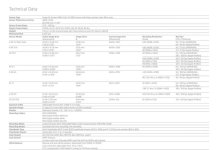
From the leaked spec sheet

17 stops of Dynamic range(2.5 more stops than current models), 6.075 um photo-sites

4.6k open gate (28mm x 19.20mm) 4608x3164 75 fps max arriraw

4.6 k 16:9 4608x2592 75 fps max arriraw

4k 16:9 (24.9mm x14mm) 4096x2304 120 fps max arriraw
 

Attachments

  • photo130155.jpg
    photo130155.jpg
    72.1 KB · Views: 0
  • photo130156.jpg
    photo130156.jpg
    83.5 KB · Views: 0
  • photo130157.jpg
    photo130157.jpg
    35.4 KB · Views: 0
Those are some impressive specs along with the expected image quality. I don't swim in these waters but it would seem to me that this camera is pretty much all that is needed for the foreseeable future. Given how useful the ~2.7K version has been .
 
Well I will break down and be the first to say it.... but I was hoping for larger improvements.

Dynamic Range increase is great in any camera, but how much highlight recovery is necessary on top of an Alexa Mini or Mini LF? Consider Arri's use case, which is typically large production jobs with a gaffer or two and ample access to lighting / grip. I really see highlight recovery and maximum dynamic range only being beneficial on run and gun solo style shoots (think event coverage or cheaply produced docs) where you can't shape light, which is kind of the opposite of arri's typical use case.

I was also kind of wishing for maybe a global shutter, with the creation of an all new sensor but wasn't banking on it. I really see global shutter as superior to rolling shutter but I understand there are constraints with both, but that is something I absolutely adore about my RED komodo.

Frame rates are also not impressive as much as they were teased. 75 fps at 4.6k full height and 120fps max (even at 2k) it appears. The original Alexa mini even shot 200fps, but maybe we will see a HFR license released or this increased via a firmware update at a later time.

In comparison, my RED Gemini shoots 96fps at 5k full height and 120fps at 5k (2.4:1), tall S35 sensor great for anamorphic, dual ISO (lowlight performance), better data rates (RED wavelet compression), and is almost 4 years old now and going for about 15k for a kit, which is an absolute steal compared to a few years ago. You can even pick up a brand new V-Raptor (8k/120) with large format sensor and very clean shadow performance all in a small little package for sub 35k for a kit. The competition is getting pretty stinking good and we know a black magic 8k updated pocket or box camera is right around the corner as well.

Now we are all aware image quality is not directly proportionate to resolution, frame rates, etc. but I am curious on what the pricing will be for this new Alexa mini 2, because with competitors cameras becoming much cheaper and pushing the limits on resolution, frame rates, and slowly increasing their dynamic range and with the popularity of the original Alexa Mini, which will most likely get you very close to the image fidelity and color signature of this new 4.6k mini..... I am just not sure how much interest there will be to owner/operators like myself. If anything I would think the original Alexa Mini would become an absolute bargain after this release as they are already breaking the 40k mark and I have seen kits going for 35k.

To be honest, I know my expectations were probably too high, but I really was hoping for a 6k arri sensor... I guess I will just have to wait for a few more years, or for whatever the Alexa Mini LF will become in its next iteration.

Another consideration is the transition from gold mount / v-mount to b-mount. Many owner/operators would have to unload all of their investment in batteries in order to transition to the new 24v design. This could add considerable cost for those who have significant investment in batteries and chargers that they have acquired over years of production, which will not interface with this new cam. The newer media (codex cards) are not cheap either. MVf-1 vs MVf-2 viewfinder is an increased cost as well. So in order to transition from the original mini to the updated mini, these components will all add significant cost just to get an extra 2 stops DR (is this even usable) and a slight bump in resolution.

The most interesting takeaway from all of this is that Arri still believes in S35 and 4k resolution being "good enough" for even the best, which is a breath of fresh air with all the popularity and "fan-boyism" for large format and high-res acquisition (RED cough cough) in a world where most people watch video streams on iPhones or 1080p tv's.

Good to know that s35 and low-res will live on for at least a few more years.
 
Last edited:
Arri is the eternal conundrum where the c300 500 are most excellent or maybe even a BM at half tohe cost of a c300 and 10% of an arri

But when your location is $5k an hour and actors $10k for 8 hours.. then $20k or $60k camra renting at $250 or $500 is irrelevant and if the $60K camera is 15% better on set then its well worth it in the scheme of the other overheads.

I could go on but probably dont need to.
 
Alexa is already the DR king, adding two and a half more stops to that is just insane! Hopefully this Alexa 35 becomes a new standard in cinema, and it ends the ridiculous obsession with full frame (a format that has become more distracting than anything.)
 
But when your location is $5k an hour and actors $10k for 8 hours.. then $20k or $60k camra renting at $250 or $500 is irrelevant and if the $60K camera is 15% better on set then its well worth it in the scheme of the other overheads.

And then the next thing is the workflow over the image quality, if the image quality is "good enough". And then one wonders in the "consumer cameras" have a better workflow, which can save a lot of man-hours on the set.
 
I know little of higher end workflows.

The ultimate is meta data recording focus iris height l-r to integrate with the led walls and other sfx

arri might be well ahead here.. or well behind - but they have a lot of vids on the arri channell that canon dont https://www.youtube.com/watch?v=dyTgd-gGs3E

But certainly in sfx world good camera data is going to save big bucks.
 
Last edited:
Dynamic Range increase is great in any camera, but how much highlight recovery is necessary on top of an Alexa Mini or Mini LF? Consider Arri's use case, which is typically large production jobs with a gaffer or two and ample access to lighting / grip. I really see highlight recovery and maximum dynamic range only being beneficial on run and gun solo style shoots (think event coverage or cheaply produced docs) where you can't shape light, which is kind of the opposite of arri's typical use case.

Controlled sets are not so much the concern. Contrast on a sunny day has not changed and never will, but a camera with more dynamic range can handle that contrast better. And yes, a bigger shoot with more resources can pump in the fill, but it is faster and better (and more naturalistic) if you don't have to. Plenty of other situations come to mind, like keeping the red in fire without having to stop down, transitions from interior to exterior without as massive a stop pull, keeping color in the sky while exposing for the shade...simply put: nature is the reason we need that dynamic range.

p.s. only one gaffer on a given set, unless there is a rigging or splinter unit crew working adjacent to the main crew.
 
I've been looking at breakdowns of how Roger Deakins lights and his approach (which often includes intentionally blown out windows, to be fair) requires more highlight dynamic range than any camera except film or the Alexa has.

Meanwhile up until recently blockbusters (Marvel included) were rendering CGI at 2K because they didn't have the horsepower for 4K.

So I'm not even sure 6K S35 is really desirable while extra dynamic range is.

This camera isn't targeted at owner/operators, but production companies and rental houses. The ways in which a Red Gemini might be better are targeted toward the market that wants one and those in that market could probably do more with it (Alexas have never had good battery life and even the Mini can be a pain to rig out) – the ways in which the Alexa35 is better cater to its market.

For instance, I think most Red owners love the flexibility of raw and that each camera has a different and sometimes improved look over its predecessor. Whereas LogC ProRes has been a standard for years and so a camera that provides that and doesn't deviate far from the formula is helpful for post houses that are locked into an existing workflow.

These cameras are ideological opposites, Red has a incredibly forward-thinking iconoclastic approach and the Alexa is incredibly conservative. For me, why someone would choose one of those cameras is basically nonsensical, I think to those who'd prefer it, the OTHER would be nonsensical. This is actually a much bigger upgrade and more forward-thinking than I expected from Arri.

In post this almost reminds me of Avid vs Premiere or Nuke vs After Effects. One is designed to be flexible for a small team or an individual, the other is designed to have a regimented and efficient workflow for a larger team to work with. (I have my own biases there, which make even less sense.)
 
Last edited:
... But certainly in sfx world good camera data is going to save big bucks.

But this also becomes a horses-for-courses scenario.

BTW, ARRI had a semi-medium format camera out for more than half a decade but nothing since then. You'd think that, for the ultimate auteurs, there'd be a successor like Sony accomplished with Venice II.

And what is their trick with 17 stops?
 
CharlesPapert, I am glad you brought up your point about nature and the sun and I would have to 100% agree. That is a good argument for a need for more DR and I have found myself in every one of those situations. Trust me, I am a camera nerd...who pixel peeps, and yes, I do care about and desire increased DR in which I compare sensors often in this regard. However, outside of Hollywood grade DP's like yourself and camera nerds like myself, I just don't think 99% of ordinary people watching films will even notice an increase of 1.5-2 stops of DR, or even care about slightly more blue recovered in the sky, or slightly more amber in a flame. A lot of times edits are so fast paced nowadays you don't even get to fully absorb an image before the frame changes. Then to consider the absurd fact that most people in America primarily end up watch high-end productions on 8-bit displays (phones, tablets or 1080p TV's) with severely limited DR.

DLD, I personally think the extra stops (if even truly usable) will come from the new workflow they are touting and it is more of an editing feat that an actual technical improvement from the sensor, kind of like what RED was playing with when they released HDRX and Canon's dual gain output DGO. I could be wrong and have been wrong before lol....

The real reason they improved the Alexa Mini if I had to guess is to get it Netflix approved for 4k, which was everyones only real complaint with Alexa mini. The improvements in DR, color, workflow, etc. to me sounds like typically marketing points to justify spending $XX,XXX to upgrade. However, with these improvements also come constraints over the original Alexa mini (price to upgrade, media cost, data rates, new battery format required, larger form factor it appears, etc.). I still say the original Alexa mini will be the camera to buy for the next 2-3 years as now it will finally be affordable. Kind of like how the Arri Alexa classic has been holding its own still as a budget option for the last few years.

For Arri's sake and the industry I hope I am wrong and this camera will knock our socks off. But to be honest RED let me down with DSCM3 and now Arri let me down with the S35 4k Alexa Mini. Maybe black magic will release an industry disrupting camera....

The one thing that was very interesting to me was that they mentioned you can now change the texture signature of the sensor to better emulate options similar to using film stock. This is very intriguing.....
 
Last edited:
CharlesPapert, I am glad you brought up your point about nature and the sun and I would have to agree. That is a good argument for a need for more DR and I have found myself in everyone of those situations. Outside of Hollywood, I just don't think 99% of ordinary people watching films will even notice an increase of 1.5-2 stops of DR, or even care about slightly more blue recovered in the sky, or slightly more amber in a flame. A lot of times edits are so fast paced nowadays you don't even get to fully absorb an image before the frame changes.

Well, that's a slippery slope. When one starts giving in to that philosophy, we might as well all just be shooting on our phones (as people are fond of pointing out, that's what people are watching on now--although the television sales industry still somehow seems to be alive and well). Two stops is actually a LOT of highlight detail--enough for me to have to think about in concrete terms when I am actually looking to blow out a window, I'll need four times the firepower!

I shoot a lot with Alexas and for most projects I'm hired on I don't need large format and I prefer not being limited in my lens choices, so I am looking forward to this camera.
 
it is stupid that watching a phone means filming on it is good enough.

because the gamut the screen can display has no connection to the gamut the camera can capture.

It is no more connected than the taste of my chips (fries) and my burger even though they are on the same plate.

also when one works a file in post one maps stops of recorded light to a percentage illuminace of the target screen .. so it is entirely possible to map a 18 stop image to an 8 stop display.
 
Well, that's a slippery slope. When one starts giving in to that philosophy, we might as well all just be shooting on our phones (as people are fond of pointing out, that's what people are watching on now--although the television sales industry still somehow seems to be alive and well). Two stops is actually a LOT of highlight detail--enough for me to have to think about in concrete terms when I am actually looking to blow out a window, I'll need four times the firepower!

I shoot a lot with Alexas and for most projects I'm hired on I don't need large format and I prefer not being limited in my lens choices, so I am looking forward to this camera.

CharlesPapert I still see all your points and again have to agree. I am still excited about the camera, no doubt... and am sure I will get my hands on one eventually as a rental on productions in the future. Like I said I hope it kicks a**.... and a few months ago I actually started positioning myself to be able to purchase this camera for my studio, if I really wanted to (sold some high-end glass and my komodo) but at first glance of the specifications, I just don't know how much of a gain there would be to most clientele over an original Alexa Mini (which I still pass on owning over my Gemini as I have a need for HFR capture often). It's clear to see that the mini's improvements weren't targeted towards being more attractive to owner/operators like myself, which was sort of the reason I fell into RED sector unfortunately to begin with instead of Arri. That was also my primary reason of purchasing Gemini over Monstro at the time as I am also an advocate of S35 capture and love vintage S35 glass and certain S35 zooms, thus I am not fond of the limitations of Large Format for this reason.
 
Last edited:
Two stops is actually a LOT of highlight detail--enough for me to have to think about in concrete terms when I am actually looking to blow out a window, I'll need four times the firepower!

The leaked paper says 2.5 stops, not highlight stops. Unless they move middle gray down in Log-C or add ND, the extra stops will come at the bottom.
 
I don't watch much TV (aside of sports) but, when I do flip through the channels, what annoys me the most are shaky shoulder held shots with similarly mashed lighting. So not Willis or Surtees.

YMMV.
 
Back
Top