
Barry_Green
Moderator
PANASONIC PX270
First Look
First Look
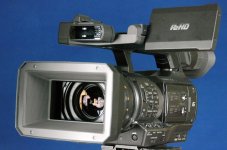
Panasonic loaned me a preproduction PX270 so I could evaluate it for a “First Look” article here at DVXUser. Initially I thought “sure, okay, I'll look at it”, but if there's one sector that seems to have lost favor in the last few years, it's the 1/3” handheld fixed-lens camcorder, so – honestly, I wasn't all that excited about it.
Until I used it.
Consider my mind blown. I'm used to Panasonic making small incremental changes in models, like from the AF100 to the AF100A. I thought this PX270 was going to be a minor evolutionary step forward from the HPX250 (especially given the small increment in the model number, going 250 to 270). But it's not. This thing is a huge step forward. Scratch that -- it's an Olympic long jump forward. Comparing the PX270 to the HPX250 is... well, it's unlike any prior model comparison I've ever done. Because the PX270 isn't an update to the HPX250, it's – it's more like a complete re-imagining of the HPX250. I mean, it has an HPX250 in there; everything the HPX250 was, the PX270 is... but that just starts to scratch the surface.
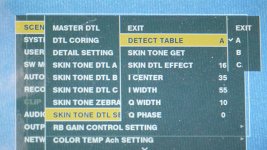
Digging through the menus is like one of those dreams where you're in your house and you find a door in the basement you've never noticed before, and when you open it, it leads downstairs to a whole new floor that you never knew was there – and there's a game room, a media room, a library, and a pool too. In the PX270, one press of the menu button brings up a limited menu that is quite similar to the HPX250's. But if, instead of just pressing that menu button, you were to hold it down for three seconds – well, that's like that basement door opening, and it opens onto an utter plethora of new controls, new features, and new capabilities that far exceed what a Panasonic handheld camera has been able to do before. These features will be familiar to those who work extensively with the larger AJ-series shoulder-mount cameras, but to find them on the handheld camera is blissful. And, for many people, likely intimidating. I can imagine quite a few shooters will be intimidated by the array of options that are available. Just one example: in the HPX250 (or pretty much all prior Panasonic handheld cameras), we're used to having a scene file setting for SKIN TONE DTL and being able to set it to “ON” or “OFF”; in the PX270 there are three separate SKIN TONE DTL settings (A, B, and C) and you can establish different ranges for each of them, including “GET”ting skin tone (sort of similar to using the eyedropper in photoshop to sample a color), and you can then set the I Center, I Width, Q Width, and Q Phase of each, to finely dial in exactly what represents “skin” in your scene – and you can even turn on “skin zebras” that will show up only on what the camera is currently thinking “skin” is.
In terms of gamma, prior handhelds have had seven fixed gamma curves – but now you can tweak them by dialing in the master gamma, adjusting the black gamma, the film-rec dynamic level and black stretch levels, the video-rec knee point and slope, and choose among three settings for the black gamma range. Yes, you read that right, Film Rec and Video Rec from the VariCam are in here. Sheesh, practically everything from the VariCam is in here.
Here are just a few sample menu shots from the Scene File menu, to give you an idea of what it's like in here:
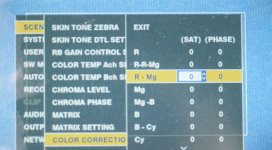
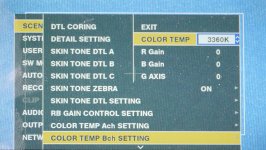
(yes, you can manually dial in your white balance, in 50-degree increments, but you can also specify a red and a blue offset in your manual white balance!)
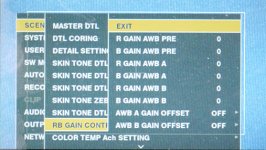
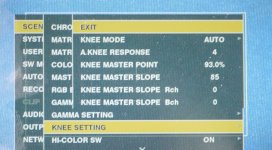
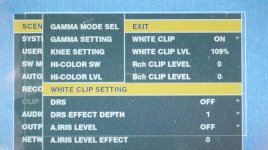
Worried about clipped highlights? Now you can set exactly what level they clip at, and even control at what levels the individual color channels clip! Forever banish the yellowish skin tones that can happen on overexposed footage...
Now, sure, other cameras have had advanced image controls before, but this is a quantum leap for Panasonic.
Everything about this camera just gives more, more, more. It has all the same codec options as the HPX250 (DVCPRO, DVCPRO50, DVCPRO-HD, and AVC-Intra50 and AVC-Intra100) and then it has more, more, more – it adds 1080/60p recording, it has the option for AVC-Intra 200, and it adds AVC-LongG in 6, 12, 25 and (most importantly) 50 megabits. How big of a deal is that? To me it's a huge deal because it opens up the markets that you can use this camera in. It finally means a high-quality, low-bitrate option that will meet and exceed the BBC's requirements (or Discovery or any major HD network.) AVC-LongG50 is a 50-megabit codec, with 10-bit recording depth and 4:2:2 color sampling, that should deliver significantly better quality than Sony's premium MPEG-HD422 codec. Sony's codec uses the older MPEG-2 standard and is limited to 8-bit color depth; Panasonic's uses the more efficient MPEG-4 (AVC) codec and records a full 10-bit color depth, while still taking up the same amount of space. You could record over two hours of footage on a single 64GB SDHC card or MicroP2 card (or, of course, a full-size P2 card). Of course, you could also select from even more codec options, the AVC-Proxy options, which include HD at 6 megabits, or smaller resolution at utterly tiny bitrates. And you can record those proxies alone, or in combination with full-res footage. Heck, you can record them to two different media (full footage onto the P2 or MicroP2 cards, proxy footage onto an SD card).
Furthermore, the addition of AVC-LongG25 and AVC-LongG50 means that now you can record high-quality footage to cheap SD cards. The PX270 features a standard P2 card slot and two MicroP2 card slots; those cards can record all the formats the camera offers, of course. But you can also use a standard SDXC card in a MicroP2 card slot, and record footage at up to 50 megabits per second. This is a tremendous change for a Panasonic P2 camera – now it means you can use your P2 camera for jobs where you have to hand the footage off to the client at the end of the day! No more having to copy, offload, and download footage onto drives... you can just use a regular SD card, and record AVC-LongG25, which, with its full raster, 4:2:2 color and 10-bit resolution, makes footage arguably comparable in quality to AVC-Intra100. Or, you can step it up to AVC-LongG50 and get even less compression and footage that's visually comparable to AVC-Intra200, all on regular (aka cheap) SD cards! I even recorded AVC-Intra50 on an SD card. Obviously I'd recommend using MicroP2 for the utmost in reliability, but the ability to get premium quality on reusable cheap media (without having to downgrade to AVCHD) is a quantum shift in Panasonic's handheld camera line. Now the same camera can be used for top-end production, for stringers, for freelancers, for any purpose. Finally.
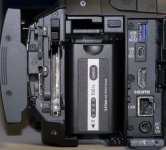
That's all well and good, but how about this – you can broadcast proxy footage right from the camera, live, over an ethernet connection or wirelessly through an optional WLAN adapter. How's that for flexibility? Send a live stream back to the station while you're in the field, and simultaneously record high-quality footage that the news crew can edit together for the evening broadcast when you get back to the station. Or, it gets even wilder – how about setting up multiple cameras, and being able to control them from a remote location, wirelessly? The PX270's optional WLAN adapter can be paired with a 4G/LTE network to give a remote operator control remotely from the production van, the studio, or, well, heck, anywhere in the country, maybe anywhere in the world. The camera sends back footage and the remote operator can control zoom, focus, exposure and camera settings. You don't need a separate paintbox for this camera, you just need an ethernet cable and a laptop. Or forget the ethernet cable and use wi-fi. Or 4G/LTE. How wild is that? To be fair, I'm drawing these conclusions from reading the user manual, as this preproduction camera wasn't outfitted for testing these capabilities, so – before you put your hard-earned money down, verify with your dealer about what these capabilities truly are. This is my understanding from reading the downloadable owner's manual. Remember, this is a “First Look” at the camera, not a comprehensive review of all its features, because it's not ready for that.)
How is all this possible? How have they upgraded the processing and controllability so much? According to my contacts at Panasonic, they actually put the entire processing engine from their premium PX5000 camera into this PX270 body. It's basically the same camera(!) All the internals (other than the sensors and lens) is the same in this PX270 as it is in the AJ-PX5000. They basically took the PX5000, pulled out the 2/3” sensor block and stuck in a 1/3” sensor block, attached a 22x zoom lens on the front, and stuffed it in the dryer to shrink it down to handheld size. And the result is the AJ-PX270.
To me, this is one of the most surprising, and significant, moves Panasonic has made in years. We always hear the internet complaint about how companies purposely “cripple” their cameras to “protect” their more expensive product lines. That is absolutely not the case here! They put all the goodness – the same processing, the same codec engine, the same hardware – from their best camera, in this little handheld body. That's fantastic.
Now, obviously the PX5000 is going to perform better. It has bigger chips, and will usually be paired with a lens that costs at least 5x to 10x as much as the entire PX270 package. Using 2/3” chips gives the PX5000 literally 4x as much sensor area as the PX270's 1/3” chips, and accordingly no 1/3” camera is going to deliver performance comparable to an equivalent-generation 2/3” camera. That's just physics. But it's a pretty sure bet that whatever the PX270's chips and lens are capable of delivering, the PX5000-sourced back end of the PX270 will let you make the most of it.
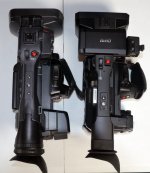
As for design and size – the PX270 is slightly smaller than the HPX250 (or its twins, the AC130A & AC160A). It's still a pretty big handheld camera, a little sleeker and a little shorter (front to back) as compared to the HPX250. Panasonic's marketing shows it as being slightly more compact than a competitor's camera (which I am sure must be a Sony EX1R).
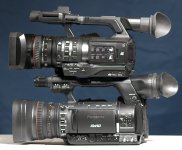
In terms of design, it veers away from the monolithic “tube” design of the HPX250; instead, the PX270 looks more like a mashup of the original DVX100 and an EX1. It's been nipped and tucked throughout to reduce the overall bulk; it has a sleek waistline and a sixpack of abs compared to the cylindrical HPX250. It isn't overall that much smaller, but it does feel tighter, lighter (about 1/2 lb lighter) and just overall better. The HPX250 always felt a bit “puffy”, the PX270 feels tight and trim.
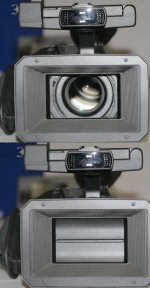
As for similarity to the EX1, it uses the same positioning of the flip-out LCD, and (finally!) uses the same type of integrated lens cap – thank heavens for that! We've been waiting about eight years for Panasonic to adopt the integrated lens cap design that Sony originated back on, what was it, the Z1U back in 2004? Well, it's finally here – thankfully.
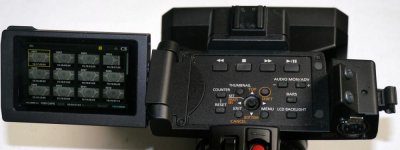
The LCD is substantially crisper than the HPX250's, which was already really pretty good. The viewfinder is quite sharp, with gorgeous color. It's not a super-magnified picture; the view is more along the lines of a traditional 2/3” camera's viewfinder, but it looks good. The buttons are more familiar to Panasonic users than the EX series; the PX270's got largely the same layout and number of buttons as the DVX100 (which was, in my opinion, the best layout they've ever come up with), but with added controls like a 2/3” camera.
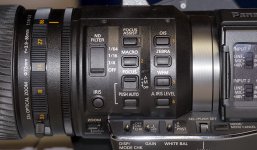
Not to put too fine a point on it, but the controllability is pretty much ideal for users who are familiar with the Panasonic line, and for those who are familiar with standard 2/3” camera controls. I mean, really, it's a little pathetic that I would receive such a blip of joy as I did when I put my hand through the hand strap and my index finger found the “iris” button... right there where it's always been on broadcast lenses, right where it should be, right where it belongs. Such a simple little thing, but it shows that they're actually LISTENING again!
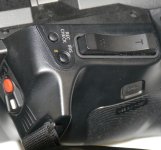
Other operational things that seem so small, but make a difference – there's a record button under the lens, right where it should be. The zoom is now fully variable – just as it should be. No more cheesy three levels of zoom (fast, medium, and sort-of-slow)... now it seems like it's fully variable; press a little harder, it goes a little faster; press a lot harder and it goes a lot faster. The slowest zoom speed results in it taking about three MINUTES to zoom from full-wide to full telephoto. You want a super-slow creep zoom? It's got it. You want fully manual zoom? It still has that; just flip the switch and you've got 100% manual control. Say you wanted a constant-state zoom but you needed it to operate at an exact speed? No problem, you can dial in the exact percentage speed you want it to go at, from 1 to 100. And the top handle's speed is variable too; previous cameras had only a fixed speed for the top handle, and variable for the side handle rocker, but now both are fully variable. Need a fast zoom? It has a menu option that doubles the speed of the zoom at its fastest – it results in a little noise though; shuffling that much glass (remember, it's a 22x zoom!) requires some effort on the part of the zoom motor, so it gets a little noisier. For the quietest zoom, you can set the menu option off and it quiets the motor down, resulting in a zoom time of about 4 seconds from full wide (3.9mm) to full telephoto (86.0 mm).
They've done something different with the user buttons: instead of having separate user-assigned-function buttons, they've made many of the existing buttons into reprogrammable User Buttons. The Focus Assist button is also used as User 1; the Macro button is also used as User 2, the Slot Sel button is also used as User 7, etc. I can see this becoming a tad confusing, since presumably you'd want to use the stated function that's listed right on the button, so – how do you get a user function? You'd have to use a button that you don't plan on normally using (like maybe Slot Sel or Macro) and assign alternative functions to them. Granted, it does provide more customizability, but really I'd rather just have had them add a row of three user buttons and be done with it. That's how they've done it on all the prior cameras, and it's always worked well, so I don't think this is particularly a step forward.
FUNCTIONALITY
Functionally, the PX270 really gets it right. The arrangement of buttons on the side of the lens feels like the good old days of the DVX100. The audio dials are no longer punitively trapped behind a clear shield (preventing you from easily adjusting them), but now they're easily accessible behind a flip-out plastic cover.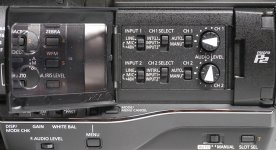
It has actual automatic level control, selectable per channel – how painfully obvious, and yet difficult, has that been to get? It has a front audio level control, just like a shoulder camera. Sure, it cribs a few ideas from the EX1 and Canon, but – they're good ideas. The relocated LCD panel (same as on the AC90) is where it belongs now, and having the playback buttons located under that LCD panel is just good ergonomics and efficient space usage. It even has a built-in level gauge, so you'll know for sure if your tripod's level or if your handheld shot has level horizons. Granted, this is a feature that's existed in DSLRs for years, but this is the first Panasonic pro camera I've seen it on, and – why not? Why shouldn't it have a level gauge? I've shot my share of slanted nature shots, but that wouldn't happen with this camera.
You want full-sized P2? It's got it. You want micro-P2? It's got it. You want to skip P2 and record to SDHC cards? It can do that (up to AVCI-50 and AVC-LongG50). Timecode in and out? Sure. Genlock? Of course. An internal web server for remote control through a network port? Why not? Wireless control through 4G cell service? Sure, pile it on. 1080/60P? Yep. Variable frame rates in 1080P, up to 60? Yep. 1080i? Of course. 720P? Naturally. Standard-def? In 4x3 and 16x9. PAL and NTSC switchable? Oui. Four channels of audio? Of course – and up to 24 bit, too. 10-bit video recording? Definitely. Long-GoP or Intraframe? Both. 4:2:2 on-camera? Sure. No need for an external recorder here... but if you want one, you can connect to it through HDMI and/or HD-SDI (or even 3G-SDI). 1/4” or 3/8” tripod socket? Both – heck, it even has both sockets on the bottom and on the top handle. Want to record upside down? It has a scan reverse function for that – handy if you're in a crowd and trying to hold the camera overhead, you could just put on scan reverse and hold the camera upside down high overhead. Focus peaking? Which would you like, on the LCD or the EVF? How about the ability to dial in different levels for each monitor? Why, of course it can. Remote control? It has the standard ports for zoom/focus/iris and start-stop, but also can be remotely controlled through a LAN or even wifi... It even uses the same batteries as the HPX250/HPX170/HVX200/DVX100, and also has a new battery with a built-in charge meter right on it.
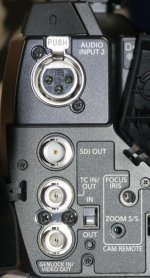
Oh, and for the first time ever on a Panasonic handheld, you can actually change the battery while recording. If your battery's running low, you can plug in the AC power supply, swap out the battery, unplug the AC and never even interrupt the recording. And, the battery charger and power supply are now different products, so you can actually power the camera from AC, and simultaneously be charging a battery in the charger. Again, a little thing, but a little thing that might actually matter.
So what CAN'T it do?
Well, it's a 1/3” camera, so it's not going to deliver the shallow DOF of a 2/3” camera or S35 camera. Which may be a turnoff for filmmakers, but is a definite blessing for event coverage, sports, and news shooters. Because it's a 1/3” HD camera it's not going to be an extreme low light champion; Panasonic says it's about 1 stop more sensitive than the HPX250 (which was no slouch) but it's not going to be comparable to what an S35 sensor camera can do. That said, it does offer a “Normal” and “High” sensitivity mode, in addition to up to 36dB of “Super Gain”, so you're definitely going to be able to get the shot in any conditions, it just depends on how much grain is acceptable to you (36dB of gain is quite a lot and does result in a significant amount of added grain in the image).Another thing it doesn't do: RAW. Except that it sort of does. Raw is the big buzzword in digital cinema, but doesn't really have much to offer in the broadcast world – I can't think of too many situations where a news or live broadcast would have any desire to go through a Raw workflow. But, with the processing power of the PX5000 inside, the PX270 could give you about as much control over the image as you'd likely ever need, even on par with a Raw workflow. Consider that you've got a 10-bit source signal in 4:2:2, and you have control over every aspect of the color with its 12-pole color matrix, adjustable gamma and black stretch options, fine-tunable white clip and user-settable knee point and slope, heck, you can even adjust the red or blue channels in the white balance presets and individually control the red or blue gain or the green axis on each white balance channel. You can process the HELL out of the signal, and feed that out live, uncompressed. For those who want to “shoot flat and fix it in post”, you can do that (using Film Rec at 600% gives a very flat image); but for those who cannot “fix it in post,” you can still have tremendous control over the image.
And, it doesn't do 4K. It does 1080 up to 60p, including variable frame rates, but it's not a 4K camera.
One thing that's not mentioned much, but to me is a pretty reassuring thing, is the CPS password-protection capability of the new MicroP2 card. You can assign a password to a card, which will prevent anyone else from accessing the footage on the card. When these cards are so small (and thus have the potential to be misplaced), I think it's quite reassuring that you can “lock” the cards so that if they do become lost, at least nobody else can get access to the footage on them.
Really, then, the PX270 shows a different approach to the handheld market for Panasonic. Previous offerings were limited in their functionality, and sometimes (especially the AVCHD models) they included menus that looked a bit consumer-ish. The PX270 oozes “broadcast” from every pore. The PX270 is not a consumer camera stuffed in a bigger body, it's a full-fledged 2/3” broadcast camera, scaled down and wedged into a handheld body. The processing, the menus, the controls, the layout, everything about it says “VariCam” – except the price tag, and the chip size. Obviously you're still going to get more out of a 2/3” camera than any 1/3” camera can deliver, but this is one feature-packed 1/3” camera!
Detailed image testing is going to have to be put on hold until a finalized camera is delivered and all features are enabled; I explored some aspects of it and found that in general, it is comparable in sharpness to the HPX250, and the factory claims it's about a stop faster. The image controls let you extract a substantial increase in potential dynamic range though; on a DSC backlit 17-stop dynamic range chart, I put the HPX250 in Cine-D with the knee on LOW and was able to discern 10 different stops, and with extreme optimism I might convince myself that I can see the hint of an 11th. I put the PX270 in Film Rec at 600%, pointed it at the same chart, and can easily discern 13 stops above pure black.
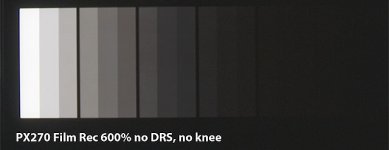
Now, how much of this is actually “usable” will depend on the noise signature of the final camera; the lower the noise, the more usable the full spread of dynamic range will be. But suffice it to say that yes, the new image processing and the new sensors should definitely let us extract more range from the image. There isn't a “log” recording format in the PX270, but this type of increase in potential dynamic range is certainly log-like and the 10-bit recording formats make it more practical to actually use all the dynamic range the camera is capable of.
So what does the footage look like? Kevin Railsback, master nature videographer and DVXUser member and author of the Filmmaking Naturally blog, got to put it through its paces. He'll be posting a longer, more detailed edit of his footage separately, but for now, here's a little segment edited together by Art Aldrich of www.otek.tv:
PX270 or HPX250? No question – the PX270 is the one you want. It's the one I want. Is it the ultimate handheld camera? Let's just call it: yes. It's got a huge zoom range, it's got low-bitrate long-form recording to cheap SD cards like an AC130, it's got the 1080/60p and variable frame rates like the AC160A, and it has the exceptional recording codecs of the HPX250. Plus network operation, wireless operation, 3GSDI output, timecode in/out, and the type of menu control we're used to seeing on a full-size VariCam 3700. It does pretty much everything (except super-shallow DOF). Let's be clear: this is NOT the camera for someone considering a DSLR. This is a handheld broadcast camera that every shoulder-mount operator wishes they had. Consistency of operation, familiarity, and overall power and controllability are a huge leap forward for Panasonic.
A 1/3” camera isn't for everyone nowadays. But for those for whom it would be appropriate, this PX270 deserves careful consideration. I think it's their most significant advance in 1/3” cameras since the HVX200. And that's saying something.


