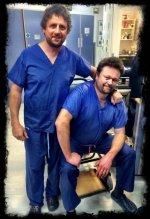
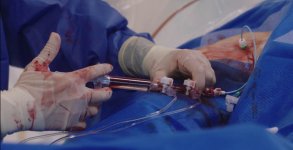
Filming a medical operation.

morgan_moore

Major Contributor
Might have to film a pacemaker being fitted.

Does anyone know about issues of this.

For example our gear might have to be irradiated? or even dipped in disinfectant ... in which case our options would be a little limited (but having 3 housings not impossible).. or we might be ok far back with a telephoto

Im sure we will get guidance from the client but just wanted to start getting my head around the challenges..

S
 
I've done a few of these... ie, http://www.jove.com/video/50377/implantation-of-the-syncardia-total-artificial-heart

Exact regulation is likely different in the UK vs. US, but I'll offer some insight which may carry over:
- Lighting will be a challenge. Surgical lighting tends to be very strong at its focal point, and not as strong outside. Built-in switchable NDs are a must (or VariND may work as well).
- I've not had to irradiate cameras. I have given cameras and all other gear a wipedown with Cavicide or the like. Myself, my monopod, and my camera body were "gowned" during the procedure as well.
- NEVER touch the surgeon
- There are few good ways to "automate" filming. Any rigged overhead camera will invariably catch a wonderful closeup of the back of the surgeon's skull at the most intricate portion of the experiment, and lighting simply changes too much throughout.
- What has worked best for me is a tall monopod directly over the surgeon's shoulder, moving with them, staying close but not too close... (again, NEVER touch the surgeon)
- Adjust your scene file to get the best read on reds. Not as much of an issue these days, but older HDV cameras blew out the reds in an annoying way.
- Expect an astonishing number of inappropriate jokes during the procedure from hospital staff
 
Don't worry... surgical smoke plumes smell of hyacinth and cinnamon buns ;)

Yahoogling "medical videographer" brings up a series of war stories, hints, and so forth that can also be of help
 
the biggest challenge is adjusting to the fact that what is a very unusual situation for us and the patient is just another day at the office for everybody else in the room. however looking at what is going on through a lens and having ones own filming job to do makes it easier than otherwise could be. at least this is my impression from filming a birth via cesarean section in a hospital that was a great experience but pacemaker may be different?
 
They even gave you crocs? That's kind of them. I had to bootie up my street shoes.

What cam package did you wind up using? Any inventive problems/solutions?
 
The cheap crocs were chinese knock offs and a size to small for everyone!

We used..

Sony Fs7, Big rig and sticks. 28-85 and 70-200/4
Canon 7d, handheld rig 18-55 STM
Canon 5d , sticks 70-200 2.8
gopro4 on a mono pod
nex5n on a short pole. 16 pancake.

Clearly the FS7 can handle the odd flouro and scene light better than the other camera by a country mile.

Errors.
My 70-200/4 was a bit wobbly.. and Issue im aware of but clamping it down slows down lens changes.
I lavved the consultant but that was crap as he added a lead coat to his outfit which muffled the sound.

Communication. Communication. Communication.
I guess in hindsight we would have shot differently but to some extent that was not 'our fault' basically we shot a bit frantic and should have let some shots lie, done less handheld etc.. but there was constant concern that things could go wrong and we get booted out (entirely reasonable) so we tried to hoover up as much as possible from the go.

As it happens six of seven patients consented so we got loads of time but we did not know that is how it would pan out.

Generally I think we were over cautious and could have got a couple of bits re-enacted or at least aked for a pause while re-setting the cameras, but you can see the reason for the over caution as we respected that the procedure and patient safety would come first.

I bummed some interview because there was background chatter.. again I should have had the skill to say.. "Is it OK for me to ask you all to be quiet for a moment"

By the end we were flying the GoPro over the table and all sorts but only felt able to do that once trust was established.

So a clear meeting establishing the 'rules' at the beginning would have helped - over caution was to some extent the weak link in our shoot.

DeLogged, not graded FS7, 70-200 at maybe 150
Untitled_1.21.1.jpg
 
Last edited:
Just out of curiosity what was the sterilisation process for the equipment? Any other gotcha's for filming an an operating theatre?

Re your "communication communication communication...." A thought that just occurred to me was (in hind sight which is when I get my best ideas :-) would it have been possible to observe the team in theatre without filming? IE you could have done this early on to understand how the team worked etc see how you could have worked, what kit you need and build up trust with the team.

I am assuming you could have done this without needing any signed consents etc early on in the process.
 
Most of my kit is pretty hanging having just come out of filming the cross country running season and a short film about 'mudmen'

Lack of communication communication communication meant we didn't actually know what specific regs would be in place.

Basically we wiped everything down with baby wipes so the kit looked kind of clean, we put the sticks feet in bin bags to keep contact to the floor minimal.Thats it.

Could be have observed? - yep we could have - but due to the lack of
communication communication communication I felt it was best just to get hoovering up footage from the green light

(in my mind if something had gone wrong we could have been turfed out pronto, entirely reasonable)

As for consents - again that was not too clear, between showing patient faces and just being in the room (
communication communication communication)

Everyone we filmed had consented. I doubt any patient faces will go in the edit, really we only showed patient faces as part of a big wide - didnt do any CUs.

Also patient data is all over the xray screens - Im sure that will be fuzzed out in post
 
Last edited:
I have been involved in a similar situation as this from the other side, as the physician, and as an amateur filmmaker observed with interest. In my case the hospital was having a commercial shot. From your photo in post no.8 this was a cardiac catheterization or stenting procedure, not really surgery. There is plenty of nonsterile stuff in the room for that, for my shoot they had a couple of lights, tungsten I think and used a 5dMk2. We had a nurse on the table as the "patient", the catheter (tube) just vanished under the drape. For another part of my shoot I sat on a stool in the cath lab, wearing a white coat , while they asked me a few questions. (later they shot a general surgeon in the same spot, he would never actually work in that location in the hospital, but the background with, monitors equipment looked good so they used it again). Neither one of us would ever sit like that in that location talking.

An actual pacemaker being implanted is usually a much different procedure, hats, masks, sterile field, that you can't get too close to. A 70-200 on a Canon 5d would work for the brief shots of actual surgery, most of the rest is easy to fake with a fake patient.

Most cath labs/operating rooms have no idea how long a shoot takes, but if the hospital has hired you, I think they would be accomodative as long as you tell them before how long you need.

Do not assume patient data will be fuzzed out, in my case the hospital knew of my interest in film and let me see the commercial before it was finalized, on one angiogram the patients name was partly visible as "Joh Smit" i.e. easy to guess and equally as bad the hospital name was listed as a sister hospital from 100 miles away. I gave them images from an angiogram from the correct hospital to use (minus patient name). In my case, there was a real patient in the commercial shown coming into the emergency room, and later having recovered on the golf course,, but the films were from someone else, selected for the issue to be as clearly seen as possible on TV.

Hope some of this info is of use
 
Back
Top