F55: F5/F7/F55 CineEI LUT primer, quick quide & history

This is a burning lut.

If you are burning you are not going to grade - the idea is something you can dump on an editor at the end of the day and he can drop into his NLE and just cut.- not add to in post - so the goal is a 'finished' image no grade allowed - yes destructive therefore, no space for on set error, one hit wonder.

To change the contrast you change the lighting using old school skills. I prefer to shoot a corporate sit down with high CRI hard lights through a 6.4 scrim - not a 1.1 pukeo panel (that would also get around the lack of WB in Slog)

It has less contrast than a 709 curve, I feel it would work on poppy corporate stuff. But of course we can make others like a 'girly' lut - and of course it is my first go :)

This has so much more appeal to me than that f-ing matrix baloney.

S
 
Last edited:
Turns out we all like different things and we all have clients that like different things - I think there's a general move away from hard and punchy among my more corporate client base as well and I don't think I have any clients these days that would go for that look if given a choice. Bizarrely, they've probably been influenced by the 'influenced by log' low con desaturated look of a lot of more recent drama and commercials on tv over the last few years.

So much so I've started buying low con filters and the like to play with for certain gigs.
 
The skill that IMO needs developing by all of us is understanding the pros and cons of the different modes of operation and clearly communicating/budgeting them before job starts. S
Sam, I appreciate your perspective and your approach. I agree with everything you have written. With lesser experienced shooters, the "gamma dujour" seems to overwhelm the appropriate choice for the scene being shot. This is the age of Slog, where everyone thinks every scene needs to be shot in Slog, whether it's 2 or 3. The focus on Slog3 seems to be the latest craze. as you have pointed out, however, there is a fairly specific scene DR that is most appropriate to each gamma and format. For sure, one can play it pretty safe by using an Slog gamma on everything, but, there are consequences. Whatever the scene DR is, it's desirabe to fill each quantum data bin with as many data bits as possible. An Slog gamma with huge DR does no good if only 25% of the data bins have data in them. Likewise, an HG gamma that has blown hilites and/or crushed shadows does no good. At least the Slog gamma is somewhat recoverable, albeit at the cost of data resolution and noise, yes? In a simplistic sense, I think we all know when an HG is more appropriate to use than an Slog. Notwithstanding the other factors, like post production render time and coloring. And, at least IMHO, applying a LUT, wheter burned in or applied in post, is only a starting point to final tweaks and grades. I do question the chronic use of the LC-709A LUT because of the color space LC709A is designed for. It may provide an attractive grade on a REC709 monitor. But, since its color space is really designed for REC2020, I have to wonder what it'll look like when REC2020 monitors hit the market. It's akin to grading HD material on an old NTSC monitor. (I suppose one could argue that REC2020 monitors are 10 years away, so no worries)

Another real issue with HG gamma curves is where the knee is placed. That's part of the consideration with HG8009G40 and G33. Having the experience to know the difference is what separates DP's from the crowd. And I would say knowing when to use Slog2 or 3 is the same.
 
Last edited:
Cuevo.

That is a cool response - you know your stuff I can tell. I was waiting for the quantum data bin attack :)

Well it is interesting that you mention the figure 25% - because that is exactly how empty your bin can be, to the digit.

Why? because you are recording 10bit (simply 1000 tones) and delivering 8 bit (simply 250 tones) which means you can go four times too flat or indeed fill your bin to 25% per stop and get good tone.

Fill it any less and you will risk banding in post.

Now my observation of the Slog3 curve is that it is very linear - so for the first time this maths actually works wheras in Slog1 the curve was below the golden 25% and you got quantization.

Now filling the bin 25% is right on the absolute limit (really Slog was of course designed for 12bit F35 - 4000 tones) and I would prefer Slog4 to have less DR and more bits per stop.

The system I used with my F3 by selecting Cine1 not slog to get more tones - but I got in a world of sh_it with no luts for editors.

So. Slog3 is at the limit of flatness.. too flat to be an ideal for a 10bit container.

Now what to do with that non ideal situation?
1) live with that
2) build your own LUT/profile/look/matrix

I am currently doing (1) because the workflow is so easy with the Sony luts in resolve and catbrowse that match slog3 so well. Option 1 is nailed through the workflow, your editor in kuala lumpa or the arctic can get those luts. Your rental directors monitor probably has those luts.
(2) would be more ideal but opens a more complex workflow to the editor!

S
 
Last edited:
Turns out we all like different things and we all have clients that like different things - I think there's a general move away from hard and punchy among my more corporate client base as well and I don't think I have any clients these days that would go for that look if given a choice. Bizarrely, they've probably been influenced by the 'influenced by log' low con desaturated look of a lot of more recent drama and commercials on tv over the last few years.

So much so I've started buying low con filters and the like to play with for certain gigs.

Yep, grey is the new black.
 
Turns out we all like different things and we all have clients that like different things - I think there's a general move away from hard and punchy among my more corporate client base as well and I don't think I have any clients these days that would go for that look if given a choice. Bizarrely, they've probably been influenced by the 'influenced by log' low con desaturated look of a lot of more recent drama and commercials on tv over the last few years.

So much so I've started buying low con filters and the like to play with for certain gigs.

When did I say I liked it? Yep I absolutely agree that is is not a fashion LUT, Im sure it would do lions, pyramids*, golden sand and blue sky in Power Discovery Channel colours. It was my effort at a 709 feel but has a few tweaks that should negate the 'sony' look - which Ive had some practice with dialling out, and it is low noise while actually never offering black (or white) if you check the scopes.

I will do a fashion LUT too.

S

*yes im looking at you.
 
Here's an interesting observation of mine...FWIW....
I was playing around with the Gretag Macbeth color grid and how to apply it with Slog2 and 3 gammas. Using Resolve's X-rite color checker, I'm able to do some very acceptable primary color corrections in my footage, without using LUTs. I'm slowly building a library of "routine" lighting conditions in which I have captured a GM color grid. With this library, it is becoming almost unnecessary to shoot the GM grid on every job. It's a question of recognizing the scene conditions and picking the appropriate library test shot, then applying it to my footage. This is, generally, giving me a quick and dirty first grade, without burning in a LUT. What remains, in most cases is a tweak to the shadows to bring it into legal range. But primary colors are pretty good, as long as I haven't blown hilites or skintones. No extensive post grading needed unless a specific "look" is desired, in which case the footage would have gone to the colorist anyway.
 
Wasn't having a dig at you, just saying it wasn't a look that I would have any use for in this day and age with the corporates I deal with, where the trends (in my world at least) are veering away from that type of feel.

I didn't say anything about fashion.
 
In CineEI mode, I don't think there is a Sony look. You can pretty much create whatever look you want.

Absolutely. Some posters have basically wanted a ready to burn 709 look, now to get that one could enter custom mode switching on the sony look or make and burn a lut, that what that was a pop at - creating 709 with out the sony feel.

Of course one could say it is too contrasty - but contrast is also the lighting.

S
 
But Sam, 709 is not a look. It's a colour space.

I can crate a flat look in 709, I can create a contrasty look in 709, I can create an oversaturated neon look if I want. With Slog3 and 10bits I can create a wide variety of looks. Having grown up shooting film, that's what I like about the FS7 in comparison to say, the C300 with which I've shot 50% of my jobs in the last three years and couldn't push as far.
 
Last edited:
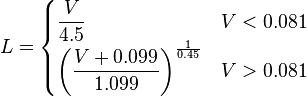
Actually I think 709 is defined as a change in brightness in stops will create a define change in brightness on the screen.

b2439302294015fb3d625f6071911a88.png

So a 'proper' 709 image should have a certain DR between black and white - about 7 stops - distributed in a certain manner - a look.

But I dont want to get techie - im using shorthand.

By a 709 look I mean bright contrasty blue skies, red telephone boxes and black being the new black look.

Im aware that since The Bridge (which was graded for CRT gamma and distributed in Iplayer in the same gamma by a mistake) that 'fashions' have changed.

In some circles grey is indeed the new black

Conversely Im grading something else for some kids and they want colours off the scale - they reminded me that they are of 'The Instagram Generation'

So you are right - the old rules do not apply if the client thinks it is pretty that is a home run!

Entirely personally I think the 'log look' is rubbish.

S
 
Last edited:
Sam,

Low contrast looks have been around as long as I can remember. Certainly, way before "The Bridge". With each technology change there's been a different way of getting there. In the 80s we used to get our reprints on low contrast film stock. When HD came out we'd use filters to negate the contrasty, low dynamic range of video. Nowadays, it's the other way round and we're all trying to find the best recipes to put contrast and saturation back into images.

FWIW I really liked the look of The Bridge, and having shot many times in Sweden and Denmark I thought it captured the dull grey, sunless tones perfectly and more importantly, it suited the script. Which is kind of the point; different jobs have different requirements.

It's not about grey or punchy or saturated or whatever. In fact, I don't really care what the client thinks. I only care about what I think is right for the particular job. After all, the client isn't (often) a professional film maker. I am. And so, If I want a punchy look, I'll go that way. If I want a flat look I'll go that way. Again, that's what's great about the FS7, many looks at an affordable price. It's brilliant. I think we can all agree on that:-)
 
Yep it is exciting and returning to the purpose of the thread - which seemed to be about burning in luts for quick turnaround hopefully Im not the only one here who feels that that is not really how the cam is designed to be used.

Yes we all have to learn how to do that and some will do it more than others.

I watched the Bridge on CRT trinitron that the Mrs had.. the blacks were black.. I really feel that is how it was supposed to be seen, we did a side by side vs my craptop. But a Gød Jul either way :)


S
 
If you read my post carefully its written to provide a detailed background on MLUTS, why they exist, and how they can be used. Burning them in just one possibility but I leave that up to the reader to decide.

I think I've answered a lot of good questions around MLUTs people may have and also addressed some cautions.

I just hope people found it helpful through all the mud.
 
Yes, Dennis, I found your efforts to explain and demystify MLUTS quite valuable. In fact, I hope you are sufficiently encouraged to continue to post on this topic. Coming from a Panasonic HPX250, where one at least had the benefit of creating and applying a handful of scene file "looks," our newly-purchased FS7 nonetheless represents a quantum leap in cinematographic options. All of these discussions and exchanges contribute to my understanding, and therefore I find them exceedingly valuable. I'm glad you started the thread, glad other folks chimed in with their perspectives, and really glad about everyone's generosity in sharing their experiences and what they know. Maybe when I have something worthy to contribute on shooting with this camera, I can contribute to the discussion and someone else's knowledge base.
 
Back
Top