F55: F5/F7/F55 CineEI LUT primer, quick quide & history

These are the guys I come across who sort of wandered into post from web design and so do a course to learn the button to know just enough to do good enough, but not enough to do 'good' if that makes sense. I hate it when you get a Producer like that because there tends to be this innate fear that they feel they're gonna get found out, as opposed to trusting you and chatting about any questions you may have.
 
When its appropriate and warranted, I don't see using Look Profiles as any different as a custom scene profile.

I tend to not try educating my clients or getting them to do things differently than they are use to, or you're right, I might as well sell my Sony and start shooting with Canon because my client already knows from all their other projects that the guys shooting on Canon deliver nice looking footage straight out of the box. That's a bit difficult to compete with, I'd say with those clients you definitely don't want to stand out.

Anyway its a great option to have for when its needed. Now only if Sony brings it to custom mode so you can put your Look Profile on top of your own white balance settings underneath and really control it a bit further..

I'll keep dreaming.
 
Absolutely - there seem to be two schools - internet age kids in funky glasses who know way more about post than me.. and ex tape editor types who kick and scream all the way.
You should try working for the BBC...

Numpties are everywhere, young and old, experienced and newbies alike. It's always been so.

I have no problem with my clients knowing little or nothing at all. That's what they pay me for.
 
I've shot for the BBC. Directed and Produced for them back in the day - luckily always as a freelancer :)

I have zero problem with people with a lack of knowledge. If they're paying my bills I don't have a problem with people with a lack of knowledge having a lack of interest in learning more of their craft.

It's only ever an issue when it stops me doing me job which on occasion has been a thing.
 
All of this seems to come from a basis position of wanting to do stuff as badly as it has always been done. (or as badly as since 'we' first went HD)

On that basis I don't really know why every one is not using an EX1 they are about £1500 now.

I watch most things that are not a movie (or deeply studio) and think - I could do that better or that looks crap. I look at my own work and think .. there is a lot further that could go.

My stuff has maybe looked OK with the FS100 but really it is all rubbish. Im excited to join the fat codec club to actually start making images that are not just moving toilet paper but might have some depth.

S
 
Yes and of course no. Ive been through this journey twice now. 2001 or thereabouts I moved from film stills to digital - my £7000 1.4mp nikon D1 - I knew that the material from that camera was a major step back (often shooting double - digi for press and film for archive or magazine) - but deadlines drove us digital. From 2001-5 I knew 'film was better' and my work was to some extent compromised (I got out of that by getting a £15K hassy digi back in 2005 to escape that conundrum). I can get a scan of a 1990 negative today that is more vibrant than my 2000s digital stills work - however crap my scans of negs in the late 1990s might have been I still have the core images I recorded. I never shot motion picture film but know/feel etc that 4k10bitLog is very close not to be a compromise and can sustain my personal 'vision' which to some extent has defined my career path. That is personally exciting and feels like the end of a chapter in my video apprenticeship - the 5d2 and FS100 were toys to learn on the FS7 is a tool to work with.. Im not going to shoot baked 50mpsHD cos some cluts tape editor wants that. (apart from of course I will if the price is right!)
 
Last edited:
DP or Camera Op does not get to dictate post workflow to the editor.

However, it's always fantastic to touch base with the editor beforehand to discuss workflow and offer options to them. These days I throw in a couple of CC Luts on a drive with footage in the rare cases I'm not cutting the stuff I shoot.
 
All of this seems to come from a basis position of wanting to do stuff as badly as it has always been done. (or as badly as since 'we' first went HD)
On that basis I don't really know why every one is not using an EX1

Well we've been down this path before Sam so I won't belabor it here. Stuff wasn't done badly before by people who knew what they were doing. A lot of it looked gorgeous. Just because you don't understand how to work that way don't criticize it.

If you insist on giving that dumb cluts editor ( who by the way may be twice as smart as you are - and nobody is a tape editor anymore) your fabulous Slog3 footage , he very likely will be the guy who color corrects it and if you think that teaching him a one click LUT is going to give you a great look - I have bridge to sell you.

I've been working for excellent video producers and editors who just don't see color, exposure and light the way I do. That's why they hire me. I will continue to give those guys the best baked in look I can and use Log when its appropriate.

The FS7 can give you a beautiful baked in look with lots of DR when needed ( if needed) and though you may think of it as old school, a wide dynamic range doesn't necessarily mean squat to creating a great picture. Lots to learn about this camera.

So ultimately we all have our ways of doing things and we all have our own clients - there is no right and wrong way.

Getting back to the original question about recording baked in LUTs, I've just started playing with this and so far I'm not convinced at all that the 709TypeA look is especially appealing right out of the camera. I set up a nice looking woman in front of the camera this afternoon and while in Slog3 the 709 and Hypergamma LUT's looked better to me. 709TypeA looked washed out and the flesh tones looked compressed.

I've just started testing though. Along the same lines I was comparing Hypergammas in Custom and thought that if you didn't need the head room ( say on an interior which is what i was looking at) and your were going for something that was a baked in look - that HG7 looked like it was compressing flesh tones - I preferred HG8 and even more I liked HG4. Probably HG7 needed to be underexposed more, but i wanted more of a WYSIWYG.

In fact a cursory look had me feeling that the lower the gamma number ( 33 instead of 40) the better I liked the flesh tone. It seemed to have more meat,. This makes sense since the lower gamma numbers require raising the exposure and thus giving more exposure detail to the middle parts of the image. This is probably why I liked HG4 over HG8. However I wasn't looking at anything where highlights were an issue. This was ythe first time I started to get a handle on hypergammas and how to use them.

Lots more to learn though.

Lenny
 
Last edited:
Overall I want people to understand the pros and cons of diffrent workflows and choose what is right for them. Also maybe acknowledge that the workflow with a camera that can shoot log and that it may not be best use to apply old methods to ones new more powerful toy. As argument polarize they always become meaning less. We all have something to learn here.

=======

Len wrote.
Stuff wasn't done badly before by people who knew what they were doing. A lot of it looked gorgeous. Just because you don't
understand how to work that way don't criticize it.

I completely understand how to shoot a scene in camera - It is just that is very resource hungry - basically you must shoot to a 7stop DR and that will require more lights, more time etc.

If you insist on giving that dumb cluts editor ( who by the way may be twice as smart as you are - and nobody is a tape editor anymore) your fabulous Slog3 footage , he very likely will be the guy who color corrects it

I know editors who are brilliant at editing of course. Actually the 'clutz editor' is not dumb but angry - often he basically is being made into an unpaid colourist - which is annoying to him as 1) its not his skillset 2) he is not getting paid extra. The clutz is management.

If you think that teaching him a one click LUT is going to give you a great look..

If you shoot for a 'one click lut' then the post people just need to apply it - you have made the great look. They don't need any evaluative skill if you shot for that LUT and got your colour/exposure perfect - as everyone does here apart from silly old me. The colour/tone will just pop in to the image.

The FS7 can give you a beautiful baked in look with lots of DR when needed ( if needed) and though you may think of it as old school, a wide dynamic range doesn't necessarily mean squat to creating a great picture. Lots to learn about this camera.

DR is the opposite of 'punch/contrast' and contrast is what makes (most) scenes sing. So of course the FS7 has enough DR to create a baked look (as does my FS100 at 20% of the data load and 25% of the cost or the C300 at 50% of the data load and, oddly, 150% of the cost)

So ultimately we all have our ways of doing things and we all have our own clients - there is no right and wrong way.

Absolutely. But I feel these cameras offer new ways of working previously only available on very high budget jobs - they can change things. Forward thinkers like Kubrick grabbed the Steadicam and 'ran with it' - even though dolly track is entirely serviceable and still the right thing for some shots. He did not ignore the Steadicam. Im suggesting explore the possibilities Im not suggesting that Garret inventing the Steadicam means you have to throw out all of your track.


Getting back to the original question about recording baked in LUTs, I've just started playing with this and so far I'm not convinced at all that the 709TypeA look is especially appealing right out of the camera. I set up a nice looking woman in front of the camera this afternoon and while in Slog3 the 709 and Hypergamma LUT's looked better to me. 709TypeA looked washed out and the flesh tones looked compressed.

Ill post on that in a mo.

In fact a cursory look had me feeling that the lower the gamma number ( 33 instead of 40) the better I liked the flesh tone. It seemed to have more meat,. This makes sense since the lower gamma numbers require raising the exposure and thus giving more exposure detail to the middle parts of the image. This is probably why I liked HG4 over HG8. However I wasn't looking at anything where highlights were an issue. This was ythe first time I started to get a handle on hypergammas and how to use them.

HG33 or 40 - this has always confused me as Im not sure if 33 is forcing me to push up the mids in post (route to noise) or forcing me to open op (route to cleanliness)
 
Last edited:
Given the choice of baking a sony look and baking my own LUT - Id pick the latter any time (ignoring for the moment of the lack of WB options in SlogEI mode)

The main reason is that one can build/evaluate a LUT behind ones desk on ones huge monitor rather than trying to build a look using the fiddly little controls on the camera.

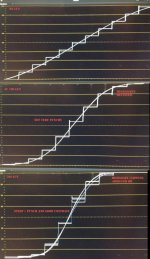
Firstly it might be interesting to actually see what LUTs do to your luminance. Here I have analysed a 10stop grey scale image.

Now 'punch' and 'tonality' in a 'delivered image' are brought about by a steep curve - the steep curve means a small change of 'scene tone' translates to a large change in delivered 'image tone'. (this is the opposite of the 'wooden log look'). DR is how many steps can be recorded before clipping occurs.

The two, tonal steepness (good tonal variance- punch) and DR, are basically a trade off - good image tone is going to restrict your DR (or at least imply an extremely aggressive knee or toe) - good DR is going to lead to images that lack tonal detail (punch)

So let us have a look at the 709 LUT and the LC 709 LUT.. (image below)

We can see that the 709 LUT basically loses you three stops of DR (clipping headroom) while the LC LUT does not introduce enought steepness to the curve to have proper 'punch'

To be fair on the LC curve it does add some punch and with its wide DR it creates a look that is quite pleasing and 'modern' and robust to handle wide scene dr, exposure variance. It is easy to handle but will never give the real rich punchy feel that one might see on some of the glossy HD channels. It looks like gritty drama - not blue skies and lions.

Either could be baked or one could explore (or make) LUTs from third parties - personally and not shown on this image I feel there is some colour stuff going on under the hood of the sony LUTs that I feel is excellent (a lut as well as sorting out luminance must also bring back saturation and convert the camera gamut to the delivery gamu)

Clearly one could want to pick a lut to fit your scene - ie a studio lit session with controlled DR is probably best shot with the 709 LUT, while day exts might lend themselves to the LC lut.

To shoot perfectly in camera you are either going to need to light your scene to the DR of your LUT - or have many LUTs onboard to match you LUT to the DR of your scene.. and pick and use the right one.

Using multiple LUTs to match your scene will, IMO, fast become as confusing as using the paint and HG facilities in your Sony camera (in fact we can see that an agressive knee in camera look is a strong contender to give punch and retain highlights - better than the two luts below)

Of course you could just shoot Log and apply an appropriate lut in post (one click grade) or find a 'ballpark' lut (usually LC709) that gets you close and move the final 5%-10% by simple use of the Luminance curve in your NLE/Colour suite (a two touch grade) or you could do a 'proper grade' applying different saturations/tonality to secondary portions of the image to enhance your story. If you bake any portion of the image you clip will not be grade-able.


I know which option I find most preferable.. you may find a larger version of this image here.. https://dl.dropboxusercontent.com/u/33167160/luts.jpg

luts.jpg
 
Last edited:
Sam,

I appreciate your devotion and seriousness to this forum and solving problems with this camera, and have found many of your posts valuable and you've got a sense of humor. Moreover I hate to get into personal issues on a forum, but i gotta say I find it aggravating for you to again and again lecture us about how the old way of using a baked in look is somehow an inferior way to work. Its insulting to me personally to have you again and again tell me I should throw away this camera and get an Ex-1 if I don't shoot Log. BTW - all graphs and discussion in the above post is all fine but its not news to most of us - video 101.

We all know the difference between Log and 709 and we understand the pros & cons. Shooting stuff you will grade yourself is very different from handing off to a client and you need to adjust to the clients needs and abilities. So lets just be respectful of everyone's desire to work the way they want. The FS7 offered numerous ways to shoot with baked in LUT's and and there are lots of confusing issues to discuss. if you don't want to use them stay away from that discussion.

Re HG33 and HG40:
I'm completely thinking out loud here so maybe I'm off my rocker but today is the first time I've started to get a handle on these gammas. My tests today led me to start thinking that one way to treat these HG's would be to expose them all pretty much the same way with mid tones in a good place for a Baked-In look. Caucasian flesh somewhere around 55-60 would be my guess but i'm not sure yet. For something that doesn't need to be lifted in post I usually put the top of my flesh at 60.

Now that means that the ISO of HG33 is lower than HG40 and that you need more exposure. HG40 raises the mid tones relative to the highlights. At first that might seem great for more DR but it also means that an HG40 flesh tone up near 55-60 might be already getting compressed and it looked that way to me. Thus I found faces looked better on the HG33. You are putting more of the sensors meat in the mid tones this way. In fact I liked the look of HG4 even more, and the other HGs with even less DR also looked good to me.

However raising the exposure on HG33 probably means lowering your highlight latitude. In fact the less DR in the HG the closer you're getting to a standard 709 . It happens that i wasn't looking at a shot with highlight issues, so why waste valuable sensor real-estate on something that's not there. You could still realize that HG1 provided less highlight protection than HG 7 or 8 of course.

So that's one way to expose for the HG's . Of course HG1 gets closer to Std 709, but there all treat treat highlights much nicer.

Alister Chapman would say that HG's should be exposed a little lower and lifted in post though.

So an alternative way to to think about this would be to look at each of these HG's in terms of how much highlight DR they provide and I think the ISO's are rated that way and that's why they indicate where you should be putting middle grey. In that case you might set your exposure for the highlights. Presumably your exposures would always be lower and then you would need to lift the mid range in post . No more perfectly Baked-look but perhaps an easier adjustment in post than using LUTs and a look that would keep more of the shooters color and contrast intentions intact. The range of HG's available is designed then for you to adjust to how much highlight protection you need. HG1 might be best for less highlights, GH7 & 8 for lots of highlights.

800HG40 gives you a higher midrange for faces so it would need less lifting of the mid range in post. It might be great for backlit exteriors but you would need to experiment to see how low the exposure would need to be to avoid a compressed face. Maybe 800HG32 would give you a better face even though you need to lift it more in post. Experimenting in Post with the HG's would teach you a lot and not every shot has someone 's face in it so every shot might like a different HG.

The same thinking BTW might apply to shooting SLog3 with Baked in LUT's. I went into this camera thinking 709TypeA was the Alexa look so it had to be better, but now I'm not so sure. Is there a difference between shooting Cine EI and using one of the HG LUT's vs shooting that same HG in Custom ? Need to check that out.

You implied above that having all these different Gammas at your disposal would be too complicated, but I say "au contraire" as i'm a control freak, and don't thrust most editors as far as can throw them. BTW - I always light to the DR of the camera.

So that's my thinking tonight for what its worth. Comments welcome especially from people with more experience on the F5 and F55.
 
Last edited:
My feelings thus far on how to actually proceed.

Every job may require a different approach - each with Pros and Cons.

I would suggest.

Uncontrolled RnG shoot - delivered with no post. (consider using your EX1 on full auto - no one cares!)
Use a HG profile - mainly because of the WB facility and NR in Custom mode - which HG profile? - TBA
+White balance with off axis lighting
+NR
+No grading.
+good to 4000+ISO
+director and op see a good image
-sony look
-scene must be lit to fit DR of camera profile
-no space for operator error
Post: none

Controlled shoot - delivered with no post.
Burn a sexy custom LUT being a slightly contrsty version of the LC709 LUT
+No grading
+reasonable DR
+director and op see a good image
+no sony look
+the look of your sexy lut
-2000 ISO only
-no facility for off axis lighting
-scene must be lit to DR of camera lut
-no space for operator error
Post: None

Controlled shoot - one click grade
Shoot Slog EI and appy your sexy custom lut - you probably monitor with it to.
+no sony look
+the look of your sexy lut
+you can use a new lut later if your other lut was not quite as sexy as you thought or the client wants a different feel
+colour and tone can be tuned in post if there was 'operator error' DR can be bent if needed.
-scene should be lit to LUT DR or you deviate from 'one click grade'
-scede can handle upto 12-14 stops but 'emergency' post needed
-2000 ISO
-no off axis lighting
Post: Apply single LUT

Controlled shoot - two click grade (use grey card/macbeth card)
Use CineIE up to 2000 or Custom EI above 2000 NR engaged
+no sony look
+post will match scene DR to Post DR
+post will counter off axis lighting
Post: Apply appropriate LUT and manually balance colour and luminance

Controlled shoot - colourist (use grey card/macbeth card)
Use CineIE up to 2000 or Custom EI above 2000
+no sony look
+post will match scene DR to Post DR
+post will counter off axis lighting
Post: Apply appropriate LUT and manually balance colour and luminance further grade to enhance story elements.
 
Last edited:
baked in look is somehow an inferior way to work.

I hugely admire people who can paint their cameras, handle all the different barrage of paint settings (or maybe selection of different luts) on location. 'Old school' sony operators are masters of that - it is a huge skill - especially if you also can light to fit the camera scene file of whatever nature.

The skillset and gear set to do that is way beyond what I can usually do on any location that is not my own studio.

Now consider this. A day exterior (too large to light/scrim etc) might be presenting 10stops of DR, you have metereed that perfectly, perfectly selected the right Tstop, you have delved into your lut/paintbox and selected '10stop daylight' - you are going to nail it in camera - nice - a really skillful job.

Now the sun goes in - you get out your meter and and the scene has gone to having 8.5 stops of DR. You access your lut/paintbox and you have only got lut/paint boxes for 8 and 9 stops of DR, but the scene is presenting 8.5 - you are no longer in a position to nail it perfectly in camera.

Id call that inferior - and that is nothing to do with the skill set of the operator - you just did not have the right tools - just like you cant shoot 4k on an SD camera.

And that was two shots - now if the sun pops in/out mid interview and you cant ramp your scene file, well you are in a bad place. doing drama in failing light and trying to sustain continuity?.. a worse place.

--

Consider this too..
A lot of skilled operators use gradND to control sky - again a sign of a skilled operator.. but what if your shot pans from the floor to the sky? Well that gradND is no good to you - now applying a GradND in post can track the camera move (and be shaped to exclude darkening the church spire!) and present a better result. Again nothing to do with the skill of the operator.

Nothing I say means that you or any other operators are not of the highest calibre.

--

The skill that IMO needs developing by all of us is understanding the pros and cons of the different modes of operation and clearly communicating/budgeting them before job starts.

I hope to contribute to that process of communication by introducing phrases like 'one click grade' 'two click grade' and 'full grade' - each has implications and a skillset to use.

On a personal level (particularly in stills where Ive had excellent deep colour wide DR cameras for years) I have been on a big journey evaluating the relationship between location and post and I feel I have, by some reliance on 'shooting for post' become far slicker, smoother and more intuitive on set. Nailing that for 'motion' is exciting and to some extent the peak of this art in the modern era IMO.

S
 
Last edited:
Look Sam,
i think you miss the point I'm trying to make. There's nothing wrong with the issues you raise but you're not the first guy to think about them. Stop lecturing me or anyone else anyone about how we work. We've all been facing these issue for many years and choose our solutions appropriately. This is a camera forum. If you want to discuss SLog vs Baked in looks or various approaches to working, make that a separate thread, someone will want to talk about it, but don't hijack every discussion of baked in LUT's to the same thing.

I don't want to look at all these suggested workflows or all the graphs about different gammas. Its video 101. I want to understand the camera. i'll pick my workflow and gamma for the nature of the job.
 
I saw your example of it applied to Osslunds image in the other thread, too much contrast on the skin tone for my liking. Contrast is always easy to introduce after if needed without being too destructive but removing it is the contrary.

I have a modified version of LC709-A I use for some quick turn around stuff. Mainly it's pulling black down a bit.
 
Back
Top