It occurred to me that maybe in a side to side comparison, the CCD might show the most pure motion of any camera. Even with film, you can see some shutter artifacts in certain extreme situations and wondered, if you got really crazy about this, if you could see a more "pure" movement with the CCD.

Navigation
Install the app
How to install the app on iOS
Follow along with the video below to see how to install our site as a web app on your home screen.
Note: This feature may not be available in some browsers.
More options
You are using an out of date browser. It may not display this or other websites correctly.
You should upgrade or use an alternative browser.
You should upgrade or use an alternative browser.
F35, better motion thn even film?
- Thread starter VinceinLA
- Start date
I understood that film shutters do contribute a fairly mild rolling shutter effect but its too fast to really tell. The other aspect to it is the judder. Never shot a frame of celluloid but my intuition has me believing that as film gets pulled through the image plane it may get torqued, by micrometers or smaller, which would translate to the lovely jittering effect from old tyme cinema and even modern accurately registered scans. Due to size variances of the perforations and sprockets during capture and scanning help to contribute to the micrometer deviations which when projected look like millimeter distance jittering. So the CCD may have a more perfect and digital translation of movement- I suppose then making the argument that it more closely matches human vision.


combatentropy
Veteran
Zacuto's 2011 Camera Shoot-Out, Episode 3, measured rolling shutter, and film showed none. For easy comparison I took a freeze frame of each test:
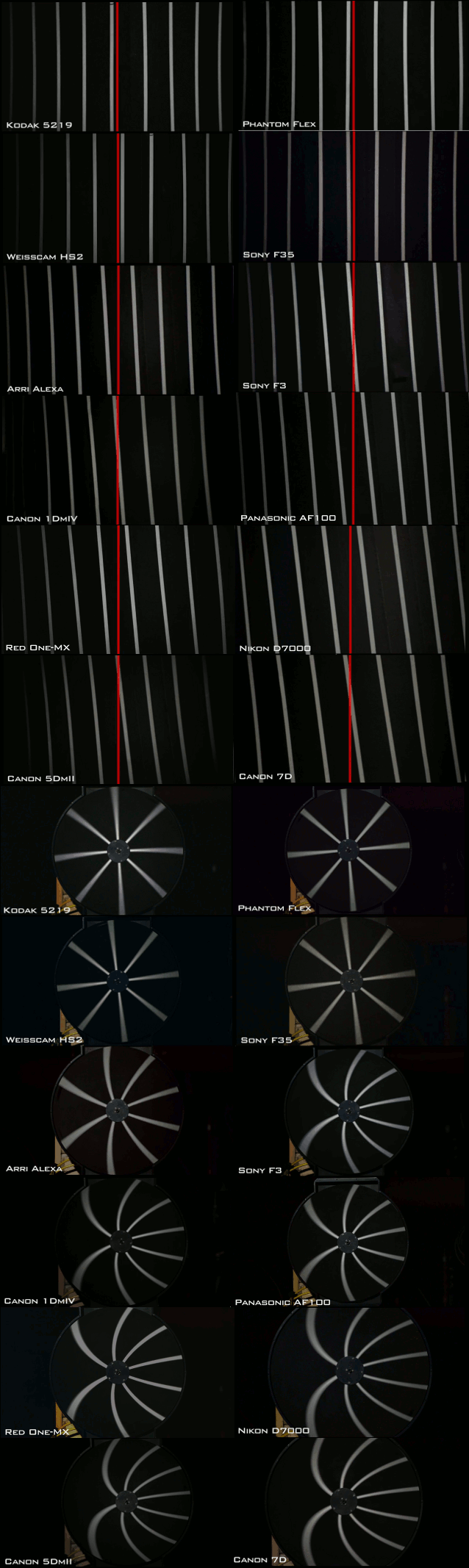
(A video is often the most tedious way to deliver information. It's slow, has long ornate introductions, and presents the findings serially rather than spatially. Usually an efficiently worded article, with pictures, is best.)
(A video is often the most tedious way to deliver information. It's slow, has long ornate introductions, and presents the findings serially rather than spatially. Usually an efficiently worded article, with pictures, is best.)

torresfilms
Well-known member
Might just be me but I think the Kodak one shows a tiny amount of bending compared to the F35. Look at the near horizontal section.
Yup. I definitely see it. Good catch dhessel!
combatentropy
Veteran
Film looks different than the other global-shutter cameras, but I'm not sure that means it has slight rolling shutter. It might be from the mechanical shutter's blurred edge or imperfections in timing and registration that others have alluded to.
First, look at the first test, with the vertical lines. Film's is straight up and down, just like the other global-shutter cameas. If it had a slight rolling shutter, then the lines would tilt to the right slightly.
Second, look at the actual video of the spinning wheel (it starts at 6:23). Rolling-shutter cameras skew to the right and change as they turn. Film's is ever-so-slightly bending downward and not changing.
There's something miniscule going on, but I'm not sure it's rolling shutter. One thing I agree with is that film's shutter isn't quite the same as the lock-step, precisely timed, sharp on-off, electronic shutters in the F35 and others (for better or worse).
Last edited: