

JMtheDP
Veteran
I thought it was worth making a post about the sensor on the F35, as it can be confusing if you're not familiar with it.
The F35 is a derivative of the Panavision Genesis, a camera which Panavision and Sony developed together jointly. Although much of the cameras is different, the overall design, philosophy and crucially the sensor are the same.
The sensor in both cameras is a Super35 sized CCD, with a total resolution of 5760 x 2160.
Anyone with a basic grasp of maths will know straight away that seems a little odd as that should give you an aspect ratio of 2.66:1, but the sensor is 16:9.
The reason the resolution is so high for a camera which will "only" deliver 1080P is because Panavision and Sony opted to use a design known as RGB stripe.
If we understand the reasoning behind it, then hopefully you can understand why the camera seems to punch way above its weight resolution-wise.
For ease of understanding, I am going to refer to pixels on the sensor as PHOTOSITEs, and when I talk about a pixel I mean the finished image.
I think we can all agree that every pixel of a colour image needs red, green and blue information to generate a colour picture. Traditionally, broadcast cameras solved this problem by having three chips - one for each colour - and a prism splitting the light. Although a lot of people looked down on this process, early colour film worked exactly the same way.
There are quite a few hurdles in scaling this up to 35mm size so for the next generation of cameras to be able to use a single, 35mm sized chip (and be able to use all of the lovely lenses), then another solution had to be found. Fortunately Kodak had developed a solution many years earlier (the 70s) called the Bayer pattern. This is a way of dividing up the sensor into a fairly ordered pattern of alternating RED/GREEN/RED/GREEN and GREEN/BLUE/GREEN/BLUE lines. Visually, that looks like this:
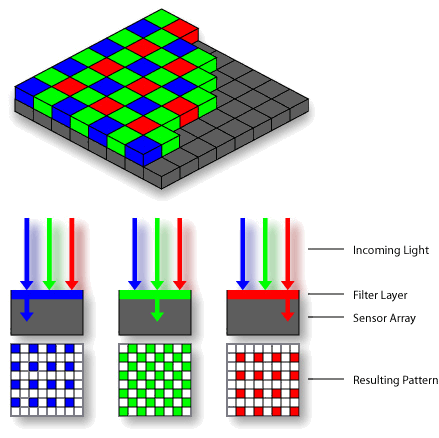
Now the argument over exactly how good the bayer pattern is at its job is a complex one, but I think it is a very clever solution to a problem and it works much better than you think it might.
HOWEVER, it is fairly unavoidable that some resolution - particularly in colour - will be lost as each PIXEL in the finished image only has the precise information for one of the three colours, if you are doing a 1:1 conversion.
Panavision and Sony decided that they wanted to make sure their camera delivered a 1080P image (remember, this is years before RED) which was the best it could possibly be. They decided to go the brute force route and give each pixel three photosites, one red, one green and one blue.
The idea behind this was to ensure that each pixel of the full image did not have to guess any colours and could deliver a full 4:4:4 image (full colour information at full resolution for every colour).
To go one step further, there is a thing called nyquist theorem which states to make best use of any recording medium you should sample at double the frequency (eg. why CDs are mastered at higher than 44.1khz etc...) - so they doubled the number of pixels.
To put it simply, on a PER PIXEL basis, each pixel of the finished F35 image was fed by SIX photosites. Compare this with ONE from a RED's 4k/5k and you have a good idea why the camera looks so good. Don't believe me? Shoot a RED at 2K and compare.
Here is an illustration by Sony:

The F35's sensor is also a CCD, which means a GLOBAL SHUTTER - no rolling shutter here.
Interestingly, ARRI took a similar approach with the ALEXA and instead of using an RGB stripe, they used a bayer pattern with the same vertical resolution as the F35, but half the horizontal resolution. In their mind this also produces good 2K pictures, and I agree.
----
Now, there are a few issues with the F35 sensor - no sensor is perfect. This is the main one, I am sure I will think of others.
Vertical smear - it is a feature common to all CCDs, but the F35 seems particularly weak to this. Pointing a bright light directly down the lens can cause vertical lines to appear. Usually purple. Think anamorphic flare but titled 90 degrees. Not much you can do about it other than avoid the object. Camera flashes down the barrel also do very odd things, as I found out recently. However, strobe lights not pointed at the camera render beautifully due to the global shutter.
----
FURTHER READING:
A lot of this information is taken from a Panavision seminar many years ago, "Demystifying Digital Camera Specifications". It should be on the Panavision site somewhere, but I can't find it. Here is a youtube link to the first part. I'm sure you can find the others. It is a very technical, but interesting presentation.
http://www.youtube.com/watch?v=gqq8QKMmtYg
The F35 is a derivative of the Panavision Genesis, a camera which Panavision and Sony developed together jointly. Although much of the cameras is different, the overall design, philosophy and crucially the sensor are the same.
The sensor in both cameras is a Super35 sized CCD, with a total resolution of 5760 x 2160.
Anyone with a basic grasp of maths will know straight away that seems a little odd as that should give you an aspect ratio of 2.66:1, but the sensor is 16:9.
The reason the resolution is so high for a camera which will "only" deliver 1080P is because Panavision and Sony opted to use a design known as RGB stripe.
If we understand the reasoning behind it, then hopefully you can understand why the camera seems to punch way above its weight resolution-wise.
For ease of understanding, I am going to refer to pixels on the sensor as PHOTOSITEs, and when I talk about a pixel I mean the finished image.
I think we can all agree that every pixel of a colour image needs red, green and blue information to generate a colour picture. Traditionally, broadcast cameras solved this problem by having three chips - one for each colour - and a prism splitting the light. Although a lot of people looked down on this process, early colour film worked exactly the same way.
There are quite a few hurdles in scaling this up to 35mm size so for the next generation of cameras to be able to use a single, 35mm sized chip (and be able to use all of the lovely lenses), then another solution had to be found. Fortunately Kodak had developed a solution many years earlier (the 70s) called the Bayer pattern. This is a way of dividing up the sensor into a fairly ordered pattern of alternating RED/GREEN/RED/GREEN and GREEN/BLUE/GREEN/BLUE lines. Visually, that looks like this:
Now the argument over exactly how good the bayer pattern is at its job is a complex one, but I think it is a very clever solution to a problem and it works much better than you think it might.
HOWEVER, it is fairly unavoidable that some resolution - particularly in colour - will be lost as each PIXEL in the finished image only has the precise information for one of the three colours, if you are doing a 1:1 conversion.
Panavision and Sony decided that they wanted to make sure their camera delivered a 1080P image (remember, this is years before RED) which was the best it could possibly be. They decided to go the brute force route and give each pixel three photosites, one red, one green and one blue.
The idea behind this was to ensure that each pixel of the full image did not have to guess any colours and could deliver a full 4:4:4 image (full colour information at full resolution for every colour).
To go one step further, there is a thing called nyquist theorem which states to make best use of any recording medium you should sample at double the frequency (eg. why CDs are mastered at higher than 44.1khz etc...) - so they doubled the number of pixels.
To put it simply, on a PER PIXEL basis, each pixel of the finished F35 image was fed by SIX photosites. Compare this with ONE from a RED's 4k/5k and you have a good idea why the camera looks so good. Don't believe me? Shoot a RED at 2K and compare.
Here is an illustration by Sony:
The F35's sensor is also a CCD, which means a GLOBAL SHUTTER - no rolling shutter here.
Interestingly, ARRI took a similar approach with the ALEXA and instead of using an RGB stripe, they used a bayer pattern with the same vertical resolution as the F35, but half the horizontal resolution. In their mind this also produces good 2K pictures, and I agree.
----
Now, there are a few issues with the F35 sensor - no sensor is perfect. This is the main one, I am sure I will think of others.
Vertical smear - it is a feature common to all CCDs, but the F35 seems particularly weak to this. Pointing a bright light directly down the lens can cause vertical lines to appear. Usually purple. Think anamorphic flare but titled 90 degrees. Not much you can do about it other than avoid the object. Camera flashes down the barrel also do very odd things, as I found out recently. However, strobe lights not pointed at the camera render beautifully due to the global shutter.
----
FURTHER READING:
A lot of this information is taken from a Panavision seminar many years ago, "Demystifying Digital Camera Specifications". It should be on the Panavision site somewhere, but I can't find it. Here is a youtube link to the first part. I'm sure you can find the others. It is a very technical, but interesting presentation.
http://www.youtube.com/watch?v=gqq8QKMmtYg
Last edited:


