FS7: Exposure aids in CineEI mode

moldcad

Veteran
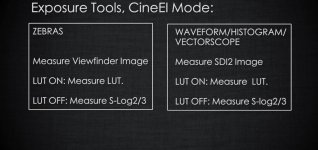
Sorry @RASL I almost derailed your FS5 Slog-2 noise issue thread; I'm now moving to a new one with my doubts. Watching Alister Chapman's videos on FS7, I am not sure if it's me not grasping what he's really saying here (most probably) - or could he have something confused on the below screen grab? Please comment.

Piotr

EDIT: I guess it's been myself who is being hard to understand; OK so Alister is saying about important differences between zebras vs. other aids (depending on which signal, and LUTed or non-LUTed, they are monitoring) - yet the table below doesn't seem to quite reflect that. Or am I blind?
 

Attachments
  • exposure adds in CineIE.jpg
    exposure adds in CineIE.jpg
    53.2 KB · Views: 0
Last edited:
Ben, what I actually want to know would become clear if you cared to watch Alister's FS7 episode No. 9 - but since you prefer to ignore Alister, I'm afraid you can't help me in this one :)
 
Fair enough. Alistair repeatedly gets as much wrong as he gets right is the point I'm making. So if you have a specific issue or question that we can help you with that doesn't involve me having to listen to him then ask away :)
 
Ben, let me ask you a question. Not exactly what moldcad was asking, but it is related to statements from Alister. I hope moldcad does not mind.

Alister states that it is better to use hypergammas/cinegammas than any slog curve in low light situations or when extra dynamic range is not needed. The reason he gives - in a few words - is that by not filling the entire "dynamic range bucket", you will actually be recording less information: "if you need to grade the S-log3 to gain the same contrast as a dedicated high contrast gamma such as 709, then the lack of recorded data can make the image become coarser than it would be if recorded by a narrow range gamma" (http://www.xdcam-user.com/2016/01/log-is-a-poor-choice-for-low-light/).

I have mixed feelings about that. When being able to expose correctly slog3 in low light situations with my FS7, I have gotten very nice results that have the same look of the rest of my slog3 shots (same color science). In some cases however, I did notice that hypergammas/cinegammas gave better results. What is your experience of using slog2 or slog3 in low light situations? Do you agree that it is better to stay away from them in low light?
 
Personally I believe Hypergammas are worse than the Devil and shouldn't be offered on the camera at all. They are the cause of 90% of the complaints about the dreaded 'Sony video look'.

'Low Light' is a relative term. As far as I'm concerned Cine-EI's native EI2000 is pretty low light capable compared to other Super 35mm sized sensor digital cinema cameras, especially if you're clawing back another stop with a speedbooster or similar.

I use Cine-EI and slog3/sgamut3.cine exclusively except for a couple of times a year when I do some live streaming work.

If you're talking about wanting to shoot at ISO 5000+ in custom mode then I'd still avoid hypergammas and instead use whatever iso you require to expose properly along with slog gamma and possibly some noise reduction if you really need it.

The fact is, if you can't expose properly due to light then you can't expose properly. No gamma setting is suddenly going to bring more light into the sensor. but the natively crushed blacks of a hypergamma might give you the perception of less noise.
 
Ben, let me ask you a question. Not exactly what moldcad was asking, but it is related to statements from Alister. I hope moldcad does not mind.

Alister states that it is better to use hypergammas/cinegammas than any slog curve in low light situations or when extra dynamic range is not needed. The reason he gives - in a few words - is that by not filling the entire "dynamic range bucket", you will actually be recording less information: "if you need to grade the S-log3 to gain the same contrast as a dedicated high contrast gamma such as 709, then the lack of recorded data can make the image become coarser than it would be if recorded by a narrow range gamma" (http://www.xdcam-user.com/2016/01/log-is-a-poor-choice-for-low-light/).

I have mixed feelings about that. When being able to expose correctly slog3 in low light situations with my FS7, I have gotten very nice results that have the same look of the rest of my slog3 shots (same color science). In some cases however, I did notice that hypergammas/cinegammas gave better results. What is your experience of using slog2 or slog3 in low light situations? Do you agree that it is better to stay away from them in low light?

He is technically correct.. but in reality moving a HG image from yukko colours to nice is so much harder than moving Slog to nice it makes HG a total pain to use.
 
Ben, let me ask you a question. Not exactly what moldcad was asking, but it is related to statements from Alister. I hope moldcad does not mind.

Of course I don't mind - I'm starving for information so everybody feel free to hijack my threads as long as you put more valuable information to it.

But since RASl's question again has to do with what Alister said - and I can feel this forum doesn't seem to esteem his statements - I wouldn't be honest if I didn't defend Alister. In fact, his FS7 series videos have been enough for me to grasp the general understanding of the completely new tool my FS7 is to me. In his 10 episodes, there are only 2 fragments which he either put incoherently, or I simply failed to understand. These are the ones:

1. In his tutorial No. 6 he recommends using S-log3 with S-Gamut3.cine (as opposed to S-Gamut) as "easier to grade" color space. I don't have enough experience with any to actually tell whether this is true, so I'm asking you guys - is it really so, and what's the rationale behind it (Alister didn't offer any)? BTW, a related question is that using Sony's Catalyst Browse, I'm only able to apply the REC709 LUT on S-Gamut recorded picture; when I record using S-Gamut3.cine colorspace (as Alister suggests), the "source" is locked as sRGB and even applying the 709 LUT doesn't work (though of course it does in NLE). What's the reason for this Catalyst Browse limitation?

2. In his tutorial No. 9 tutorial, he says that out of the exposure aids available, when working in CineEI mode
: "Zebras measure what's in the fiewfinder, while waveform and histogram - the SDI2 signal; so if you have LUT enabled in the EVF, Zebras will measure the LUT level; if you have LUT enabled on SDI2 - so will the other 2 tools. BUT: if there's no LUT on SDI2, VF and histogram will be measuring the S-log2/3 RECORDING levels". Now please go back to my first post here, and help me answer my question I asked in a somewhat convoluted way: is the screen grab from Alister's said video actually consistent with what he's saying? I'm not saying it isn't - just find this passage a bit unclear, compared to all the rest of Alister's FS7 video tutorials...

Piotr
 
Personally I believe Hypergammas are worse than the Devil and shouldn't be offered on the camera at all. They are the cause of 90% of the complaints about the dreaded 'Sony video look'.

Yes, Alister has always been a preacher for HGs; while he was right they're better than Cinegammas found in lower-end cameras, I agree with Ben they can be extremely difficult to work with - especially for obtaining the right gentle highlight roll-offs while avoiding noise in the shadows and/or compressing skin levels... In my years with the EX1, it took me a long time to develop PPs achieving this - but even though I had one for seemingly most lighting situation, it happened very often none was quite good for a new scene/lighting I came across and din't expect... Whether CineEI and log curves on my new toy will prove better in handling this, I need some more time to tell, though.

Piotr
 
Why do you persist in trying to get others to explain, defend, or decipher what someone else has said? Why don't you go ask the person who said it.
 
You know what, Doug? I had no idea that a grown and accomplished man can bear aversion to somebody for so long - I'm not like this. Even if I have a controversy with someone, as soon as he/she doesn't treat me with hostility any longer I promptly forget about all past confrontations and move along.

You're clearly not like that, pity because I appreciate your knowledge and experience and never said "on another forum that I have no interest in what you have to say". If you understood me like this, it's your problem - but to put effort to bash me in two separate threads like this?

OK, so this forum doesn't appreciate Alister - let it be, but where did I ask to defend him? Your hostility towards me seems to handicap your understanding of my posts. Why not simply ignore them, Doug - rather than take time and effort to post answers like this?

Stay cool,

Piotr
 
The two gamuts map colour to different places - the second is simpler to untangle because the mapping more "linear"

--

the zebras are are activated by what is showing on the omboard monitor - the other tools are calculated by the image being recorded (to card)

zebra therefore can confuse as lut is toggled on/off

Does this answer your questions?
 
Yes Sam, thanks a lot. As to the second one, I guess Alister's table I posted as not quite coherent with his own words would be clearer if he distinguished between the "LUT" and "MLUT" naming convention.

As to the first: of course I compared graphical representations of S-gamut.cine and S-gamut, and agree with you (and hence indirectly Alister's advise) - the only last thing I'm still not clear about is why Sony's own Catalyst Browse seems to only be able to "delog" S-gamut (by offering LUT options), yet not the "simpler" S-Gamut.cine...
 
Catalyst is an awful piece of software, but I don;t have any issues quickly previewing sgamut.cine stuff in rec709 on it.
 
OK, so this forum doesn't appreciate Alister - let it be,


Well, just to clarify... I'm sure he is a lovely guy. But he not only does paid work for Sony, he also comes from a background of 'getting the shot' as opposed to 'making the shot brilliant' and I feel it reflects in the work of his I have seen.

He is most certainly not the Yoda of Sony cameras, despite making some videos on them.
 
I agree Catalyst is - first of all - an unready software yet, so if I'm asking this question is out of curiosity whether any technical reason for my problem exists. Because Browse has a couple of advantages, actually; it's free, you can log your XQD cards with it, mark in-out points of your clips and copy to your system; you can also transcode to many formats. Also you can export your "quick and dirty" grading as your LUTs from it, and apply the built-in 709 LUT (which I guess is the same as on Sony's cameras) to your log-recorded material before copying/transcoding.... So, quite a lot of free functionality, actually - still don't know why I cannot apply the LUT to me clips recorded in S-log3/S-gamut.cine while I can do it with S-log3/S-gamut...Not that I need to (I actually don't as stated elsewhere) - just curiosity!

Piotr
 
Catalyst is a nice piece of software, to sort and view and most of the time enough to correct the cine-ie of custom slog files. Only reason I don't use it as much as I want is that it cannot convert/transcode xavc-i to dnxqd-x (4K 10 bits). I asked Sony and they answered that they 'definitely wil consider to bring this into the software in the future'.
That would be an advantage for windows users.
 
Last edited:
I'd much rather pay attention to Alister Chappers than the stay at home cinematographers that frequent this forum. At least Alister has the temerity to be out 'getting the shot' while others spend their time making themselves look brilliant through forums posts.

In my few encounters with Alister I can attest he is a 'lovely guy' a very knowledgeable one too and one who retains his modesty.

Moldcad, I see you still buy cameras to talk about them.
 
I'd much rather pay attention to Alister Chappers than the stay at home cinematographers that frequent this forum. At least Alister has the temerity to be out 'getting the shot' while others spend their time making themselves look brilliant through forums posts.

In my few encounters with Alister I can attest he is a 'lovely guy' a very knowledgeable one too and one who retains his modesty.

Agreed.

Moldcad, I see you still buy cameras to talk about them.

Negative, sir. If I talk/post about them is only to hear/read and learn about them from others. And believe me, some do help me learn...

Piotr

PS. Oh, and I shoot, edited and sold 12 DVDs/BDs with live performances of classical music international stars (like the Polish guitar player Marcin Dylla -- go google him), some of which were nominated by the Polish Music Phonography/Videography Academy for the renowned "Fryderyk" (does this name ring a bell for you?) award. Even though my main area of expertise is quite elsewhere...So clearly, I'm not just talking about cameras.
 
Last edited:
So, quite a lot of free functionality, actually - still don't know why I cannot apply the LUT to me clips recorded in S-log3/S-gamut.cine while I can do it with S-log3/S-gamut...Not that I need to (I actually don't as stated elsewhere) - just curiosity!

OK, I must have been doing something wrong - tried again, and both Slog-3 gamut formats can be LUTed in Browse, if anyone wishes so. Have no idea why it didn't work yesterday; most people would add "still learning" but I'll add "only started learning". Anyway, sorry for confusion.

Piotr
 
Back
Top