EX1 on a Flycam 6000

basspig

Veteran
I'm testing out a Flycam 6000 stabilizer. This was the first time I took it downtown. This video was shot at night, about 9pm, where the lighting gets interesting at a carnival:


http://www.youtube.com/watch?v=H5-wf-d3n1I


I shot a lot of daytime footage downtown, and walked several miles with the rig attached to me. Quite a spectacle that attracted all sorts of looks from random people that I passed by. I'll have more of that footage edited into Youtube videos later on in the day...

It's been a busy weekend.. Friday I shot a documentary for Zambelli Fireworks and did a 3-camera shoot and 5-channel 24-bit audio recording, up close to the mortar launchers, with flaming debris landing all around me and my camera ops! I'm exhausted from all the walking and standing and carrying of gear this weekend... lost several pounds this week from all the workouts.
 
Hey Mark,

Those images seemed to glow in that light. :)

I have questions about your flycam though. I have one that I set aside for awhile and just got it out again recently.

I had originally balanced for an HV20. Even with a monitor and battery on the bottom sleds it took a significant amount of weight to balance. So my first question is; how much weight did you use to balance the Sony?

My second question is; what do you think about the springs? Mine came with springs that seem about 10 times too heavy for the HV20.

Because of that the arm doesn't flex enough to absorb the footstep motions. I'm assuming that they're about 50% too heavy on the EX1. I'm going to see if I can get some new springs this weekend.

Also on mine most of the joints are smooth, but the end of the arm could be better.

Have you had any thoughts about it?

Duke
 
some nice footage there basspig, sounded like you had a shotgun attached (your voice was much softer than everyone else's) what are you using?

i notice there is a bit of the pendulum effect on the camera (nature of a lot of the stabilizers) any way that can be alleviated through practice or is that just a side effect of it?

Thanks!
 
Duke,

Yeah, it was nearly dark, being 9pm here on the east coast, and the balance of sky light was just right with the balance of light from the carnival. I used CINE4 gamma, which makes the mids/shadows darker, but preserves the colors on the highlights, which is ideal for shooting fireworks, which is what this profile is set for.

The springs are indeed too stiff. Cine City says the arm is adjustable for cams 5 to 33 lbs. So an EX1 is on the absolute minimum end. My EX1 has a 1 lb stereo mic mounted to it, and I was just able to balance left/right with the screw all the way in on the camera table, but I had to back both screws nearly all the way out on the arm sections on both ends of each section. It seems to me that the arm could be made of aluminum and the springs half the thickness. This would make for a lighter system.

When I first tried this setup, I put my EX3 on it, with the 4lb 8XS wide angle lens, and the stereo mic, altogether weighing probably around 12lbs. To balance that, I had to use ALL of the weights, but the springs seemed not too heavy. I also had to slide the gimbal support up a couple inches, making it necessary to remove the label, which prevented further upward motion. With the EX3, I found that it was almost too heavy for the vest; the socket bracket kept sagging down and below the cushion, causing it to chafe against my hip. It was also a real pain in the back to wear with that camera. When I rebalanced it for the EX1, it became manageable and I was able to walk a half mile with it on without too much difficulty. I'm going to edit the rest of the footage that I shot downtown during 7pm, as it's much smoother. I was having trouble controlling the rig in this crowd and turning around constantly to see that my 6 year old daughter wasn't being lost or kidnapped in the crowd.

It looks like a major pita to attempt changing those springs. And finding just the right replacement could be elusive. The idea did cross my mind! If the arm were made of aluminum, that would go a long way to reducing the weight burden too. With the EX1, it's hardly perfect to damp the vertical motion of steps. But it's not that noticable unless there is a stationary object near by to visually reference from. Stuff in the distance looks pretty smooth. That last shot with walking past the rows of parked cars seemed to be pretty smooth.

I think the pendulum effect is a matter of inexperience.. I see it a lot on footage shot by inexperienced Steadicam ops. The operator must anticipate his moves and use the left hand to guide the pole into vertical position when making a turn, or it will do the airplane banking effect. Also, a light touch is important, or else your arm will transmit vertical motion to the camera! My right hand is on the L pipe that links to the top of the arm, holding it from swinging out. My left hand is on the pole. But both left and right have to be limp, so as not to transmit too much body motion--tricky to be limp and holding on at the same time. That's why Steadicam ops get the big bucks! Not to mention, it's a sweaty, pretty heavy exerting job.

The mic is not a shotgun, although it's directivity and rear rejection is very good and it seems to 'tele-zoom' the sound source in front of it. It is a Rode NT4. Big and bulky--too big in fact, to fit in the Sony mic mount, so I made my own to replace Sony's pathetic mount. I get shotgun-like directivity, and stereo sound with it. An ideal combination for my purposes.

I'll put up some daytime footage that I think is smoother, as I was by myself and not wading through crowds of teenage girls acosting me to get on Youtube. :)
 
This is what Cine City told me about the Flycam 6000 weight bearing:

Dear basspig,

Hi,

Thank you for your mail.

This Stabilization system can bear camera weight upto 5 to 33 lbs , Therefore , This complete Indicator kit will perfectly work with your Sony EX3 with the Fujinon 8XS 4-32mm wide angle lens or camera set up.

Kindly place your order , I will send you invoice accordingly.

Quality of our product is excellent , Buy with confidence.

For any further queries , Feel free to contact us.

Thank you,
Best Regards,

Pratibha
 
Cool, thanks for the replies on that. That Rode mic sounds pretty nice, I may have to look into it on my future gear list...

I'll be on the lookout for more footage, I've been starting to eye a stabilizer for my EX1, but for right now, I've got my homemade counter-weighted monopod that does "fair" for run-n-gun shooting in the woods...
 
The only downside of the Rode NT4 is bulk, weight and size. 85% of it is handle and battery compartment. I wish Rode would make a version that didn't use a battery, so they could cut the size way down for the phantom powered version. The business end of the mic is really very small and lightweight.

With a little modification, the Flycam 6000 can be a great tool.
 
IE 8 crashed so I lost what I wrote at length..

Good find, Duke. I am reading that forum. Wondering where those guys got custom springs made.

My manual gives conflicting weight ranges.. in the early part it says 14-23lbs. Later on it talks about Indicator Magic Arm 6000 handling 5-33lbs sled load. So which is it? :)

Here's the other footage, as promised. I have to figure out why there's so much pendulum action going on.. is that just bad technique, or a defect in the Flycam, or that I don't have the gimbal in the right place? This is my next investigation.

Here's that footage from around town with the EX1 on the Flycam:


http://www.youtube.com/watch?v=0_HCi4j-1Pkhttp://www.youtube.com/watch?v=H5-wf-d3n1I

.
.
 
There are a couple places mentioned on HBS that build them, but I saw one of them cuts the threaded plug out and reuses it. I want to have the original springs in case I ever want to fly a Betacam or Red One. (You never know. It seems like whenever I absolutely get rid of something then I need it.)

I heard back from Pratibha at Cinecity. They will make the springs for me for $50 including postage so I have ordered them at 50% strength.

My Flycam is actually from a couple years ago and has a few minor changes compared to the new ones. It has the adjustment screws, but not the indicator. The problem with that adjustment is it can make the spring tighter, but not looser. If you keep loosening it beyond a certain point the arm just droops.

One thing HBS posts recommended was moving the gimbel/grip upwards, which I did. Mine was below the sticker on the post because the sticker stopped it there. I cut the sticker at the hyphen between Flycam and 6000 and moved the gimbel up. [Note, there is a recessed set screw in addition to the knob.] It was at 6.5" from the top and now ~4". I reattached the sticker lower on the post.

This actually did help a whole lot for stops, starts and turns. If you think about it. The shorter distance at the top means the camera moves less when the bottom moves.

I had already wired mine for a wide screen field monitor. (By looking down at the monitor I can see where I'm walking and the monitor at the same time, which helps the footstep motion.) I'm going to use an L-ion battery instead of the lead acid battery I have now, in order to reduce pendulum effects and weight.

I may move the gimble even higher, but they warned if you get it too high it will hit the sled on certain movements.

I'm also going to consider cross drilling the arms to lighten them. They are way over engineered in steel for the weights they will be carrying. Real Steadicams are titanium or carbon fiber these days.

I could probably get a couple of pounds off the rig right there. Another thought was just to cut out a section from each arm and replace it with square aluminum tubing. I don't doubt that I can get 5-10 lbs off of the entire thing without weakening it appreciably.
 
Last edited:
That's great news about the custom springs.. I'll have to ask them to make me some as well for the EX1 balancing. I think the springs need to be longer (more coils) and thinner.

I myself also moved the label so I could place the gimbal up higher, but I think this screws up the dynamic balance and causes it to tilt from side to side in a sort of ocean wave, pendulum manner when turning, stopping or starting. I'm going to experiment with this and try to determine the optimal gimbal location. I think if it's balanced between the two end masses, then a change in direction at the gimbal will result in no tilting of the pole. If the gimbal is too high up, and you move left, the camera will tilt left because the bottom weight is lagging due to Newton's 3rd Law.

It's pretty simple to achieve static balance, but dynamic balance is much trickier, however, I suspect it also carries the greatest reward in terms of keeping the pole plum and the camera level.

My biggest problem seems to be the arm. It seems necessary to make the lower belts on the vest way too tight in order to keep the arm socket from pushing down below the vest edge. This was a problem with the heavier EX3 and 8XS lens, making it near impossible to use as it seemed like the support was collapsing under the weight. Reduced weight with the smaller EX1 was just enough to make it functional. I don't know how that belt could be made tight enough and the operator still be able to breathe! I suspect the vest is too small and that it's really supposed to sit lower with the two bottom belts across the lower abdomen, not the upper belly. Oh well, made in India, what can one expect? :)

That articulated arm could sure stand to be aluminum! It adds non-functional weight to the system that we could do without. But cutting the metal and strapping on aluminum channeling? Sounds risky with a low return on investment.

Longer springs would be more linear. Currently, the arm's tension increases a lot as the arm is pushed down and the springs stretch. Also, it's a good idea to determine if the joints of the 'bones' are free to move without friction. Check the tightness of the bolts.

One thing I did tighten was the joint between the bones, as it allows the arm to swing out and smack something if it's not being held onto all the time. I see no reason to have that joint move, so tightening that section makes it more manageable.

It's quite a beast, but that's $1,500 vs $21,000 for a real Steadicam system, so I'm not too disappointed.
 
The new springs will be thinner, but keep in mind you already have a spring on both ends. I don't know if you need longer. I was looking at a clip of Thomas Church (well known Steadicam operator) using his, and his rig freely moves up and down.

Moving the gimbal up shouldn't affect dynamic balance unless balance was already off. Do you have significantly more weight on the bottom? Or is the weight distributed unevenly below because of a monitor, battery or improper spacing of the two bottom platforms?

When I put the monitor and battery on the bottom platforms I had to space them about 6" apart to get it to spin balance again. Drop time should be about 3-3.5 seconds.

Also many people on HBS recommend shortening the post after moving the gimbal up. I don't want to shorten the post, but I may try moving the bottom platforms up. For the moment though mine balances.

I find the vest too small over all, but I'm 6'4" and was 250lbs. (Going to seed I'm afraid so I dropped 30lbs. Now it fits.) I'm not finding any problem with the arm socket moving down below the vest. Maybe you can tighten the back plate straps on the vest. I hate one size fits all because those kind of things never fit me.

Does yours have the indicator arm? Or is it the plain 6000? I have the plain 6000 which does not have the adjustment block on the socket and swings out like yours. The indicator arm has two adjustments that allow you to adjust the socket so it doesn't swing out. I wrote to Cinecity to see if I can buy the adjustable socket separately. No word from them on that yet. There's an italian pro adjustment block but that's $500.

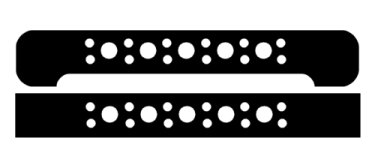
Cutting and inserting aluminum is certainly the riskier move, but those arms are 3/16" steel! At some point I'll bite the bullet and drill different sized holes, like a sci-fi spaceship strut, up and down each one to lighten the load. There are already 4 slots cut in each arm, there's no reason there can't be more. See below.

So how has it worked out with tightening the arm joints? Did that solve the swing out or just reduce it? Did you tighten all of them, or just certain ones?
 

Attachments

  • VentArm.jpg
    VentArm.jpg
    25.6 KB · Views: 0
Last edited:
I lost 20lbs since the spring began, but I'm afraid I've a little too much belly yet, as it's a struggle to get those bottom two straps buckled. If I suck it ALL the way in till I nearly pass out, I can get them buckled. :) Trying to see if I can get the vest to sit lower.. from what I read from Googled info on steadicaming, the waist belt must be almost over the hips, not the abdomen. Also, it pays to be an athlete. I can see why no one over 50 does this job.

Mine is the Indicator Magic Arm 6000. The 'indicator' is useless, as it's all the way down to the bottom of the scale to balance the EX1. When the arm is at rest, the springs are completely closed/relaxed. So the first 1/4 of the arm motion is easy, then it stiffens up. Has some bounce problems.

After a lot of reading, I think perhaps my dynamic balance is not bad after all.. I did a test holding the gimbal out in front of me and swinging rapidly right and left and the camera and weights remained vertical. Of course the camera turned in the gimbal to maintain facing in one direction but that was all.

I hope you have access to machine tools, because some of those holes look to be 3/4" and will require a die punch with 40-ton capacity to punch through that kind of 3/16" steel. That arm should have been aluminum. That's what their advertizing seemed to say. Those holes might remove 7% of the weight. You'll need a lot more than that to make a substantial reduction in weight. Even the springs are heavy. Changing springs may make more of a difference than drilling holes in the arm.

Tightening the arm joint didn't completely solve the swing out (when the camera / sled was attached, but it does prevent accidental swing out when putting on the arm/vest. The problem is that the pivot at the base of the arm is not level. It's tilted because for some reason the vest can't seem to keep the back plate vertical. I have to study this more closely, maybe in front of some full length mirrors to see what's happening behind me. If the pivot were level, the arm would stay put. I think the vest is more troublesome than the arm. The sled / gimbal works fine.

I tightened all four hex head bolts so that section is resistant to swinging out. It tends to keep the rig under control better.

I managed to loosen up the springs a bit by sticking a large screwdriver between each coil and giving a twist to separate it. The springs appear to be soft metal, as they stretched out fairly easily. So now I can dial in a little more tension and still keep the arm softer. Have yet to do some testing. Was almost 100°F outside today, so not a good day. Going to be even hotter tomorrow, so the forecast said.
 
Basspig,

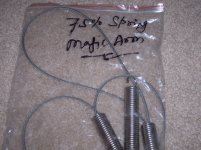
My new, lighter springs arrived from Cinecity. I have a little trepidation though. I ordered them at 50% tension. They came in a bag marked "75%". I'll have to try them out to test them.
 

Attachments

  • Flycam003.jpg
    Flycam003.jpg
    283.9 KB · Views: 0
Last edited:
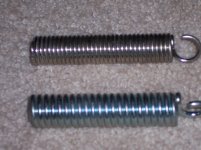
The spring wire is much smaller on the new springs. I'll put a picture up tomorrow. I installed the new springs. For the first time the arm actually moves like it was intended! I have a little adjusting to do and then I'll give it a real test. The feel is completely different than loosening the heavy springs.
 

Attachments

  • Flycam 004.jpg
    Flycam 004.jpg
    241.4 KB · Views: 0
Last edited:
From the look of the new springs, I'd say it should be about right.

I wrote Cine City myself, and they are going to send me new springs too. They said it would take a while to make them. How long did they take to make these replacements?

Good news and great to hear it really bears out my hunch that lighter springs help a lot. Heavy springs on the lowest end of their extension are non linear. Lighter springs operating in the middle of their extension are going to be the most linear. You'll also shave a few ounces off the arm weight.

Now if I can just get my vest to fit without the socket aiming down when I place the arm/sled on it!
 
The told me they had to make them too, but they shipped them in less than a week and they arrived about a week after that. Maybe less.

Do yourself a favor and run a 1/4-20 tap in the spring caps before you try to use them to clean them out. Otherwise they all bind.

I'm trying various washer combinations between the curved socket and the back plate to adjust the socket angle, but haven't found the optimum set up yet. From HBS the socket should probably be pointing up.
 
Thanks for that suggestion about retapping the threads. I'll probably put some graphite lubricant on them too, just for smoother adjustment action.

Did you have any difficulty taking apart the arm and also with re-stringing the new springs? It looks like a Chinese jigsaw puzzle.

Maybe I'll try washers or spacers on the back plate. That sounds like a great idea. Because I can't seem to make the belts tight enough to keep the socket from sagging otherwise.

I bought a EVIAN 7" LCD TV for $79 at Costco and I'm fabricating a bracket to attach it to the sled. This should be interesting..
 
Taking them apart is easy... putting them together again.... LOL

Unscrew the two adjustment screws on each arm section and the two springs drop out.

Restringing the cable is a little harder since the cable is stiff and hard to bend around the pivot points, plus the shortest distance for the cable is when the arm bones are most likely to squish your fingers.

Get all the cables squared away before you screw anything back together again. Its nor really hard though, maybe 30-40 minutes in total.

I just use a cheap little lilliput monitor for framing. Set low it lets you watch your feet at the same time for smoother stepping.
 
Back
Top