EVA1 + Atomos Shogun Inferno Rig Questions

Hallo,

I'm a camera op and I'll be working on a short film shoot next month using the EVA1 + Atomos Shogun Inferno. I've been researching the setup for a while now but haven't had any hands-on experience with the camera (as it hasn't been purchased yet) nor the atomos recorder, so there's several things I am unsure about.

Here's are a rundown of the prospective settings we intend to use:

Recording Format: CinemaDNG RAW
Aspect Ratio: 2.39:1
HFR Settings: 2.8k DNxHR 120fps
Delivery Resolution: 4160 x 1716

I have a few questions about the setup that I can't work out from searching online...

  • What does the 'MIX' mode refer to when choosing the HFR options on the EVA1? I'm guessing it's something to do with sensor cropping?
  • Whilst shooting 2.8k 120fps, can we select to conform to 2.39:1 AR on the Atomos?
  • We're planning to send a wireless video feed using a Teradek Bolt Pro to the director's monitor during some of the dynamic sequences filmed with a Ronin; is it best to use the HDMI out from the camera body or the Atomos' SDI out to send to the monitor? Will there be any difference in the feeds?
  • Why can the Atomos only record the full 5.7k sensor readout in ProRes RAW, and not CDNG? I know even if we choose to use ProRes RAW at 5.7k, we'd be downsampling it to 4k eventually, plus, the sensor output gets downsampled to 4k when opting for CDNG anyway, so which would be better: downsampling in-camera or later in post?
  • If we were to use a battery with a 2 amp draw D-tap link from THIS battery, would we have enough to power a Teradek Bolt Pro requiring 6.5W?
  • I know we won't be able to shoot in RAW and LOG as LOG is video format and RAW is sensor reading information, but is it possible to implement a LOG curve to the video image when the RAW data is turned into video either in the Atomos or during post-production?

I understand some of my questions are fairly wide ranging. Thanks for reading my post, any responses are appreciated.
 
What does the 'MIX' mode refer to when choosing the HFR options on the EVA1? I'm guessing it's something to do with sensor cropping?
Not sensor cropping, but mixing of pixels together which results in lower resolution. The 2.8K MIX mode means that you're turning your 5.7k sensor into, effectively, a 2.8k sensor. You would never want to choose this mode unless you were intending on shooting faster than 60 frames per second. It will unnecessarily lower the resolution of all your 60fps-and-under shots.

Although, there is one other reason why to choose 2.8K MIX, and that's if you need faster rolling-shutter performance. The 2.8K mode scans the sensor twice as fast as the 5.7k mode does, so it will result in less rolling shutter artifacting.

Choosing the 2.8K MIX mode will limit your internal and external recordings to either 2K or 1080p.

Why can the Atomos only record the full 5.7k sensor readout in ProRes RAW, and not CDNG?
Right now it doesn't support either, last I knew. They were supposed to update it for 5.7k support in May sometime.

CDNG takes up twice as much space as ProRes RAW. You'd need twice as fast an SSD to record in CDNG to support the doubled data rate. That's one reason why CDNG supports 4K up to 30 fps, but cannot support 4K up to 60 fps.
I know even if we choose to use ProRes RAW at 5.7k, we'd be downsampling it to 4k eventually, plus, the sensor output gets downsampled to 4k when opting for CDNG anyway, so which would be better: downsampling in-camera or later in post?
If you're using the 2.8K MIX mode, you've answered your own question -- the only output you'll be getting is 2K. You may want to rethink the sensor mode you're planning on using, or understand that if you're shooting 120 fps all the time, you're going to be making a 2K production, not a 4K production.

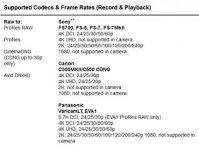
If you're recording raw, the choices are different anyway. You don't use the 2.8K or 2.2K MIX modes when outputting raw. When outputting raw, you have the choice of 5.7K up to 30 fps, or a slightly cropped-in 4K at up to 60 fps, or a pixel-mixed 2K raw at up to 240 fps. Those are your only choices when recording raw. So if you need faster than 60 fps, you're going to be getting a 2K production, not 4K.

I know we won't be able to shoot in RAW and LOG as LOG is video format and RAW is sensor reading information, but is it possible to implement a LOG curve to the video image when the RAW data is turned into video either in the Atomos or during post-production?
The Panasonic raw output is always encoded as log. It is encoded as a 10-bit logarithmic signal, very similar to V-Log.
 
Not sensor cropping, but mixing of pixels together which results in lower resolution. The 2.8K MIX mode means that you're turning your 5.7k sensor into, effectively, a 2.8k sensor. You would never want to choose this mode unless you were intending on shooting faster than 60 frames per second. It will unnecessarily lower the resolution of all your 60fps-and-under shots.

Although, there is one other reason why to choose 2.8K MIX, and that's if you need faster rolling-shutter performance. The 2.8K mode scans the sensor twice as fast as the 5.7k mode does, so it will result in less rolling shutter artifacting.

Choosing the 2.8K MIX mode will limit your internal and external recordings to either 2K or 1080p.


Right now it doesn't support either, last I knew. They were supposed to update it for 5.7k support in May sometime.

CDNG takes up twice as much space as ProRes RAW. You'd need twice as fast an SSD to record in CDNG to support the doubled data rate. That's one reason why CDNG supports 4K up to 30 fps, but cannot support 4K up to 60 fps.

If you're using the 2.8K MIX mode, you've answered your own question -- the only output you'll be getting is 2K. You may want to rethink the sensor mode you're planning on using, or understand that if you're shooting 120 fps all the time, you're going to be making a 2K production, not a 4K production.

If you're recording raw, the choices are different anyway. You don't use the 2.8K or 2.2K MIX modes when outputting raw. When outputting raw, you have the choice of 5.7K up to 30 fps, or a slightly cropped-in 4K at up to 60 fps, or a pixel-mixed 2K raw at up to 240 fps. Those are your only choices when recording raw. So if you need faster than 60 fps, you're going to be getting a 2K production, not 4K.


The Panasonic raw output is always encoded as log. It is encoded as a 10-bit logarithmic signal, very similar to V-Log.

Thanks for the detailed reply bud!

I don't think I made it clear enough, but we will be shooting most of the footage in 24p 4K, and only the 'slow-mo' sequences in 120fps initially. Keeping in mind that we'd need to scale any HFR footage we shoot UP to 4k, would the best way to shoot our 120fps sequences in a 2.8k non-RAW format, or 2K RAW?

The news about the LOG encoding in the RAW output is good to hear. I was really struggling to find anything about it online.

Could I ask your opinion on video recorders and the EVA1. The Atomos Inferno has lots of documentation online on it's compatibility and is often featured on EVA1's marketing releases which suggests it's the better option between that and say the Odyssey 7Q+. Apart from the Atomos' and the Odyssey's individual specs and usability features etc, are their any discernible advantages with picking one over the other?

All the best
 
The 2.8k video will probably result in sharper footage than the 2k raw; however the 2k raw can go to 240 fps so if high speed is most important, or raw is most important, those would be reasons to go 2k. The 2.8k video will max out at 120 fps and will likely be sharper and have a wider field of view, but it won't be raw if that is important. You really need to run your own tests to see which looks better throughout your whole post workflow when integrating into a 4k raw production.

As for recorders, I don't have much advice. I used the Odyssey a year or so ago and was not overly impressed,.but there are folks here who love them. The Atomos gets all the press because it is specifically supporting the EVA1, all its raw modes. I don't know if the Odyssey will support the 5.7k raw or not.
 
My experience with C-D recorders is that they work really well - but that it seems to take them a long time to implement 'planned' features. (I'm still waiting for some features that were supposed to be added to my NanoFlash and Gemini 444 recorders... ok, gave up waiting long ago.)
Conversely, Atomos seems to rush a lot of features into production that then may need a bit of tweeking. I've had more reliability issues with Atomos products than with ones from C-D.
So my advice would be to test the features you need on both systems. See if they really work the way you need. Leave them on/recording all day and see if either one gets too hot, or freezes up.
 
Thanks for the reply, Barry.

The thing is we're in the process of purchasing the equipment and want be clear on what we can practically do with the equipment, once we purchase it, I shall run all the necessary tests.

We'd need max 120fps for the production so the higher reaches of 240 isn't necessary. I find it strange that 240fps 2k RAW is available and not 120fps 2.8k RAW; I think we'll have to settle for 2.8k 120fps ProRes or DNxHR.

All the best
 

Attachments

  • atomos recordings.jpg
    atomos recordings.jpg
    17.9 KB · Views: 0
What's the data throughput on 2.8K mix/crop 120fps output via SDI video to ProRes/DNxHR? VS the 2.2K RAW mode output via RAW signal to ProRes/DNxHR?

The one thing that might edge out favor for RAW is if you are getting more data per frame but I am not sure how these modes compare in that regard?
 
I've not been following the EVA-1 firmware updates as I don't own one, so I'm totally lost on what each of the modes are. Can I ask what you mean by 2.8K 120fps?

Does this mean the camera is able to output the full 2.8K stream from the sensor at 120fps? Or is it taking that 2.8K sensor data and scaling it down to output an over-sampled 2k/HD (like it does for in-camera recording)?
 
He was referencing the sensor scanning mode, which can only be used to record 2k or 1080. There is no 2.8k option for raw output.
 
I've not been following the EVA-1 firmware updates as I don't own one, so I'm totally lost on what each of the modes are. Can I ask what you mean by 2.8K 120fps?

Does this mean the camera is able to output the full 2.8K stream from the sensor at 120fps? Or is it taking that 2.8K sensor data and scaling it down to output an over-sampled 2k/HD (like it does for in-camera recording)?

When shooting HFR (>60fps) you can't use the full 5.7k sensor and it's only scanned partly, giving a 2.8k non-RAW format in ProRes or DNxHR. Barry is right however, with a RAW output, it's HD or 2K only.
 
I have hardly dove into this at all, and not tested 120fps, but here's some stupid quick tests I did while cooking with a dirty glass and on patio. 240fps, raw output via SDI recorded as video (DNxHR). Sloppy but just to test noise, quality, and the 2.2k resolution. Outdoor one has super bright highlight (sky) in top left blown, down to shadows where the main action is just to see how it holds up. This is the 2.2K RAW crop + mix mode to Atomos Shogun Inferno.

password: 240
https://vimeo.com/266784333?activityReferer=1
 
Back
Top