Epic and Scarlet release in 2010

Status
Not open for further replies.
Jorge Diaz sold a used Angenieux 12-120 at one time that measured 200 lpmm on his lens projector at f4. That was exceptional, most older Angies will fall in the 120 lpmm range if they are well maintained, but that was considered a soft lens for 16mm. Wide open the older ones lose contrast and look softer as a result, but most of the bad rep comes from the huge number of them used on 16mm news cameras that got a lot of rough treatment and very little maintenance. I have two 12-120's. An older f2.8 T3.1 A type on my Auricon with the pellicle viewfinder, and a late model T2.1 HEC version with the superior high contrast coatings. Can't wait to see how that one looks as they have a rep of being very sharp wide open. It will be interesting to see how they compare.
Older 16mm film stocks do not have the resolution of HD, but that was not a shortcoming of the better lenses.

I have a sample photo taken with a Lumix G1 at 2:1 crop, using a 70's vintage Taylor Hobson 8-24mm f1.6 zoom at f2.8. At 2:1 crop the resolution of the G1 is very close to what Scarlet will be and this lens handily out resolved the camera with clean sharp edges and just very slight CA at the corners, the pixelation of the image limited effective resolution. With old glass like this there are certainly good and bad examples, but the best are certainly up to the task of producing HD resolution images.

You can see some interesting examples of C-mount vintage 16mm glass on a G1 at www.oldlens.com. Some of these lenses hold up well against anything you will find today and they have become very popular with 4/3 shooters due to their high speed. Most vignette on 4/3 as you would expect, but some of the better 25mm and up lenses have pretty decent full coverage. My personal favorites are the Kodak Ektars.
 
Last edited:
Jorge Diaz sold a used Angenieux 12-120 at one time that measured 200 lpmm on his lens projector at f4. Older 16mm film stocks do not have the resolution of HD, but that was not a shortcoming of the lenses.

I have a sample photo taken with a Lumix G1 at 2:1 crop, using a 70's vintage Taylor Hobson 8-24mm f1.6 zoom at f2.8. At 2:1 crop the resolution of the G1 is very close to what Scarlet will be and this lens handily out resolved the camera with clean sharp edges and just very slight CA at the corners, the pixelation of the image limited effective resolution. With old glass like this there are certainly good and bad examples, but the best are certainly up to the task.

200lp/mm? When I tried that lens it looked pretty soft on 5.5um pixels. You wouldn't want to be limited to f4 on 2/3". That would be like f2 on 1/3", deeper DOF than an f1.6 1/3" camcorder like the HVX or Z1 and many stops of light loss.
 
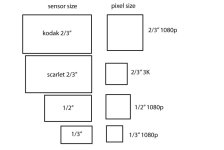
The pixel sizes.

pixel-size3.JPG

The pixel for Kodak is 5.5um. Red s35 is about the same (5.4um) so you can see how Red One pixels compare to Scarlet pixels (3.3um) and how Scarlet compares to 1/2" 1080p (like Sony EX1) and 1/3" 1080p (like Canon XF300). There will be an impact in performance. Resolution is not free.
 
The pixel sizes.

View attachment 19255

The pixel for Kodak is 5.5um. Red s35 is about the same (5.4um) so you can see how Red One pixels compare to Scarlet pixels (3.3um) and how Scarlet compares to 1/2" 1080p (like Sony EX1) and 1/3" 1080p (like Canon XF300). There will be an impact in performance. Resolution is not free.

Very interesting chart! How does the Kodak sensor tend to measure out in terms of DR?
 
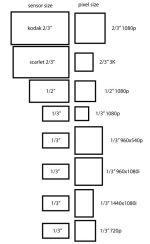
And one that includes the effective pixel area of more 1/3" flavours. 960x540p (HVX200), 960x1080i (Sony FX1/Z1), 1440x1080i (Canon A1), 720p (JVC HD100). Modern HD pixels in affordable camcorders are quite small.

pixel4.JPG
 
along this topic, this may be an interesting read for some of you:
http://reduser.net/forum/showpost.php?p=629878&postcount=11

Within the same sensor series and the current state of the art for each manufacturer, the pixel size has a direct effect on the image quality. There are volumes written on the subject and it's quite easy to demonstrate. This is why everything used in a serious application has the maximum possible pixel size.

Manufacturers constantly push the limit. Like making pixels 20% smaller and maintaing noise and dynamic range. Sony does that for years. But each sensor is a new design using newer technology, that is the nature of progress. New sensors are better when they use the same pixel area due to the advances in technology but this does not apply within sensors of the same series, produced using a given state of the art and methodology.
 
New sensors are better when they use the same pixel area due to the advances in technology but this does not apply within sensors of the same series, produced using a given state of the art and methodology.

This is one of the reasons I'm curious to see how 2/3" Scarlet M-X stacks up against S35 Scarlet M-X. Two chips of exactly the same series. So if S35 measures out to around 13.4 stops, and 2/3" measures to something like 12.8, I'd be quite happy with that delta.
 
http://reduser.net/forum/showthread.php?t=30076&highlight=myth+busted

Comprehensive thread on they myth that smaller pixels automatically = more noise less DR.
Effectively for pixel sizes between 3 and 7 microns, other aspects of sensor/processor design have more impact than pixel size alone. Overall sensor size is more relevant. A/D and processing is more important.

At 3072 pixels wide for 2k cinema format, Scarlet nearly exactly matches the standard 16mm camera aperture and at 2880 wide closely matches the 9.6mm 2/3" HD reference standard.
 
Very interesting chart! How does the Kodak sensor tend to measure out in terms of DR?

It's about 11stops. But the proof is in the actual impementation details of a specific camera using the sensor, the gamma curves etc. The sensor is only a small part of what we see on the output. You always need to compare actual cameras in a real world shooting situation. DOF requirements need to be taken into account also. The larger sensor will need to be stopped down and operate at a higher ISO which will compromise dynamic range and increase noise/alias.
 
I'm also interested:

Ceteris Paribus, is there a mathematical forumla or set of formulae which would allow one to calculate an expected DR or S/N ratio loss based on photosite size? Seems like it would boil down to rather simple physics...
 
I'm also interested:

Ceteris Paribus, is there a mathematical forumla or set of formulae which would allow one to calculate an expected DR or S/N ratio loss based on photosite size? Seems like it would boil down to rather simple physics...

Not really. Each sensor has different specs. CCD vs CMOS also makes a difference. The light gathering itself can be calculated, but you have to know how much noise the sensor produces and how much light a pixel can actually measure before saturation. If we do have precise datasheets like Kodak and Sony produce in their widely availably sensors, we can calculate everything, but in these cameras it's usually just a marketing claim. 13stops or whatever:) We need an actual test.
 
This is one of the reasons I'm curious to see how 2/3" Scarlet M-X stacks up against S35 Scarlet M-X. Two chips of exactly the same series. So if S35 measures out to around 13.4 stops, and 2/3" measures to something like 12.8, I'd be quite happy with that delta.

I'd be very happy if they meet the original specified target of 11-1/2+ stops. They have exceeded this target by two stops with the R1-MX upgrade, nobody knows yet what Scarlet and Epic will end up being, but with the latest gen electronics, should be a little better. I would expect the 2/3" to give up a stop or so maybe.

I can say based on my experience regrading older build 17 M sensor clips in Redcine-X that Red has picked up more than 1-1/2 stops of DR through software improvements alone over the last year. Red's most valuable products for the long haul are Redcode raw and their ever improving image processing software.
 
We need an actual test.

Which, of course, begs another question...how do you recommend testing DR and S/N?

I know RED has posted some charts and so forth, but what are the other perhaps less subjective alternatives? (I see about 13 stops. -Really? I only see 8? --What are you two talking about? I clearly see 15!)
 
Well DR is subjective to some extent. What one person may consider acceptable noise level may not be acceptable to another. Same is true of production styles. If you want pristine noise free images, you might control lighting to limit the dynamic range of your exposure and shoot for well saturated exposure densities. If you are shooting a gritty cinema verite style, available light and more noise might be acceptable.

The chart tests for maximum DR make no judgement about the quality of noise. They just show the full DR range from white clip to black noise floor where no further detail can be recorded at either end.

That's what I had thought was the case, I've just seen people disparage the use of charts and even "Real World" footage as too subjective, so I was wondering if there was some other alternative that relied more on some hard numbers.
 
You can use a standard dynamic range test, there are many of those aroung. You can also do an exposure series. Playing with gamma and post can change the results a little bit. But when I design I think of a cinematographer that applies the zone system by setting exposure to 18% grey. If the camera preserves highlights in skin tones, goes into clipping in a filmic way without false color and produces shadows with good saturation and texture, the dynamic range is good. I don't care about the specs or the noise level if there is false color on overexposure, a dark look or flat artifacted shadows from compression with no signs of detail and texture.
 
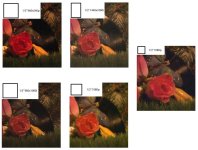
An example. Real cameras from the slashcam low light tests:

pixelsize.jpg

- The lowest resolution cameras with the largest effective pixels (on the left) are actually the sharpest, even though they have a fraction of the 1/3" 1080p camera pixels.

- The Sony is better than the Panasonic at the same effective pixel size. Differences between manufacturers are common.

- Reducing the effective area to about 1/2 or 2/3 reduces image quality on the 1440x1080i CCD model. The 1/2" 1080p CMOS model is also inferior to the large pixel CCDs of the first column, but the CMOS is also more processed and softer due to the CMOS preprocessing that is used to reduce the noise and boost the sensitivity. And this is a camera introduced years after the CCD models in the first column.

- Reducing the effective pixel area further by doing full hd on 1/3" reduces image quality further. Notice the blue patches of noise.

Physics of light gathering do predict everything quite well in these cameras.

- I also checked the PWM350. It's slightly inferior to the FX1, even though it has identical effective pixel area (being 4x larger at 2/3" 1080p). This is due to CMOS technology again.

The Scarlet 2/3" 3K pixels are between the 1/2" 1080p example and the 1/3" 1080p example in effective area.

Professional 2/3" 1080p cameras have identical pixel area to the CCD cameras in the first column.
 
Last edited:
Very interesting, Otis. I appreciate all your time in posting here. I'll be waiting eagerly to see how these next generations of cameras perform.
 
Status
Not open for further replies.
Back
Top