DZOFILM Releases Vespid Full Frame Prime Cinema Lenses

Teddy_Dem

Well-known member
DZOFILM Releases Vespid Full Frame Prime Cinema Lenses
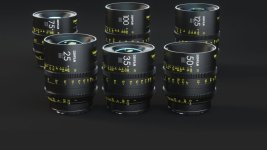
DZOFilm Cinema Lenses.jpg

- 16, 25, 35, 50, 90, 100, 125mm
- $1249 each (the 90 mm Macro is $1499). $7799 for the whole set or $6499 for the set without the 90mm
- T2.1 - T22 for all focal lengths
- Magnetic rear elements: detachable rear ND filter
- PL or EF Mount
- APO Design
- Weight 732 - 940g

http://lens.dzofilm.com/en/vespid-prime.html

https://www.newsshooter.com/2020/10...-full-frame-prime-cinema-lenses-in-ef-and-pl/

https://www.youtube.com/watch?v=vwDNu2JJA5g&feature=emb_title
 
No e mount...

That's the beauty of the DZOFILM lens strategy. The magnetic rear elements Teddy mentioned include interchangeable adapters for L, X, E, and RF mounts.

If these lenses look as good as their other offerings it will be hard for me to resist them.

DZOFILM does need come up with a better marketing strategy than "Greatness in Trivialness." Something must be lost in the translation from Chinese to English.
 
Amazing price!

Like we knew they would, the Chinese are finally starting to take over the production gear space. Within a few years, I bet only highest end production will be using non Chinese cameras, lenses and lights.
Cheap always wins eventually if the quality is good enough. No different than my Godox VL300s. Yes, I think the Aputure is probably built better, although they are Chinese too and of course, there are Arri, Mole,
Creamsource, Intellytech, etc. that aren't Chinese companies although some of them are made or assembled in China. But you cannot beat the bang for the buck with the Godox and the light and build/features are definitely
good enough for my work. I'd rather have an Arri version of the VL300 but it would be $4k to $6k if it said Arri on it versus $750.00 for the VL300.

I bet these new lenses will sell because they are so inexpensive and look like they perform fairly well.
 
Small, light, inexpensive, but with good focus throw and distance markings, PL mount. If they have good IQ and consistency, what's not to like? I already own a set of Xeens but this would be the lighter option for PL. It would be nice if they also came out with an option for the Canon RF mount.
 
Amazing price!

Like we knew they would, the Chinese are finally starting to take over the production gear space. Within a few years, I bet only highest end production will be using non Chinese cameras, lenses and lights.
Cheap always wins eventually if the quality is good enough. No different than my Godox VL300s. Yes, I think the Aputure is probably built better, although they are Chinese too and of course, there are Arri, Mole,
Creamsource, Intellytech, etc. that aren't Chinese companies although some of them are made or assembled in China. But you cannot beat the bang for the buck with the Godox and the light and build/features are definitely
good enough for my work. I'd rather have an Arri version of the VL300 but it would be $4k to $6k if it said Arri on it versus $750.00 for the VL300.

I bet these new lenses will sell because they are so inexpensive and look like they perform fairly well.

Hopefully cheap and good anamorphic lenses are the next thing that happens.
 
The quality, durability and sophistication (not to mention innovation) of Chinese-manufactured products has increased as well. While the prices have stayed very low...
 
I've been considering buying a small set of the SLR Magics but these have my eye as well. They look like an amazing value and much easier to try to manually focus than my Canon still lenses.
 
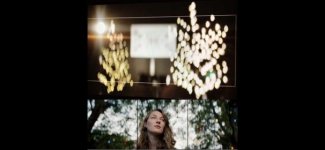
In the youtube video above at 3:05, why is the bokeh on some lights shaped like phases of the moon while others are nice circles?
 
In the youtube video above at 3:05, why is the bokeh on some lights shaped like phases of the moon while others are nice circles?

It's a vignetting effect (often called mechanical vignetting) caused by light rays being blocked by the lens barrel. A lot of lenses produce that or a cat-eye shape for bokeh in the corners. It increasing goes away if you stop down.
 
Yes, the moon shaped light bokeh is more common on wide angle lenses, and you can see it in DZOfilms demo in the 25mm. I like symmetrical elliptical - it is common on many lenses, especially towards the edges of the frame. The moon shaped bokeh can be ugly - my taste - it is particularly ugly on the Rokinon 24mm cine wide open.
 
In the youtube video above at 3:05, why is the bokeh on some lights shaped like phases of the moon while others are nice circles?

It is a design choice used by many of the world’s best and/or most desired lenses, but it can be considered a design compromise.

They sacrifice the bokeh a little in favour of other attributes.
 
It’s a little bit like truck engines. You can get a lot of power out of a smaller engine with turbo, but some people prefer the sound of a larger naturally aspirated engine.
 
Yes, even expensive lenses have mechanical vignetting. You can easily see on the Signature Primes here:


(Check out 58mm and upwards. I bet most of the wider primes show it as well, you just can't see it in the video.)
 
Last edited:
It’s a little bit like truck engines. You can get a lot of power out of a smaller engine with turbo, but some people prefer the sound of a larger naturally aspirated engine.

Oh, ok. Now I get it. I was a bit lost until the truck example.
 
Haha!


Also, these full frame 2x’s anamorphic primes by a new lens company Glaswerk Optics, based in Germany, made a full set of lenses that do not cat eye, nor crop, but they are oval. They just stay straight vertically, and do not bow or warp at the edges in any significant way.

7EF44AE8-138B-425B-ACD1-03387D8CC4EF.jpg
From Glaswerk’s instagram
 
Last edited:
One of the primary design compromises of the DZOFilm lenses is the physical size. By making them small, with small glass with close-fitting housings, light has to travel at greater angles and sometimes the housings can get in the way. But you get a small, lightweight lens out of it.
 
One of the primary design compromises of the DZOFilm lenses is the physical size. By making them small, with small glass with close-fitting housings, light has to travel at greater angles and sometimes the housings can get in the way. But you get a small, lightweight lens out of it.

Mitch, how would housings getting in the way show itself in an image?

Thanks!
 
Mitch, how would housings getting in the way show itself in an image?

Thanks!

It could be a dimmer image in the corners v the center. It could be cat's eye bokeh becoming more pronounced as you get away from center. A smaller housing likely doesn't have room for a cam-system for the focus ring, which means that even with the large rotation the higher distances will really get bunched together at the end. There may be less room for grease dampening and the gearing within may be physically smaller, so there could be increased backlash and focus wander. A smaller housing likely means thinner metal, which means that it may be less temperature stable, so marks could drift and movement stiffen with a change in ambient temperature and humidity.

Those are just some of the possible factors off the top of my head. There are more. There are lots of good reasons for a lens to be made bigger and losing size means making certain compromises. Of course there are also lots of good reasons for a smaller lens, and in the end you need to choose your poison.
 
Back
Top