DZOFILM Releases Vespid Full Frame Prime Cinema Lenses

It could be a dimmer image in the corners v the center. It could be cat's eye bokeh becoming more pronounced as you get away from center. A smaller housing likely doesn't have room for a cam-system for the focus ring, which means that even with the large rotation the higher distances will really get bunched together at the end. There may be less room for grease dampening and the gearing within may be physically smaller, so there could be increased backlash and focus wander. A smaller housing likely means thinner metal, which means that it may be less temperature stable, so marks could drift and movement stiffen with a change in ambient temperature and humidity.

Those are just some of the possible factors off the top of my head. There are more. There are lots of good reasons for a lens to be made bigger and losing size means making certain compromises. Of course there are also lots of good reasons for a smaller lens, and in the end you need to choose your poison.

Thanks Mitch.

It's good to learn about potential compromises rather than finding out the hard way. In DZOFILM's case, I think the price tag is far too tempting for a lot of people to resist despite potential shortcomings.

Brace yourself for the cheap lens x vs. expensive lens y comparisons that don't show the full picture.
 
To be clear, I'm not knocking on DZOFilm and the design of these lenses. I think it's amazing to offer such optics at such a price, and the industry clearly needs small, lightweight primes for use on drones and gimbals. But people should understand what their tools are and are not.
 
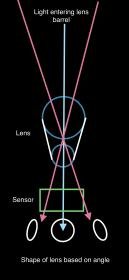
Figured i’d try to draw up this cat’s eye thing. A compact PL mount compatible FF35 lens will obstruct the light toward the edges of a full frame or LF sensor.

C0515BC3-990E-423D-AC7B-7847FCF2C48A.jpg

To not “cats eye” on full frame, would require larger lenses. Like a naturally aspirated engine tends to be bigger and less fuel effecient, but has some advantages, but these days everyone wants fuel effeciant and lightweight, so turbo or eco boost engines are becoming the norm. We could have giant lenses, but most people already are thrown off by how big cine primes are.

The other thing, is just shoot s35 and use the Middle part of full frame glass that doesn’t cat Eye.

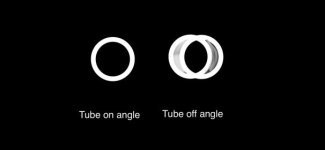
Depending on the angle of light, the shape of the lens will appear different, not unlike seeing a hoop or tube from an angle.
2EEC1E13-1896-4CD1-86D3-EB9C7101602B.jpg

05818A60-18B2-4111-83C3-188F1B536843.jpg
 
Last edited:
I think everyone has the right idea but the "cats eye" bokeh can also be achieved by spacing certain elements or groups of elements further from one another, creating mechanical vignetting internally, by choice or necessity. It's not just the size of the lens. Look at Arri's signature primes, which have beautiful bokeh, and "cats eye" bokeh towards the edges. Big glass, big barrels.

I don't understand how a relatively new company to lens design, DZOFilm, can come up with a first rate set of lenses so quickly, even with understanding / copying fundamental lens designs (sonnar, tessar, etc). I mean, Nikon initially copied the German lenses 70 years ago, and they improved upon them significantly over time. Rokinon / Xeen as SAMYANG, has been making lenses as early as 1991. I remember buying my first lens for the Nikon and it was a Samyang - pushed on me by B&H at the time :( Certainly, current Rokinons / Xeens are in general excellent lenses with some weak focal lengths, but strong contenders against the Japanese and Germans. I'm very curious to see how this lens set does in tests against the established lines!!
 
Last edited:
I don't understand how a relatively new company to lens design, DZOFilm, can come up with a first rate set of lenses so quickly, even with understanding / copying fundamental lens designs (sonnar, tessar, etc). I mean, Nikon initially copied the German lenses 70 years ago, and they improved upon them significantly over time. Rokinon / Xeen as SAMYANG, has been making lenses as early as 1991. I remember buying my first lens for the Nikon and it was a Samyang - pushed on me by B&H at the time :( Certainly, current Rokinons / Xeens are in general excellent lenses with some weak focal lengths, but strong contenders against the Japanese and Germans. I'm very curious to see how this lens set does in tests against the established lines!!

It is because of Moore's Law, the massive increase in computing power over the last decade or two, means it is much easier to make optical designs and experiment with them in the computer itself. Rather than having to make many iterations of physical prototypes.

That's why these relatively young upstart companies can compete with interesting innovative new designs, and at low costs too. No longer is this domain exclusive to giants like Nikon / Zeiss / Canon / Fujinon / etc who have decades of institutional knowledge and millions of dollars in R&D, and millions of dollars of tooling and machinery in their factories.

DZO Film lenses are part of the Dong Zheng company that has been making CCTV lenses and such for a while now. So, combine that manufacturing know how and the computer aided design, and viola! (maybe sprinkle a little inspired "homage" to other designs, as well).
 
Last edited:
I think everyone has the right idea but the "cats eye" bokeh can also be achieved by spacing certain elements or groups of elements further from one another, creating mechanical vignetting internally, by choice or necessity. It's not just the size of the lens. Look at Arri's signature primes, which have beautiful bokeh, and "cats eye" bokeh towards the edges. Big glass, big barrels.

Yes, "big" is only in relation to maintaining the other positive lens attributes.

Signatures seem big, but given what they are doing, they are actually "compact" and lightweight. In order for them to reduce the cats eye effect, they would have to be bigger, but bigger in a way that would avoid mechanical vignetting or certain corrective elements internally. Not going to pretend I can design a lens, but that is the oversimplified explanation.

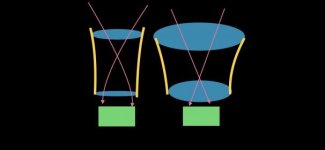
Larger Signature prime would look like this to get rid of the mechanical vignetting. I know this is all well over simplified, but the idea of "bigger" is relative to the degree light is being obstructed or warped entirely or partially.

Two lenses with similar designs, and a shared field of view, yet the "bigger" of the two could have less cats eye effect in the bokeh.
IMG_9389.jpg

Some medium format lenses, like rehoused Hassleblads, on LF or s35 sensors will not exhibit this aberration as much, however, throw the speed booster on there, and you see the edges of the lens and get the warped bokeh on the outer parts of the frame:
https://vimeo.com/271896143
It isn't about the physical size of the lens housing, but the angle at which the light can enter unobstructed.
 
Last edited:
It is because of Moore's Law, the massive increase in computing power over the last decade or two, means it is much easier to make optical designs and experiment with them in the computer itself. Rather than having to make many iterations of physical prototypes...
One doesn't need really powerful computers for that. The same thing has been going on in audio world for a while now. The small shop builders buy off-the-shelf components, plug the specs into a formula, pick the preferred design (MTM, 2-way, 3-way, 4-way, phased array, etc.), then the box size and the computer spits out the 3-D drawing. Then it has to pass the ear test, of course, so one tweaks and diddles the final version.
 
One doesn't need really powerful computers for that. The same thing has been going on in audio world for a while now. The small shop builders buy off-the-shelf components, plug the specs into a formula, pick the preferred design (MTM, 2-way, 3-way, 4-way, phased array, etc.), then the box size and the computer spits out the 3-D drawing. Then it has to pass the ear test, of course, so one tweaks and diddles the final version.

Also, there are a few lens designers anyone with deep enough pockets can go to and ask for a lens set. If market share is big enough, and manufacturing dialed in, one could avoid the lens design caughoffle all together, and just focus on build, delivery, and marketing. (and hopefully service, as well, but at those prices, buying a replacement would be cheaper than time and labour involved)
 
DZO Film lenses are part of the Dong Zheng company that has been making CCTV lenses and such for a while now. So, combine that manufacturing know how and the computer aided design, and viola! (maybe sprinkle a little inspired "homage" to other designs, as well).

Exactly, you create a mix of "years and years of experience already in optics in a non-film niche" + modern CAD/modeling + "inspiration" from other designs = the perfect recipe to leap ahead and into the market for good but low budget cinema lenses.
 
One doesn't need really powerful computers for that. The same thing has been going on in audio world for a while now. The small shop builders buy off-the-shelf components, plug the specs into a formula, pick the preferred design (MTM, 2-way, 3-way, 4-way, phased array, etc.), then the box size and the computer spits out the 3-D drawing. Then it has to pass the ear test, of course, so one tweaks and diddles the final version.

Wasn't meaning to imply someone needs a super computer with 200 petaflops to be able to calculate new lens designs. Was just referring to the general trend of better and better computers with better and better software to use with them. This together with globalization / the modernization of china, is what enabled the wave of new lenses we see at lower prices.

Thirty years ago you couldn't easily create new audio designs with a press of button then order in a heart beat all the components necessary for that as well.

The same is true now for optical designs too.
 
Hey there guys,

received the Vespids this week, so far they look decent for the price. The one thing which is strange, is the outer diameter should be 80mm so with my Misfit Kick and 80mm safe frame I have a really hard time to attach it to the lens. Maybe it's the thick paint coating of the lens? If anybody has a 80mm mattebox and Vespids, try if it is just me or this quirk is for all the lenses.
 
Back
Top