FS7: Dynamic Range Percentages

karma17

Well-known member
Sorry for this newbie-type question, but can somebody please explain the dynamic range percentage on the hypergammas?

For instance, I get the break down of:

HG8 8009G33 and 9 is highlight clipping and 33 is the gray level.

What I don't understand is the 800%.

In this case, the 800% is supposed to represent a 3 stop increase over the standard gammas,
but how is that 800%? Aren't the standard gammas in the 5-6 stop range?

When I think of percentages, I think of 200% as doubling something, so in my mind, 800% would
be an 8x increase. How does an 800% increase only translate into 3 stops?

And if I look at the other hypergammas they have 325% or 460%? And those are only 1-2 stop increases, correct?

I guess I don't understand what or how the percentage increase is being applied.

Any explanations appreciated!
 
Sorry for this newbie-type question, but can somebody please explain the dynamic range percentage on the hypergammas?
When I think of percentages, I think of 200% as doubling something, so in my mind, 800% would
be an 8x increase. How does an 800% increase only translate into 3 stops?
100 to 200 is one stop, 200 to 400 is another stop, and 400 to 800 is the third stop.
One stop doubles the amount.

Mathematically, base is 100 thus 3 stops above is 100 * 2^3 = 800.

325% would be about 1.7 stops above while 460% would be about 2.2 stops above.
 
Last edited:
In this case, the 800% is supposed to represent a 3 stop increase over the standard gammas,
but how is that 800%?


100% x 2 = 200% (that's one stop)

then 200% x 2 = 400% (that's two stops)

then 400% x 2 = 800% (that's three stops)
 
This is an excellent thread to share with all the 5th graders in America who believe they'll never need anything other than basic addition and subtraction (done on their smart phone) for the rest of their lives.
 
Or simply 3 stops = 8 times more exposure, hence 800%.

=)

I think the problem is that for many, exponential calculations aren't that "simple" or intuitive to begin with. When you tell the average person that each stop is twice the light as the previous, many will come to the conclusion that 3 stops = 6 times more exposure. It's just how most people react.

Alas, this exponential behaviour is where the beauty of light and light falloff lies, and all of our problems with digital cameras/sensors begin...
 
Hi All,

I personally find the linear percentages unhelpful beyond just 800% is bigger than 400% is bigger than 100%. Particularly since percentages are sometimes IREs, sometimes real-world reflectances and photographers and camera people pretty much always think in stops.

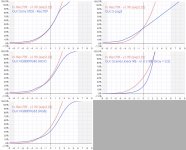
Most charts you see map levels against stops, which (I think) is rather easier to grasp. As such, here are some charts comparing STD5, HG7, HG8, S-Log3 and normalised linear against 'vanilla' Rec709:
curves.jpg

The grey areas denote the dynamic range limits of the FS7 / F5 / F55 sensors.

By vanilla, I mean the basic, consistent, formalised spec for Rec709. In reality in a camera the standard gammas diverge from the actual spec, most notably in including a 'knee'. This is a compression of highlights to allow more range to be included within the available data range. In a conventional approach, this is a gain reduction above a chosen IRE level performed on the signal after the basic gamma, so you can see in STD5 there is a fairly sharp bend. With hypergammas, cinegammas etc, the equivalent to a knee is a smoother introduction of compression introduced in log/stop space, and generally starting at a lower highlight level.

The other main divergence from the strict Rec709 spec is that cameras frequently go all the way up to 109% IRE, rather than 100%. They will often do this even in their 'standard' gammas. HG7 and HG8 are both 109% gammas, and that extra 9% allows them to feather in rather more range with that smooth rolloff but without dramatically reducing midtone contrast relative to vanilla Rec709.

So, dynamic range. Vanilla Rec709 normalises a diffuse white reference target to 100% IRE. This is around 2 1/3 stops above a mid gray target, as used with light meters. Camera Rec709 gammas introduce a knee, generally designed to place that white reference target at 90% IRE (handy, since the target is known as 90% reflectance - I've managed to avoid mentioning that until now ;-) ) and in Sony's base STD5 case this adds around one stop extra within 'legal' range (100% IRE), so around 3 1/3 stops above mid grey. If you set the camera to allow recording beyond 100%, STD5 will actually tap out nearly another stop more within 109%.

HG7 covers about 3 1/2 stops above mid grey within legal, but since it is designed for extended (109% IRE) use, it actually clips at 5 1/3 stops above mid grey, ie three stops above reference white, as others have explained. HG8 still ultimately clips at the same level as HG7, but within legal it actually covers about 4 stops above mid gray. Both are intended to be manipulated before final display, to avoid losing highlight info above 100%, and in the case of HG8 to make it look less dingy on a Rec709 display.

Ben
 
Last edited:
Thanks for all that information Ben,

I have a different confusion about hypergammas and how they are labelled. I understand what the percentages mean but what's confusing to me is the gamma rating. Perhaps that's because I'm not exposing them the way they are intended but my guess is that the vast majority of shooters actually use them the way I do.

So I use Hypergamas when I need to give a client a WYSIWYG look but there are highlights hot enough that I don't want to use Std 5. (The worst thing in Std 5 isn't even the overexposure but the way highlights get oversaturated.) As I understand it I should really be exposing the hypergammas a little darker than I would with Std 5 (709) and that they are supposed to be corrected in post. But this poses some problems.

- First question is :
Should I underexpose these gammas differently based on what the gamma rating is? (BTW I'm always referring to exposure relative to the subject say faces or a grey card here , not just the f stop #.) For example should I underexpose HG8 more than HG7 because the "proper" gamma crossover is lower - e.g. putting caucasian faces at 50 or 55 instead of 60-65 IRE as I would with Std 5? Should you expose with a grey card and match the "proper" gamma point on a waveform?

- A related question is what's the relationship between these HG gammas and their respective ISO's? Both HG7 & HG8 have much higher ISO ratings than the the others. Why ? Are you supposed to underexpose them more, and would you then expose HG7 & HG8 the same? Its all kind of confusing to me.
In fact I set my camera to show DB & never use ISO at all both because its confusing and more so because the only thing I care about with DB is noise levels and the ISO readings would be confusing on that score since they change with gammas. I don't use a light meter for setting exposure - only the waveform & zebras. I have no idea why so many people set up their cameras to show ISO when most aren't using light meters anyway. ( I use the meter for balancing.)

Last question is more important:
Since most of these clients want WYSIWYG, don't want to correct in post and frankly I don't trust them to do it properly anyway - I want to give them as close to a final look as I can. That means I don't underexpose the Hypergammas. However what does this do to the overexposure and overall lattitude and what kind of images are various hypergammas suitable for?

Usually I choose HG7 if there are a lot of highlights because it allows me to keep my faces in a good range while salvaging as much highlight detail as possible. The danger of course is getting compression on flesh tones which looks terrible so you need to be careful about exposure. If I use HG8 and bring it up enough for faces to look good then I lose highlight lattitude. (By the way am I gaining it in the shadows in that case or just losing it overall?)

For interviews my go to is HG4 which is safer for faces but still saves lattitude and gets rid of the curse of saturated highlights. The other hypergammas don't seem useful to me at all.

By the way I find for interviews that Std 5 actually renders faces the best because there are no compression issues. Burning in an Slog LUT is another possibility but for my taste its often too flat and when I give clients a choice they almost always pick one of the Custom options.

Hope this thread was less confused than I am about these issues.
 
Last edited:
Back
Top