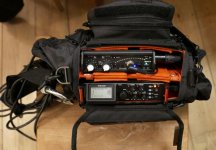
DR70? DR680Mk2 or bite the bullet for the 633???

klk

Well-known member
A post for the pros:

I very recently bought the DR70D, and when I saw the posts for the sale at B&H I immediately started the return process with B&H as it was within 30 days. When I logged back onto B&H the sale was over. Oh well, too slow to save $120. So now that I have this return authorization I'm second guessing myself...

First of all, I'm a camera guy with a sound kit, otherwise it's a no brainer on recorders. Yes, money is always tighter than I want it to be, but the difference between the DR70 and DR680M2 is not an issue, the cost of the SD 633 is however. And yes, the 633 will last me for years on end, the Tascams not sure when they will be upgraded, I just assume they will be.

My biggest complaint about the DR70 has to do with power. we seem to go through AAs quickly and I don't think the mini-USB as power plug will survive in the field for more an a few days. (I have like 14 Anton Bauer batts and was going to simply get a D-tap to mini-USB regulated cable- like I said, I'm a camera guy, used to own power hungry cameras). All those power options with the 633 look- fantastic. The menus are sort of a pain but I expect most new recorders will rely on menus. Years ago I owned a Fostex FR2LE and changing the batts on that drove me nuts- I had it in a Portabrace case. wish these things had XLR power connectors. Either way I plan on some type of Anton Bauer based power.

The power plug on the 680 looks more robust, and it's 12V. All those tiny little buttons on top actually look easier to setup/use in the field then the less-than-intuitive menus on the DR70 (I did download the manual and figured out what I needed too- the organization of the menus was not intuitive to me). I'm also sold on that 1/4" phone jack. What's up with the RCA jacks on the 680???

Now every professional mixer I've worked with has SD mixers/recorders, so maybe I just have gear envy...

BUT I'm not a professional sound mixer. I also think these Tascam recorders are ok backup recorders too. No timecode etc but that's not an issue for me. Decent sound for a great price is what I really need. The build quality is not so much of an issue either.

My question is: does the DR680M2 make a better field recorder- all things considered? Or is it all the same smell and until I go SD I'll always feel frustrated? Now for the money the Tascam HS-P82 also looks interesting, but I've never seen anyone take that in the field and the price still makes me balk.

As far as the rest of the kit, 416 shotgun, AT system 10 w/AT 899 lav (don't really like- will check out Letros. Also purchased System 10 as potential camera hop). ECM44, Sony studio headphones etc. It's a kit in progress. I add when I absolutely need something.

My own personal projects tend to be one man band shoots, it's handy to own a small, good sound kit.

Any thoughts and recommendations from the field?
 
First of all, I'm a camera guy with a sound kit, otherwise it's a no brainer on recorders. Yes, money is always tighter than I want it to be, but the difference between the DR70 and DR680M2 is not an issue, the cost of the SD 633 is however. And yes, the 633 will last me for years on end, the Tascams not sure when they will be upgraded, I just assume they will be.

How much recorder do you need to own at this point? Is there anything you cannot do with the DR-70D that you have now?

Now every professional mixer I've worked with has SD mixers/recorders, so maybe I just have gear envy...

BUT I'm not a professional sound mixer. I also think these Tascam recorders are ok backup recorders too. No timecode etc but that's not an issue for me. Decent sound for a great price is what I really need. The build quality is not so much of an issue either.

You sort of answered your own question there, eh?

My question is: does the DR680M2 make a better field recorder- all things considered? Or is it all the same smell and until I go SD I'll always feel frustrated?

Are four discrete record tracks enough right now? Do you need 6 instead? That's really what we're talking about here, since TC doesn't seem to be a concern.

SD is superb, but the only way to justify that kind of expense is how much income you believe it can guarantee in order to pay it off. Considering this:

My own personal projects tend to be one man band shoots, it's handy to own a small, good sound kit.

Again, is there anything you cannot acheive with what you have now?
 
Hey Alex,
I think I'm trying to rationalize spending more money.
As you know, in the field we're swapping batteries all the time. I've been using the DR70 in this studio shoot- on AC power, walk aways every day. I'm a little skeptical about the power in the field- every now and then we get a sound guy who uses AA batts instead of a power distribution system and it can be kinda entertaining watching the guy juggle all these little AA's, while trying to rush through a battery change. I have no faith in the little mini-USB connector the DR70 has and external battery packs.

The 680 looks a little better, the pro recorders with locking power cables- kinda done.

I was going to get a short 1/8" to 1/4" headphone cable to minimize the wear and tear on the headphone jack- a unit with 1/4" phone jack is simpler.

By typing out the question and going over your replies I pretty much answered my question. I'm basically worried about the durability of the DR70 connectors and a slightly more production friendly unit would quiet the worry- I more or less need to decide today.

The question should be- are users of the Tascam 680 satisfied with the unit? Or does the unit have too many drawbacks in field use?
 
I have a DR-680 (the first one, not the mkII) and love it for what it is. The only major drawback it has, and this can be a biggie depending on workflow, is the single rotary pot that controls all things for all inputs. If you're expecting to have a usable mix along with the iso tracks, it's a PITA to have to select each input individually to adjust its level using the single rotary pot. On the DR-70D, like with the SD633, each input has its own level control.

For me, and the projects on which I use my DR-680, I typically don't need a usable mix alongside the iso tracks. If I'm using it for FX recording, I'm tracking everything for layering and manipulation in post. If I'm on a narrative, the rough stereo mix is for nothing more than dailies and the iso tracks are what I take to post. In short, it's a great recorder and a lousy mixer.

Second, where the DR-70D and the 633 both allow per-input assignment of phantom power, the DR-680 is switchable in pairs. That means that you have to be careful about what gets plugged in where so that you don't end up sending phantom to something that can be damaged by it.

When it comes to rationalizing the expense: can you afford it now, and will you make it back in a reasonable amount of time?
 
Have you considered buying a used SD 442 mixer ( about $1,000 on eBay ) to use as a front end to your DR-70 ?

The 442 does all the heavy lifting and the DR-70 records what is sent to it.
 
Hi Alex,
Thx for the input on the 680- it's starting to sound a little limiting in the field, especially if it gets handed off to a novice.
TheDingo-
I have not considered an SD mixer like the 442. I'll look into this.
Many thanks all...
 
I have not considered an SD mixer like the 442. I'll look into this.

The big plus there is that the 442 offers direct outs on each input, meaning that you can feed each input directly to its own in on the 70D. This also means that the stereo mix outs are free for feeding a camera, another recorder, etc.
 
The big plus there is that the 442 offers direct outs on each input, meaning that you can feed each input directly to its own in on the 70D. This also means that the stereo mix outs are free for feeding a camera, another recorder, etc.

Yes, I was reading up on the SD 442- looks like a practical solution.

great ideas being passed around here!
 
The downside of the 442 is that it's pretty heavy. How many channels are you running? I ran into a sound guy that was actually using a 70D with a 302 up front. He used external power in a bag and didn't seem to have any problems with that. I actually shoot with a C100 with a SD Mixpre inbetween my mics and the camera. The pre's are pretty good on the C100 so I mostly do it for the limiters, the better meters and knobs. The C100 handle controls are terrible. I purchased a 70D not long ago for backup sound and to run a long balanced line to an unattended b or c-cam as needed.
 
In the hands of a novice, results will be poor no matter how much you spend.
I used a 680 on a feature with a SD mixer in front end. Results were good (but I'm a pro sound person).
Search for my other comments and caveats.
 
I think there is a notable difference between the 70D and 680 in terms of preamp quality. I would imagine it would be even greater in the 680 MKII (although the reviews haven't really come out yet)...
 
Picking up on DNN's point, a smaller SD mixer is an option if 4 iso channels are not needed from the mixer. I use a DR-70D with an SD Mixpre-D, in a Petrol 607 bag, mostly using 2 channels only, which makes a good lightweight setup for me: to give some context I'm not a film sound recording professional, but have been recording sound for film since the mid-1980s (ah, heady days with Nagra IS and Arriflex 16 BL!).

In a push, the other 2 channels of the DR-70D are always there if needed and, of course, some mics - such as lavs - have sufficient self-noise that the benefits of the SD preamps are not obvious: if any mics need plug-in power this becomes more relevant. The benefits of using the SD mixer (and many of these would apply to a DR680 too) are the easy to use high-pass filters, the larger knobs, the easily visible LED metering, the much better limiters, the headphone amp (using the return signal from the DR-70D, which itself has an underpowered headphone amp [but which can - unlike the Mixpre-D - usefully decode mid-side recording for monitoring purposes only]), and the preamp quality (which isn't, of course, just about self-noise).

Doesn't, of course, answer the OP's question about power options/robustness: my personal use is with AA batteries in recorder and mixer.

Cheers,

Roland
 

Attachments

  • Mixpre and DR70D.jpg
    Mixpre and DR70D.jpg
    89.6 KB · Views: 0
I was actually thinking of picking up one of the older Mixpre's which are going for around $350-400 online and linking that to my Mixpre-D for those occasions that I do need more than two channels. Sound Devices allows you to link their mixers together seamlessly. In a bag, that setup seems like it would work fine and allow you to scale your setup by the job. The soundguy I mentioned uses those Anker batteries with success. I've been using the Eneloop black batteries which gives me a decent amount of power and I have the Tascam battery pack which holds six additional AA cells which is enough juice to cover me for most jobs.
 
I was actually thinking of picking up one of the older Mixpre's which are going for around $350-400 online and linking that to my Mixpre-D for those occasions that I do need more than two channels. Sound Devices allows you to link their mixers together seamlessly.

There is no sync options for the older MixPre that I know of. Maybe I missed it since I haven't had the opportunity to pair two up?
 
"Sound Devices allows you to link their mixers together seamlessly"
- Well not all of them
It is possible to feed the (old) MixPre's L&R output into the (newer) MixPre D via the 'Return/Tape input 3/4' via a 3.5mm TRS jack. However it's unbalanced and I would kind of doubt it could handle the full +20dBu from XLR outputs. It's not gain-riding friendly either.
 
Thanks for the clarification. I'll give Sound Devices a call and report back on what they say.

Sound Devices says that the old Mixpre indeed can't link together in the same way all of their other mixers can including the 442 and the MixPre-D. That's too bad since the old Mixpre's are so cheap online.
 
Last edited:
Back
Top