DoF Too Deep?

A1 = 1/3" sensor
5D = full 35mm sensor


smaller sensors have deeper depth of field than larger sensors.

Sensors do not have Depth of Field.

Their size however, determines what focal lengths of lenses need to be used to get a certain field of view. For smaller sensors a shorter focal length is used compared to larger sensors. Shorter focal lengths have deeper depth of field.

I'm not trying to nitpick, and I understand you probably know this and what you wrote is easier and sticks in ones head a little better, but there is an influx of new people coming to DVXuser because of these cameras who don't know and could benefit from exactly the right wording so they don't go off inadvertently propagating misinformation.
 
Look at that link above stopping down has a fairly minimal effect

S

If your meaning affecting the DoF... really? Are you sure that's your final anwser?

It's kinda common knowledge I assumed, but for something a little more informed than I can personally provide, try this link INSTEAD:
http://en.wikipedia.org/wiki/Depth_of_field
"DOF is approximately determined by the subject magnification and the lens f-number. For a given f-number, increasing the magnification, either by moving closer to the subject or using a lens of greater focal length, decreases the DOF; decreasing magnification increases DOF. For a given subject magnification, increasing the f-number (decreasing the aperture diameter) increases the DOF; decreasing f-number decreases DOF."

So what can we learn? Focal lenght/distance AND/OR aperture affect DoF DIRECTLY. If you find another optical way to affect DoF I'll eat the "D" key on my keyboard so I never talk about Depth of Field again!
 
stopping down is not the only way to increase DOF. try using a shorter/wider lens and moving closer to the subject. will change your FOV as well but framing a closeup on a 18mm gives way deeper DOF than a closeup on a 85mm.
 
Some people are saying it is not suited for narrative and is just too hard to focus with.
This is subjective. The DoF is a creative decision, not a technical one. It depends on how you want to shoot, and what you want it to look like. All you will get is opinions, and someone else telling you what you should think and do.

Best advice anybody can give you is to do some testing on your own. Nobody should make the decision for you. Borrow/rent the camera, play with it in the store.. if the DoF bugs you, buy something else :)

I agree that it's fairly easy to focus. If you are having trouble use a wider lens or stop down a few notches as already suggested.

Here is a calculator that may help you: http://www.dofmaster.com/dofjs.html
 
Last edited:
stopping down is not the only way to increase DOF. try using a shorter/wider lens and moving closer to the subject. will change your FOV as well but framing a closeup on a 18mm gives way deeper DOF than a closeup on a 85mm.

if you're refering to me, that's what I said:
"Focal lenght/distance AND/OR aperture affect DoF DIRECTLY"

focal lenght/distance = "shorter/wider...moving closer"
 
If your meaning affecting the DoF... really? Are you sure that's your final anwser?

Focal lenght/distance AND/OR aperture affect DoF DIRECTLY. If you find another optical way to affect DoF I'll eat the "D" key on my keyboard so I never talk about Depth of Field again!

All of those factors of course affect DOF

But in reality the chip size (and resultant longer lense for equiv FOV) is one of the biggest factors or at least the difference in chip size from the different comaeras that exist now

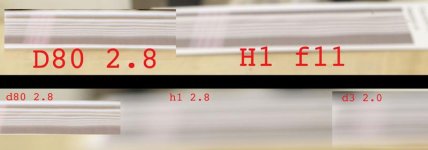
my test show similar DOF between a d90/red/gh1 at 2.8 compared to a hassy 645 at F11 for a given FOV

if one were to stop down the d90/red/gh1 to say 5.6 or 8 one would be requiring non existent apertures to get the same DOF with the larger sensor

Stopping down has a suprisingly small affect on a larger chip/longer lens combos

The images shows an area behind the Focus plane

S
 

Attachments

  • Open_close_preview.jpg
    Open_close_preview.jpg
    31.6 KB · Views: 0
Last edited:
This is giving me a headache. I was concerned about shallow DOF before I got the MKII but since I got it it hasn't been an issue as yet. With manual control a selection of lenses and ND filters you can choose the DOF you want. The only thing I've been wanting for is a 180mm telephoto lens due to the full frame FOV compared to the 1.5x crop of my D90.

I suggest you hire one for a weekend and see for yourself if it suits your shooting style.
 
All of those factors of course affect DOF

But in reality the chip size (and resultant longer lense for equiv FOV) is one of the biggest factors or at least the difference in chip size from the different comaeras that exist now

my test show similar DOF between a d90/red/gh1 at 2.8 compared to a hassy 645 at F11 for a given FOV

if one were to stop down the d90/red/gh1 to say 5.6 or 8 one would be requiring non existent apertures to get the same DOF with the larger sensor

Stopping down has a suprisingly small affect on a larger chip/longer lens combos

The images shows an area behind the Focus plane

S

I'm afraid after all I have learned in my DSLR photography class, I just have a very hard time believing that. Many still photographers and shooting styles prefer and call for an extremely deep DOF. Namely nature, landscapes, sports etc, and many of these same applications require telephoto lenses... and seeing as how the 5D mark ii is an extrememly popular camera amongst profesionals... well, I just have trouble believing this. No one else seems to think it is as big of a problem as you do. This camera can also stop down very far while maintainging good low light abilities. So yeah. But you are scaring me a bit... it just isn't making much sense to me.
 
Just use the calculator I linked to above to figure it out....

With a 35mm lens and subject at 7 feet:
f/1.4 = 1.02 ft
f/2.8 = 2.08 ft
f/4 = 3.01 ft
f/5.6 = 4.45 ft
f/11 = 12.3 ft

With a 50mm lens:
f/1.4 = 0.5 ft
f/2.8 = 1 ft
f/4 = 1.41 ft
f/5.6 = 2.02 ft
f/11 = 4.3 ft

Minimal effect? The difference between 1.02 and 4.45 ft or 0.5 and 2.02 feet is not minimal.
 
Im not scaring anyone but do believe that following tightly framed moving subjects with a 5d is a challenging activity

S
Agreed. Using that same calculator, using an 80mm lens at f1.8, you've got .12" dof at 5 feet, and stopping down to f4 gives you a whopping .27" at the same distance.

Have a look at Sophia's people by Phil Bloom...he's been shooting since he was 3 and still struggles to get sharp focus. You'll still need to light methinks. Auto focus would be a godsend in this cam.
 
Of course you still need to light! This camera will not remove the need for lighting a scene...

5 feet at 80mm is very close. I'm not even sure if you could fit someones head into that. Just have them take a step back. At 7 feet distance you have almost 7 inches of focus room to work in at f/4 and that's really plenty.

Using 80mm you will need to stop the lens down a bit more, around f/8. Few will work that close to wide on a longer lens. That will give you about 13 inches of room.
 
Last edited:
Edit.. Well I'll leave it at that.

I agree that sometimes it can be difficult to focus manually, especially on moving subjects. People make a career out of it. There are some things you can do to make it easier, but no way around it.
 
Last edited:
Of course you still need to light! This camera will not remove the need for lighting a scene...

That's fair. I probably should have said over-light. The thought of using HMIs to light a scene shot with a 1/3" cam & adapter wasn't working for me (budget)...but in anything but a small space it's necessary. Otherwise the depth of field is too shallow, and noise in blacks unpleasant. Certainly the 5D is a different story, but I'm still a smidge disappointed that I have to give up some of that low light ability to get managable dof.

5 feet at 80mm is very close. I'm not even sure if you could fit someones head into that

I'm just getting my head around the fov of the different sensor sizes, but you might find you're way off here. I get a nice cu at 1m with my D40 at 85mm...full frame would give you an even wider frame.
 
.. but I'm still a smidge disappointed that I have to give up some of that low light ability to get managable dof.
Well even at f/5.6 with ISO at 640 you get a decently clean result with good exposure. This has really never been a problem for me but I can't speak for everyone.


I'm just getting my head around the fov of the different sensor sizes, but you might find you're way off here. I get a nice cu at 1m with my D40 at 85mm...full frame would give you an even wider frame.
Maybe you are right. MS, CU, ECU, etc are kind of sketchy and depend on who you ask. Before I posted that I stood ~5 feet form a subject with a 75mm lens and the framing was tight. Maybe I was a little close but I figured if it was 80mm it would be even more so.
 
I'm afraid after all I have learned in my DSLR photography class, I just have a very hard time believing that. Many still photographers and shooting styles prefer and call for an extremely deep DOF. Namely nature, landscapes, sports etc, and many of these same applications require telephoto lenses... and seeing as how the 5D mark ii is an extrememly popular camera amongst profesionals... well, I just have trouble believing this. No one else seems to think it is as big of a problem as you do. This camera can also stop down very far while maintainging good low light abilities. So yeah. But you are scaring me a bit... it just isn't making much sense to me.

There's no real reason to be scared unless you plan on living forever with the camera. Just have to get your hands on it and find out what you think.

I'm in between, to be honest. You have to consider WHAT people are doing as well as HOW.

If you're shooting talking heads, of course you won't have trouble with focus.

If you're moving (like Morgan is doing) then it's trouble with a Full Frame sensor, even stopped down.

This is why I'm suggesting that you simply start off with a slow zoom that covers everything and get fast primes for night exterior work. A slow zoom starting at 3.4 is going to feel a bit better as far as focus tracking goes where wide-open is concerned. You also want to start wrapping your head around using different focal lengths at different distances than you would small sensors. The look will still be "different" but it'll be close to what you expected out of an Academy frame and focus won't be so hard to pull.

I'm about to run out and pick up a 28-300/3.5~6.5 Tamron VC Zoom for the MKii. It'll probably be the lens I use on this project for everything unless I get into a low light situation that can benefit from a wider aperture.

This topic, as well, is probably least important in comparison to finding a way to view an LCD without it getting to large AND stabilizing the camera. IN fact, stabilizing the camera should be priority, as it's really hard to get off sticks without a Steady-Style device or a lens with Stabilization built-in.

Just from my experience, the more important thing to be afraid of is stabilizing your camera. Every little bump and shake reads on these VDSLRs and it looks horrid.
 
I received a call for a 5D MkII rental a few days ago. The aspiring DP would have nothing to do with a 2.8 L zoom lens (some of Canon's finest "L"uxury glass). He was only looking for apertures of f/1.4 or wider.

"Are you shooting in some pretty dark interiors?" I asked.

"No, but we really want to open the lens up and take advantage of the film look," was his reply.

Ironic that I should come across this thread shortly after that conversation.

Larger sensors excite me because we can stop shooting everything at f/2 or wider and give our focus pullers a break! One easily achieves a beautifully shallow closeup shooting 80mm at f/5.6 or f/8.0, giving the actor (and the focus puller) 2" or 3" to work with, while defocusing a background even 2 feet from the actor. Need depth in a medium closeup? Use your focus calculator (or the one linked to earlier) and you'll find you can still get a shallow film look while staying in focus.

By the way, not every shot needs to be shallow (take a look at the movie...er, well, any movie!)

Most lenses are sharpest around the sweet spot of f/4 thru f/5.6 (give or take).

Yes, we must bring a little more light to the subject, but not nearly the amount of light required for a 35mm adapter. Still, as has been mentioned earlier, this camera has very tolerable noise level even at some of the higher ISOs.

Tolerable, you say, but horrible for the big screen!

I would agree. Not to mention anything about the compression and difficulty color correcting your work.

I don't think we'll see too many (if any) summer blockbusters shot on this camera (for these and other reasons). It seems to me it is an independent filmmaker's tool for great looking Web series, short films, concept work, structured and controled documentaries, infomercial, corporate, etc. Essentially any production that wants a "big look" on a small budget, intended for the "small" screen.

I don't mean to define what you can and cannot do with a VDSLR camera. But if you're a one-man crew in un-lit, low-light scenarios and you are tasked with keeping focus on a moving target, perhaps the 1/2" CMOS Sony EX1, or even Sony Z7U would be a better fit for your project (assuming similar budget constraints).

At least in this thread, I may be preaching to the choir when I say: Light the set and shoot around f/2.8 - f/8. You'll have plenty of "shallowness", you'll focus more on the story and your actors and not on your tools. And your focus puller will be able to enjoy the shoot as much as everyone else.
 
The beauty of the full frame sensor is you can get a shallower DOF where you couldn't at the wide end. I did a stills shoot last night with a nikon 35mm f/2. I lit it with 3 $10 work light fitted with 24 watt CFLs. I shot it at f/2.8-f/4 and ISO 1600 and it looks great.
 
Of course, older true manual primes will have depth of field markings on the lens. Now although these shouldn't be taken as gospel, they are a good guide to how much depth you'll have, remembering that the C of C for 1080p is a lot bigger than for 35mm film printed to say, 16 x 12, hence will have a slightly greater D of F.
Dave
 
Back
Top