
Navigation
Install the app
How to install the app on iOS
Follow along with the video below to see how to install our site as a web app on your home screen.
Note: This feature may not be available in some browsers.
More options
You are using an out of date browser. It may not display this or other websites correctly.
You should upgrade or use an alternative browser.
You should upgrade or use an alternative browser.
DIY 100w LED 9000 LUX output
- Thread starter starcentral
- Start date

starcentral
Veteran
Here are a few DC to DC converters I've been researching which cost around $10. NOTE these are constant voltage power supplies and for an LED driver you need a constant current power supply! With some external components however, its quite easy to turn these into what's needed to drive the high power 100w LED's:
http://www.satistronics.com/150w-dcdc-1032v-to-1235v-converter-boost-charger_p2985.html
http://www.satistronics.com/mini-dc...nsformer-converter-power-regulator_p2210.html
If you can't bother with electronics, here is a finished power supply that should do the job:
http://www.ebay.ca/itm/220800357100?ssPageName=STRK:MEWAX:IT&_trksid=p3984.m1438.l2649
Some cheap high power LED's off ebay:
http://www.ebay.ca/itm/220784909413?ssPageName=STRK:MEWAX:IT&_trksid=p3984.m1438.l2649
http://www.ebay.ca/itm/151131267065?ssPageName=STRK:MEWAX:IT&_trksid=p3984.m1438.l2649

Norman99
Well-known member
There are many DC to DC converters/led driver/power supplies available but watch out for the type that they are and for the use intended. For example, most of them are without dimming capability and you have to take out or put in parallel a potentiometer that has an ohm rating that at maximum brightness does NOT exceed the led's max tolerance. Also the fact that the dimming scheme is usually a PWM type that is not too good for high frame rates of certain shutter speeds on many pro cameras. A non PWM type driver or a hybrid of is what is best for video work. PWM (Pulse width modulation) will produce banding artifacts that is almost impossible to get rid of in post.
A really big list on some drivers can be found here with comments and supplier. http://www.videofoundry.co.nz/ianman/laboratory/research/driverlist.php
This can get rather complicated very fast and is brain intensive. Then again, ask at CPF forums.
It took me 4 years to make the light I wanted. Very frustrating at times but necessity is the mother of invention or DIY.
Norman99
Well-known member
Just to show how much heat tolerance a 100W led emitter( actually composed of an array of 10X10 1W leds, in a 10P10S config.) can have when mounted on the center of a 8"x8" X 3/16" thick aluminum plate for the heatsink. no fan added until later. Heatsink was suspended by a thin string as not to be influenced by table surface or any other object. No air flow around the test.
Wattage figures taken with a regulated constant current power supply at various amperages to 3 amps ( 3000ma).
Led mounted on the aluminum with AA ceramic adhesive.
2 leds tested, all from the same supplier ( China ). all same CT (6000K) and batch. Test done 4/21/2013.
IR thermometer reading taken as close as possible to the led on the aluminum.
1st led ( NO FAN ) at 3A fried out at exactly 4 minutes 36 seconds AFTER current reached 3000ma. Current was increased gradually from 0-3000ma .Displayed an increase of very blue tint with decreasing brightness 20 seconds before
failure.
Heat measured 108 degrees C at the 4 minute mark.( heat was increasing even up to the led failure point.)
2nd ( NO FAN ) led was driven to 1500ma and stabilized there for 2 full hours. Heat sink was too hot to touch, as measured 82 degrees C. temp. seemed to stabilize at that reading.
This led was then "cooled"( WITH FAN) by a 80mm 46 CFM fan placed 6 inches away from the led. The Led current was gradually raised to 3000ma at which point the temp measured increased to 91 C and stabilized there for the
following 6 hours. Test concluded at that point.
This "surviving" led was later placed in a 12 X 12 X 3/16" thick aluminum heatsink ( 160 square inches MORE surface area, note: surface area includes BOTH sides) over double the surface area of the former heatsink.
The led was powered up to 3000ma and (WITHOUT FAN) stabilized there without any issues, Temp reading got to max 96 deg. C.
There you have it, passive cooling needs at least 288 square inches of surface on the heatsink for that 100W led. Or 2.8 square inches per watt dissipitated. As a general rule of thumb, I guess.
starcentral
Veteran
Thanks for all the tips norman, you sure have taken a lot of guess work out of it. And it's appreciated.
starcentral
Veteran
The CXA2590 seems to have some serious output lumens!
I noticed Alzo discontinued their high power LED light... was it the noise, overheating, end of batch from china Alzo could slap their name on, ....
I noticed Alzo discontinued their high power LED light... was it the noise, overheating, end of batch from china Alzo could slap their name on, ....
starcentral
Veteran
I am mistaken, the Alzo LED's are still available.
1k equivalent indoors working with existing daylight coming into a room is not necessarily enough to really provide enough contrast balance to a scene. I think once we can talk about 2500-3500w equivalent then maybe we are getting somewhere.
1k equivalent indoors working with existing daylight coming into a room is not necessarily enough to really provide enough contrast balance to a scene. I think once we can talk about 2500-3500w equivalent then maybe we are getting somewhere.
Norman99
Well-known member
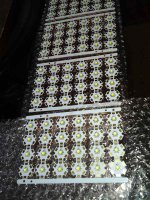
Since this is in the DIY section, I thought that you would be interested to see how I get my leds ordered in the same batch for consistency in color and output. There are some of XM-L2's that are in the 2C binning in the U2 lumen category. Notice they are mounted on pure copper stars for heat dissipation. I am not too concerned with the CRI as they will be used in outdoor fill (5200K). Each light unit will have 18 of these running at 3 amps. for a total lumen of approx 18000. Coupled with 14 degree TIR optics, will offer noon day sunlight fill out to 30Ft. distance. Battery powered. Custom made for a videographer friend of mine. Dimming from 0-100%. Who says leds are not powerful enough ?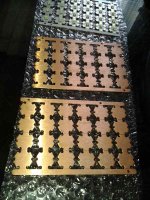
starcentral
Veteran
Nice.
This is like maybe 2.5k HMI equivalent?
This is like maybe 2.5k HMI equivalent?
Norman99
Well-known member
Not exactly as light brightness is measured in many ways. A narrow beam angle say 10 degrees that has a light source of 1000 lumens will be brighter at the subject than a 9000 lumen source that has a wide angle dispersion at the same subject and distance. The narrow beam is collimating all the 1000 lumens vis a reflector or optic to be illuminating a small field in area, whereas the 9000 lumen behind a diffusion or wide beam reflector has to disperse the 9000 lumens to cover a much wider area, and that same spot area will only see perhaps only 100 lumens of all the available 9000. Beam angle is the most important brightness deciding factor in projected light. That is also why a very, very narrow beam is able to "travel" or "throw" farther than a wider beam having the SAME initial lumen factor. I could in fact make a 2.5 HMI equivalent very easily, and be battery powered at that too. If you take a 2.5K HMI ( approximately 50, 000 lumens, give or take a few) and emit a 40 degree beam from it via a reflector, the brightness illuminating a door at 50 feet distance will be LESS than a 1K HMI AT THE SAME DISTANCE using a 15 degree narrow beam. I can easily achieve that 1K HMI narrow beam equivalent using Leds. I can also do a 2.5K HMI equivalent wide beam using leds. I just use more leds, larger heat sink, active cooling and dual/triple battery configuration. It all depends on what one needs as far as beam angle and specific distance brightness. A light that specs as a 5K equivalent is meaningless if beam angle and distance lux value is NOT specified. That is why many elcheapo panel led lights claim a 1000W softbox equivalent yet fail to mention beam angle and the lux value at a specific distance. Really good leds are in the 5-6 X more efficient than their filament counterparts. so a led that consumes 16 watts is like a bulb that consumes 100 watts. 1 to 6 ratio. ( Rough rule of thumb, at least for now )

KurtF
Well-known member
With some external components however, its quite easy to turn these into what's needed to drive the high power 100w LED's:
Just curious, any examples of the required components and the correct configuration to make the conversion? Links to a schematic?
Thanks.
Norman99
Well-known member
Not as easy as it seems. The electronics and schematics are the easy part, The hard part is:
1- Heat must be considered as a 100W led gives off easily 80 W of heat ( at least) that must be managed properly by a heat sink and/or a fan. A fan makes noise, especially if running at high rpm's when considering a smaller
heat sink. Just calculating a heat sink capable of dealing with that amount may take you in the largish 300 sq.inches of surface area. Even if heat is managed properly there is the question of where in an existing enclosure
is the place to house the heatsink. The led must be sitting directly on the heat sink itself, or a portion of that dissipates the heat to the sink as fast as possible.
2- The positioning of the led die in a reflector that had a filament must mimic the filament placement AS WELL AS the beam dispersion angle of the filament. Filaments are usually placed in a defined position within the reflector's
parabola ( or Fresnel cavity ) in order to give a nice even beam, and altering that position with a led that may sit deeper within that parabola will give undesirable results. A led die usually has a 110 degree beam spread as compared with a filament that exceeds 180 degrees. Some form of modification may be necessary to make that happen.
3- Cost/time/trial&error, all that add up to a hefty sum of $$ if any calculations are off. It is not a simple matter of just swapping out the bulb for the led.
4- Replacing the reflector that was designed for a bulb with one designed for a led. ( you could get by with this one, but final results are questionable)
Not to discourage, but here we are dealing with thermal management, optical science and the real possibility that the modification may end up in the trash.
Like the ol' saying goes " You can't make a silk purse from a pig's ear" well, maybe it is possible but it will take a lot of time, effort, $$, knowhow, a considerate wife and the patience of a saint.