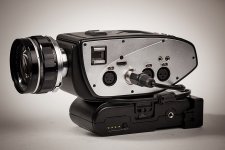
Digital Bolex featured on Fox series "GLEE" tonight.

It is also the best option for teaching fundamental photographic/cinematography skills without the manufacturer imposed limitations of predetermined video options. Raw cinematography is the future of the entertainment film industry, not compressed video.
I think pulpfiction hits the nail on the head with:
pulpfiction007 said:
Learning cinematography and photographic skills has less to do with the recording format being used and more to do with lenses/lighting/composition/aperture/shutter speed/movement.
If you're trying to get those things across, then having to worry about a RAW workflow is more likely to prove an obstacle than anything else - worrying about running before walking. Whilst RAW may have desirable features in some parts of the "real" industry, then I'd argue it may be positively a bad thing in a teaching environment - foster a somewhat sloppy "oh never mind, we'll fix that in post" attitude. Surely better to teach with a less forgiving system, and help instil early discipline and the need for precision?

And much as I myself have loved film, and still love the idea of it, then times move on. Surely in a teaching environment it's more important to teach with the tools of today and tomorrow than yesterday?

I also agree with jdv's points about s35 sensors most definitely being the way of the future - so yes, surely it makes sense to use such in the teaching environment today?
 
Learning cinematography and photographic skills has less to do with the recording format being used and more to do with lenses/lighting/composition/aperture/shutter speed/movement.

Which is why a simple manual camera like the D16 that requires the discipline of a film camera is such a great teaching tool. ISO, frame rate, shutter angle/speed, manual iris lenses. With the D16 changing ISO changes analog gain applied to the sensor before AD conversion so does actually change the encoded response to light. The ISO speeds are factory calibrated with a light meter.

Would you teach a still photography course and not use raw images? Raw cinematography offers the same advantages. It is a powerful creative tool that is state of the art and becoming more common all the time. It is also the only way to truly take full creative advantage of the available color bit depth and DR of modern digital cameras. It is becoming an essential skill set for those who want to pursue cinematography and color grading as career tracks.
 
Last edited:
Which is why a simple manual camera like the D16 that requires the discipline of a film camera is such a great teaching tool. ISO, frame rate, shutter angle/speed, manual iris lenses. With the D16 changing ISO changes analog gain applied to the sensor before AD conversion so does actually change the encoded response to light. The ISO speeds are factory calibrated with a light meter.

Would you teach a still photography course and not use raw images? Raw cinematography offers the same advantages. It is a powerful creative tool that is state of the art and becoming more common all the time. It is also the only way to truly take full creative advantage of the available color bit depth and DR of modern digital cameras. It is becoming an essential skill set for those who want to pursue cinematography and color grading as career tracks.


With respect to ISO/shutter speed/frame rate/manual lenses - Any number of cameras can offer those tools for teaching including the D Bolex.

I'm not arguing the D Bolex WOULDN'T be a great teaching camera, I simply stated that there are far more important variables to cinema/photography than format...because operators will encounter COUNTLESS formats, such as Pro Res/MPEG 2 HD/XAVC HD/XAVC 4K/AVC Ultra AVC Intra etc etc etc.

Tech changes and so will formats. What WILL be a constant for a would be cinematographer is their ability to compose a shot/recognize and shape light/utilize good movement ( A strength for the DBolex with it's CCD), and apply the correct variables to achieve certain looks and tell a story with a camera.

Would I teach raw in a photography course? Sure, but it is one tool down the line of post processing, and is not integral to creating a beautiful photograph. It helps for certain, but the eye of the photographer should be able to achieve a moving photo on any number of cameras...many of which will have vastly different files/technologies/interpretations of data.

The Lightpost software that comes with the D16 encodes to Prores. My NLE can import, encode, and deliver in any of those formats, but they are all just compressed video codecs of one kind or another. I'm not suggesting that the D16 should be the only camera in a curriculum. But for the price of an Alexa or a low end Red package you can put 5 or more of these in the hands of students that want to learn raw workflow fundamentals as part of a cinematography or post production course. It is mechanically robust enough to stand up to the rigors of day in day out school use.
 
But for the price of an Alexa or a low end Red package you can put 5 or more of these in the hands of students that want to learn raw workflow fundamentals as part of a cinematography or post production course.

Of course for the price of 1 D16 you could put 10 Canon T3i's into the department. If you must have RAW, then you could purchase 6 Canon 60D's (which can shoot RAW with a hack), or 4 Black Magic Pocket cameras....

I could go on, but you get the point. RAW seems to be the crux of your argument, yet there are other options for shooting RAW at better price points. And again, shooting RAW a tiny aspect of what it means to be a pro DP.

And if your want to teach your students how to use an Arri or RED, you must use those cameras. No one wanting a RED operator is going to hire a student who has not used one, whether or not they understand RAW. There is, after all, far more to getting the best out of a video camera than selecting the RAW option in the menu.

"It is mechanically robust enough to stand up to the rigors of day in day out school use."

That is a completely unverifiable statement at this point. Digital Bolex hasn't even filled its initial order for these cameras. And while a few pro shooters have had the D16 for a few months, the idea that consumers know anything about it's reliability is nonsense. Could it be tough as nails? Perhaps, but the proof is in the pudding and that means at least a year or more of wide-spread use by every day users. It could just as easily end up being a buggy shop magnet - only time will tell.

Perhaps more importantly, the camera is completely non-weather proof, correct? Meaning virtually any DSLR will be more robust with a far greater track record of reliability. A pretty big point for teacher/departments on a budget as students are as a whole not the most careful of users.
 
The pocket cam is mechanically delicate, the mini-HDMI connector is very easy to break. You need expensive media and accessories like a cage and a cable lock and lots of batteries that will double the price to make it practical. So far even with the fastest SD cards it has issues dropping frames shooting raw. Plus it does not provide the kind of direct manual controls you need. Low end DSLR's are fine for what they do, hacking them is not practical.
The D16 is as weather sealed as most DSLR's that claim to be weather proof. The internal electronics are conformal coated so they are dust and water proof. The connectors are all gasket sealed and firmly anchored to the body as well as the circuit boards, the sensor block is as well protected as any interchangeable lens camera can be. Better than most. Far better than the BMC cams with their unprotected boards.
The D16 is intended to be as robust as its film camera namesake within the practical tolerances of modern electronics. It isn't submersible, but a little water or dirt won't kill it. It has been through a pretty thorough regimen of torture tests from 107 degree shooting days at the Salton Sea to sub zero temps. The basic precautions that one would take to protect any high quality camera and lenses are good enough.
 
Last edited:
Latest from Elle shot while they were in New York for hands on demos at NYU.


Not bad at all, but as a demo of any sort (at least as a subject for this thread anyway), it's somewhat misleading to have post blur vignettes I would think. Yes, for a "real" completed project, no doubt. But, for a demo, no bueno.

I'd have to agree w/ the counterarguments here though. For what it's worth, a 50D w/ ML RAW hacked involved provides far superior results than this at a fraction of the cost and obviously many more hardware options to boot. If we're really going to give any form of comparison, this baby just doesn't hold up right now. It's another tool, yes, and most important is the story, cinematographer's eye and many other factors coming into play. Hardware-wise however, it's just outdated and overpriced for what it offers compared to stronger, more inexpensive options [IMO].

You are probably seeing some issues with a vintage 16mm lens rather than any post processing FX. Don't agree about the 50D at all. The D16 at least is a practical self contained digital cinema camera with extended recording capability and excellent on board audio, not a hack . Its DR vs sensitivity are better than a 50D generation DSLR.
 
Last edited:
a 50D w/ ML RAW hacked involved provides far superior results than this at a fraction of the cost

Rolling shutter makes my blood congeal.

Built-in XLRs with phantom power also is nice. I'm trying to decide whether the proposed Switronix battery pack makes the ergonomics fall apart. But it gives 12 hours of shooting. Plus, if my calculations are correct, you could power a nice viewfinder, like the Cineroid Retina, from one of the two D-tap jacks on it. With the right adapter you may even be able to plug the XLR DC out from the camera to the viewfinder and forego the Switronix.

switronx-alone.jpg

And then you have access to all the C-mount 16mm lenses, which are interesting.

You can get a Japanese Cosmicar one for a couple hundred dollars. Looks good, here's a video shot with that lens (albeit on a different camera):


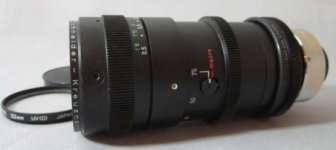
Or how 'bout a German-made 12.5-75mm f/1.8 zoom for just a thousand?

schneider-zoom.jpg

This Canon 15-75mm f/2 is only $200.

canon-zoom.jpg

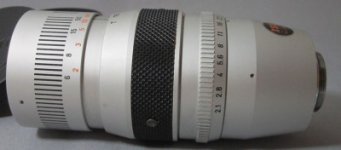
And if you really want tight depth of field there are a few even f/0.95's, but they're around a thousand or so.

schneider-f095.jpg

Still that's the equivalent depth of field in Super 35 of f/2

With battery, viewfinder, and lens, the whole thing is teetering towards seven or eight pounds or more, and they (Adam Wilt) say that the ideal weight for handheld cameras is around five. Still there's something to be said for the monopod.

Either way you have pretty good ergonomics, even for run and gun, weddings, etc. The camera, viewfinder, and mics are all powered with one battery. Plus an hour or two of recording time before having to change cards. For someone who primarily wants to make art but also money on the side by shooting the occasional wedding or play, this could totally work.
 
Last edited:
Add the Hotrod PL mount and you have access to any pro cine lenses too, 16mm or 35mm. The camera front end is an interchangeable mount system. MFT passive mount will be out in a month or so. Sigma 18-35 Nikon mount f1.8 on the BMPCC speed booster is going to be a stellar combo for the D16.

 
Rolling shutter makes my blood congeal.

Built-in XLRs with phantom power also is nice. I'm trying to decide whether the proposed Switronix battery pack makes the ergonomics fall apart. But it gives 12 hours of shooting. Plus, if my calculations are correct, you could power a nice viewfinder, like the Cineroid Retina, from one of the two D-tap jacks on it. With the right adapter you may even be able to plug the XLR DC out from the camera to the viewfinder and forego the Switronix.

View attachment 86352

And then you have access to all the C-mount 16mm lenses, which are interesting.

You can get a Japanese Cosmicar one for a couple hundred dollars. Looks good, here's a video shot with one:


Or how 'bout a German-made 12.5-75mm f/1.8 zoom for just a thousand?

View attachment 86354

This Canon 15-75mm f/2 is only $200.

View attachment 86355

And if you really want tight depth of field there are a few even f/0.95's, but they're around a thousand or so.

View attachment 86356

Still that's the equivalent depth of field in Super 35 of f/2

With battery, viewfinder, and lens, the whole thing is teetering towards seven or eight pounds or more, and they (Adam Wilt) say that the ideal weight for handheld cameras is around five. Still there's something to be said for the monopod.

Either way you have pretty good ergonomics, even for run and gun, weddings, etc. The camera, viewfinder, and mics are all powered with one battery. Plus an hour or two of recording time before having to change cards. For someone who primarily wants to make art but also money on the side by shooting the occasional wedding or play, this could totally work.

I'll most definitely agree with the c-mount, which is a God send for inexpensive and high quality glass. There's so much to choose from even with brief Ebay search and you've given some great examples (including probably the best video I've seen from this camera thus far). Rolling shutter (as w/ any CMOS camera) is always an issue, but with a ton of workarounds however. It hasn't held anyone back from filming fast paced action scenes and doubt it will.

One note on the footage though: I'm honestly not seeing anything from any source that doesn't look like work done off of a 7D source, including the example you've given. While it doesn't mean that it looks BAD per se, this footage doesn't appear to be helping the defense of DBolex superiority over DSLRs as of yet.
 
Last edited:
Youtube and Vimeo are the great levelers. The D16 is first and foremost a 2k DCI format digital cinema camera. Its unique qualities really stand out when projected on a large screen via a 3-chip DLP cinema projector in a high quality low compression codec. I thought compressed video from a 7d looked very soft and mediocre the day it came out. The D16 is capable of far better, but is only going to look as good as your delivery format. The fine differences in color discrimination for instance are not really that noticeable within REC709 HD video limits. They are in DCI-P3.
We had a $60k 3-chip DLP in house a few months back for a client demo and I did get a chance to play with some early footage samples and different codecs and color spaces on a large screen. That is where this camera comes into its own. It is like a digital version of Kodak Vision 3 200T film stock in 16mm. Similar color quality, similar resolution and sensitivity, a bit less DR but not that far off in practical terms if lit properly.
 
Last edited:
Would you teach a still photography course and not use raw images?
It would depend on the course, but if you're talking about most of the fundamentals of photography (composition, lighting, etc) then talk of RAW is likely to be at best a distraction, and at worst counter-productive - students being left unable to distinguish between basic good technique and a sloppy "it'll be OK to fix in post" attitude. If choosing a camera for such a course, then whilst the ideal would be to have a coded/RAW switchable option, if it had to be one or the other, I'd forsake the RAW. For most points under tuition, any RAW workflow would just take extra time and be irrelevant to the aspects then being taught.

Later on, then yes, RAW techniques should be brought in. But to teach such is it really necessary to be on images originated by the students themselves anyway? Surely RAW workflow manipulation can be just as easily taught using stock images? In fact, may that not even be preferable, as then the examples can be assigned to match specific exercises, specific manipulation techniques?

The DB may have some beneficial aspects, but overhyping them doesn't help, and I agree with jdv that if comments about how "mechanically robust" it (or any other piece of equipment) are going to be made, they need to be backed up with evidence. At the very least, what sort of guarantee are Digital Bolex prepared to give about speed of repair/replacement in event of a failure.......? If they really are confident that their product "is mechanically robust enough to stand up to the rigors of day in day out school use", I'm assuming a pretty good guarantee....?
 
this footage doesn't appear to be helping the defense of DBolex

That footage is from a Blackmagic Pocket. I posted it about the lens, for folks to see whether it's sharp enough. It's an f/1.3 for $135 at a good, all-around focal length (12.5mm, which is about the "normal" focal length for this chip size). I've heard of people liking even cheaper industrial lenses, but I've yet to see the definitive C-mount lens review database. Seems like it's still scraps here and there for any recommendations. Sorry, certainly didn't mean to mislead about which camera is used. The title of the Vimeo video says BMPCC, but I've also edited my post to clarify.
 
Youtube and Vimeo are the great levelers. The D16 is first and foremost a 2k DCI format digital cinema camera. Its unique qualities really stand out when projected on a large screen via a 3-chip DLP cinema projector in a high quality low compression codec. I thought compressed video from a 7d looked very soft and mediocre the day it came out. The D16 is capable of far better, but is only going to look as good as your delivery format. The fine differences in color discrimination for instance are not really that noticeable within REC709 HD video limits. They are in DCI-P3.
We had a $60k 3-chip DLP in house a few months back for a client demo and I did get a chance to play with some early footage samples and different codecs and color spaces on a large screen. That is where this camera comes into its own. It is like a digital version of Kodak Vision 3 200T film stock in 16mm. Similar color quality, similar resolution and sensitivity, a bit less DR but not that far off in practical terms if lit properly.

Aren't some of these videos from Vimeo available for download [of the original file uploaded]?
On my end those were the ones I've watched for the most part.
 
Add the Hotrod PL mount and you have access to any pro cine lenses too, 16mm or 35mm. The camera front end is an interchangeable mount system. MFT passive mount will be out in a month or so. Sigma 18-35 Nikon mount f1.8 on the BMPCC speed booster is going to be a stellar combo for the D16.


There is some strange "grid noise" on the edges of the flowers in this video. Wonder what's going on there, most definitely not compression artifacts. Never seen it before on Bolex footage.
 
There is some strange "grid noise" on the edges of the flowers in this video. Wonder what's going on there, most definitely not compression artifacts. Never seen it before on Bolex footage.

Not sure what you are seeing but here is a full size jpeg of one frame sample processed in Raw Therapee. That Sigma lens seems to have exceptionally good color contrast to me.
13369135484_d459f810cf_o.jpg
 
Thank you so much for posting your own graded frame! It lacks the radioactive red I keep seeing in online videos from the the D16.

reflower.jpg

There's something wrong with the way people are grading, transcoding, or something. I saw the same thing in early Ikonoskop footage.
 
Back
Top