Death of Kodak; Death of Film

From the wiki on digital cameras...

----------------
The first true digital camera that recorded images as a computerized file was likely the Fuji DS-1P of 1988, which recorded to a 16 MB internal memory card that used a battery to keep the data in memory. This camera was never marketed in the United States, and has not been confirmed to have shipped even in Japan.

The first commercially available digital camera was the 1990 Dycam Model 1; it also sold as the Logitech Fotoman. It used a CCD image sensor, stored pictures digitally, and connected directly to a computer for download.[SUP][18][/SUP][SUP][19][/SUP][SUP][20][/SUP]
In 1991, Kodak brought to market the Kodak DCS-100, the beginning of a long line of professional Kodak DCS SLR cameras that were based in part on film bodies, often Nikons. It used a 1.3 megapixel sensor and was priced at $13,000.
----------------

Note the price... I can tell you... at $13K in 1991... I definitely was not in that market... Fuji did essentially the same thing using a Nikon body, and putting 'their' sensor in it for the S1-S5 series DSLR's they use to have. Fuji has now retreated from that market as well...
 
II'll have to confess the biggest thing I will miss about film, is the smell. From the time I was a young boy shooting stills I always dug the smell of film when you tore open the foil pouch or popped open a can.

RIP

I think you should seek professional help in this regard... but for stills there was something 'magical' about seeing the image come up in the print developing tray... well... for B&W printing...
 
I think you should seek professional help in this regard... but for stills there was something 'magical' about seeing the image come up in the print developing tray... well... for B&W printing...

hahaha, i guess i need professional help. +1 on the smell. Film smells amazing. I forget what it smells like and then I get on a 35mm show and I just want to stick my head in the changing bag! (Good way to get a hair in the gate, fyi)
 

Well... this is probably it... so much for Wakan Tonka Kodakah...

When a bunch of poo pooing suits give this sort of 'order', it's pretty much all over except for the small share holder legal actions...

-------
As if all that weren’t enough, a Kodak shareholder issued an ultimatum to the company. Sell or else! Investment Partners Asset Management, a Metuchen, N.J.-based firm that owns Kodak stock and convertible bonds, sent a letter to Kodak’s board, urging Kodak to find a buyer that “has resources to commercialize the company’s intellectual property more efficiently.”
-------

This sort of thing has been the death knell for many a 'venture capital' funded by 'vultures'... The net result is a bunch of lawyers end up with the 'intellection property' for pennies, and then threaten to sue the s**t out of anyone who looks like they are using it to negotiate licensing terms.

This may end up like Technicolor... bought by a French electronics firm, Thompson, then having the buying company change it's name to the well know and highly regarded brand name...
 
Last edited:
I'll have to confess the biggest thing I will miss about film, is the smell. From the time I was a young boy shooting stills I always dug the smell of film when you tore open the foil pouch or popped open a can.

As a kid when I started at Natec Sound here, we had 2x35mm projectors for the bigger music studio and I remember drawing big breaths when the fresh new work prints came out of their cans.

One older English producer used to tell us a story about when he was a kid working on the set. He'd take the finished full spools off the camera and rewind them in the dark room in pitch black. Late one Friday after a days shooting on I Claudius with Charles Laughton, he raced the film magazines into the dark room because he had a hot date that night.

In his haste he didn't lock the rewinder spools properly and at full rewind speed, a full spool jumped off the rewinder crashed onto the floor and rolled around unwinding the unprocessed film. After he recovered from the shock, he realised he'd have to spend the whole night and maybe the next day very slowly and carefully untangling and hand winding the film back onto the spool, in total darkness. He managed to do it.

They didn't finish filming 'I Claudius' and I like to think that incident Laughton used as the basis for Claudius abdication speech, after which he galloped off.

Cheers.
 
Last edited:
Well I posted this thread three-or-four days ago... and Kodak has fullfilled my prediction much faster than I thought.

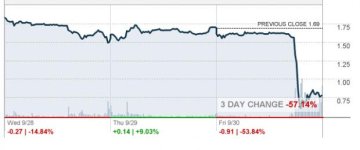
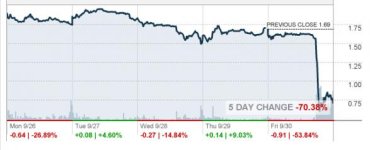
Just yesterday, Kodak stock fell 53% on bankruptcy rumors. Yikes!

http://money.cnn.com/2011/09/30/technology/kodak_bankruptcy_rumors/index.htm?iid=HP_LN

The last three days
Picture 12.jpg

The last five days
Picture 13.jpg

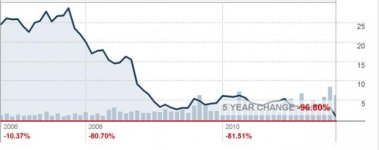
The last 5 years
Picture 9.jpg


Kodak, for sale or gone. We'll see. They think they have $3 billion worth of patents... If they sell all of them, then what? Keep bleeding? They need to restructure. I just hope their motion picture film division lives on. Maybe spin it off?
 
Last edited:
Don't panic everyone! For film, there's also Fuji which is not in danger (as far as I know). But yeah, let's hope Kodak gets out of this somehow. Would hate to lose the black and white stocks.
 
Looks like we're going to lose some time honoured phrases, like 'Kodachrome frenzy' for multicolored hot air balloon fests etc. But I think that went a few months ago? Haven't seen any balloons either.

And the film projector reel change cues at the top right of the screen. We were at the movies yesterday and I found myself once again unconsciously using those cues to time the reels and as result the flow and pace of the movie. My wife hates it.

If I was using Red to make a black comedy, I'd include a series of those cues all timed correctly but after the last one, about 2 mins later another set, immediately before a totally different scene change. heh heh, just trying to spark the thread up a bit.

Cheers.
 
http://www.eoshd.com/content/4163/a...ening-and-there-is-nothing-we-can-do-about-it

Eastman-Kodak are on the brink of bankruptcy. With the transition to digital, Kodak under-estimated everything about it. They failed to cater for photographers and enthusiasts – Kodak’s real market. They abandoned their niche in pursuit of the masses. They became jaded and didn’t see the opportunities in their existing market, especially that the internet could provide. Instead Kodak rolled out wave after wave of uninspired and under-featured digicams aimed at the mass market. Kodak was on the cutting edge of sensor technology but never utilised it properly. Then in a move that never made sense they offloaded the sensor business completely. Just to get that mistake in perspective – it’s the equivalent of Kodak selling their film business shortly after the introduction of the SLR in the 1950s.

Kodak’s line of DSLRs wasn’t price competitive and was quickly abandoned. Kodak’s motion picture 35mm film stocks were never replaced with a digital cinema camera. Instead we had things like an EasyShare dock and a $100 compact even the most ignorant of super-market shopper wouldn’t choose over a Canon.

We have a failed company as a result, and Leica might have to look to Panasonic to provide sensors for their M9 successor now.
 
I don't think the demise or restructure of Kodak is big news. They have been on the decline for well over a decade, and the half-hearted attempt to build digital cams illustrated how inept they were at finding a place at the digital table. HP is another example of a company with a proud heritage that has pissed itself away for years (despite what Carly says). Hopefully, there is enough money in making film stock that they will continue or possibly spin the division off. FWIW, they recently quit making Kodachrome, the most revered film in all of still photography.

Grant
 
From "The Street"; 5 Scary Stocks to Sell Now, october 31st 2011

Eastman Kodak
Former blue-chip Eastman Kodak(EK) has fallen far from its once-mighty perch. The current $300 million market value is now down more than 95% from its peak, and even that valuation may be rich. The company hasn't earned a profit since 2004, is choking under more than $1.4 billion in debt and is looking to sell assets just to keep the creditors at bay.
Trouble is that those assets, such as the company's patents (and the royalty streams they engender), are one of the few sources of cash flow for the company.
Kodak is set to unveil quarterly results this Thursday, and judging by the plunging stock price, results won't be pretty. Rumors swirl that cash is getting tight and lenders are getting anxious. The Kodak brand may well live on as the company's still-appealing assets (such as a printing division) get acquired by rivals, but equity investors may no longer play a role in that future, if current bankruptcy rumors come to fruition.

As I was saying, no matter how much the motion picture emulsion people at kodak are dedicated to their job, when the company goes under, so will they. Kodak may not go under, but I would say they are almost as close as they possibly be. And with all the past criticism for AIG and GM and the current occupy movement, don't expect any government handouts, especially to a company that has long faded from glory and sells printers and cameras. It's not too big to fail, and it's failing.

The BEST outcome for us, is that the motion picture film division is spun off into another company or is bought by another company and they continue to make film.


My major point I am trying to get across is that film is an expensive and difficult process to manufacture... the death of film won't be from the complete film community not wanting it... because there will always be quite a few who desire it... however, it's not as easy of a thing to make, so the death of film will be when the business side decides it's done. There can be thousands of individuals who like film, but if they can't buy the film in the large numbers required to not only keep manufacturing it, but to make a nice profit, it will die. Companies can't run on thin margins, not with all that R&D... So it won't be from complete and absolute abandonment, but from just enough people not buying it to make the big businessmen think it's not worth their time.
 
I did not need to look at Kodak stock to know that within the next five years there will not be a single movie theater projecting in 35 and not a single movie shot on film. If in 2016 you can find a single motion picture in production using film cameras, you'll be very lucky.
 
From all accounts, it does sound like the motion picture film division at Kodak is one of the remaining profit centers in the company. I suspect it could be spun off into a separate enterprise that, at least for a few years, would still have a viable market for its products. Doing extensive R&D on new film-based technology seems to be a dead end, however. The big problem is that Kodak became a highly diversified company with many different business interests, many of which have collapsed, leaving the core film business saddled with a lot of unrelated people, buildings and unproductive assets that it doesn't have the wherewithal to support by itself. Breaking up the company and letting the unprofitable parts go under may be the best thing for the film business.

Even as an independent entity, the film division will need to continue downsizing over time as use of its products unquestionably is decreasing. I wonder if one of the big international companies with more diversified interests in imaging technology -- I'm talking Sony, Panasonic, Canon, Fuji -- would be a potential buyer for the film production assets, and could manage its decline gracefully over the next few years? The worst scenario would be for the whole enterprise to go under all at once and take the film manufacturing division with it.

- Greg

That is the best case scenario in my opinion right now. But you have to ask yourself how big businessmen think. They don't care about filmmaking... they care about profit. I don't see anyone buying the motion picture film division and spinning it off or absorbing it, knowing it's really a dead man walking... no matter how beautiful a medium. Sure it's not one of the poison apples of the former kodak empire, but it's not a division that has a shining future. Buying a film emulsion company when productions are leaving the medium at a rather steady rate, is not the most attractive business model. Continuing the division and gracefully downsizing to a finale, is the most appropriate choice to the company who created the division, Kodak. This is mainly because they have already invested and paid for the process from start to finish. But buying all of the personal, equipment, and facilities from Kodak and then starting to ride out the last days of film would be a very difficult investment to take. Right now, I would assume the Kodak motion picture division is worth much more to Kodak than it ever could appeal to anyone else. That is why I worry so much about the health of Kodak. Because if Kodak fails, I see a great potential that despite being one of the best things about Kodak, the motion picture emulsion part of the company will still be a hard sell to spin off as a new company.

I hope it is spun off and we enjoy it for years to come. It is a possibility. But I've seen a lack of profit kill many beautiful ideas. Looking at the data (falling sales, and declining R&D) I'd say it's going to be a tough sell to anyone outside of Kodak.

But you never know. Right now, what we do know is that the entire entity known as Kodak is not able to help itself right now.
 
Last edited:

Yeah, but it remains to be see if Kodak will end up like Bendix Woods... what is Bendix Woods... Here's a picture...

Studebaker-Trees.jpg
 
Back
Top