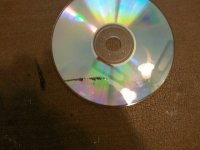
Damaged CD. What happened???

David W. Richardson

Chapelgrove Films
I was just given a commercially-produced (or so it appears) CD from a local band. When I got home, I found it was damaged in a way I've never seen before.

It appears that the silvery part of the CD is right on the top surface of the plastic disk. It has been scratched all the way through to the opposite side (of the silvery layer), and bits are flaking off from the scratch.

I always thought CDs and DVDs had the silvery layer (the 'recording medium') sandwiched between two disks of plastic and sealed. I knew scratching the plastic on the bottom could cause problems when playing the disk, but I've never before seen a disk where the top layer is the 'recording medium' and be scratched off with ease by a fingernail or most anything else.

Has anyone see this kind of thing before?
 
I always thought CDs and DVDs had the silvery layer (the 'recording medium') sandwiched between two disks of plastic and sealed. I knew scratching the plastic on the bottom could cause problems when playing the disk, but I've never before seen a disk where the top layer is the 'recording medium' and be scratched off with ease by a fingernail or most anything else.

What you received is likely a duplicatd CD rather than a replicated CD.

Replicated discs are actually pressed fom a master disc, and both the reflective aluminum and the data layer are sandwiched between plastic and ploycarbonate.

Duplicated discs are burned onto CD-R media, and on a CD-R the reflective aluminum layer is on the surface, just beneath the label surface. That's what's flaking off, not the recording layer.

That's what I was thinking, but the in the scratched section I can see straight through the CD. In other words it didn't just scratch off the label, it scratched off the recording area too. Yet there's no deep gouge in the plastic that I can feel on the top side, or the bottom for that matter. So it's almost like both the label layer and the recording layer are lying on TOP of the CD itself. Very strange.
 
I tried to upload pics, but I keep getting 'Invalid file'. No idea why. Filename extension is 'jpeg', which the upload box says is one of the valid file types.
 
That's what I was thinking, but the in the scratched section I can see straight through the CD.

Yes. It is a duplicated disc. A CD-R. There is a very thin, photoreactive dye layer underneath the reflective aluminum layer. It's basiclly transparent to the human eye, but the laser can see it. The laser makes changes to the dye layer during recording. The darkened spots created by the laser block the laser from reflecting off the aluminum, et voila: data storage.

So if the label and the thin aluminum layers flake off, which they occasionally do for various reasons (including, but not limited to, manufacturing issues), the disc will still be see-through.

I ran live sound for a talent show once and had a stack of CD-Rs brought to me by various performers: their performance tracks. I put a small piece of console tape on each one to label them (most were brought to ke without cases). I pulled the tape off one of the discs and the label and reflective layers came off with the tape, but only where they were in contact with the tape. I'd never had that happen to me before, but I stopped using console tape after that.

Interesting. The music does skip a bit, but I was amazed it played at all. Now, though, I'm worried that the label might flake off inside my CD/DVD player and cause problems.
 
Okay, here are the pics -- front and back of the CD, showing the 'scratch', which is quite long and wide.

The reason the CD still plays is that it reads from the inside out, so the TOC is still intact. The reason it skips is that the flaked area leaves short gaps in the readable data stream.

For what it's worth, that looks like a home-published job: recorded on a CD-R drive or duplicator, printed title from a CD printer like THIS (but a cheaper, monochrome version).

Honestly, I'd try to get a new CD from the band. It needs the reflective surface to read the dye layer. Once that's gone, there's no going back.
 
Well luckily I was able to rip the 2 songs that I need for our movie intact from the CD, so that's all I really cared about. In fact, I ripped the first 4 songs, but the last 3 would not rip.

Thanks for all the good information!
 
Back
Top