
Navigation
Install the app
How to install the app on iOS
Follow along with the video below to see how to install our site as a web app on your home screen.
Note: This feature may not be available in some browsers.
More options
You are using an out of date browser. It may not display this or other websites correctly.
You should upgrade or use an alternative browser.
You should upgrade or use an alternative browser.
Coverage, Blocking, Cuts and JAWS
- Thread starter J.R. Hudson
- Start date


Bigmagic
Well-known member
John this thread has been inspiring. I pulled out my copy of "Jaws" and went thru the scenes with an eye for the "montage". You have focused attention on an important part of what makes the words come to life. I have books and dvds that get into blocking and editing but your breakdown of the scene is a very effective learning tool. Thanks for the inspiration.

J.R. Hudson
Spirit Animal
Tks Big
I'm going to be doing another one and would love if others did some as well. It's interesting to see how its broken down and how we all interpet the scene and how it affect us.
I'm going to be doing another one and would love if others did some as well. It's interesting to see how its broken down and how we all interpet the scene and how it affect us.

Jay Rodriguez
Coffee Member
great piece of work John, bumping this out of excitement.

yagfxg33k
Well-known member
It is truly outstanding work. I learned a LOT from this. It's interesting that Steven Spielberg's later films he uses a lot less setups then you see in that jaws sequence. I have noticed that he tends to try to maximise the use of any given setup instead of doing so many like you see in this jaws sequence.

Young-H._Lee
Well-known member
thanks for taking hte time to do this john, very helpful
vagfxg...i agree...spielberg tries to minimize the number of shots as much as he can...using camera movements, complex blocking, panning...to capture as much as the screen geography in one take as possible...i think this is a fantastic filmmaking strategy as it minimizes the chance that audiences will get confused in the screen space and get lost on what the heck is going on...
whereas directors like michael bay...
J.R. Hudson
Spirit Animal
Thanks guys! What a blast! Anyone remember the Pyscho one I did ?


Cryogenic Filmworks
Veteran
overlandfilms said:Back on edits, I have always liked deciphering Michael Kahn's work in Raiders of the Lost Ark. Has anyone else found the jump cut in that otherwise perfect film?
e
By "jump cut" do you mean where they take two take and try to splice them together to look like it was one take? If so there is one in Apocalypse Now (Redux) when Willard is looking through Kurtz's book or diary. When he is flipping the pages the book moves ever so slightly.
Bigmagic
Well-known member
I enjoyed the "Physcho" one as well John but this one because of the montage and the "crossing the line" is more interesting. I have watched a number of Hitchcock films over the last few months so maybe I'm a little worn out on him. I still like his movies(I watched "The 39 steps" today) but I enjoyed your Jaws breakdown the most. Still the #1 all time dvxuser breakdown in my opinion.(Thanks for the fiver you slipped me for typing that John). Just kidding I love it.

HansK
Veteran
John_Hudson said:Thanks guys! What a blast! Anyone remember the Pyscho one I did ?
I missed that one. Is it still posted here online? If not, would you mind posting again?
Cryogenic Filmworks
Veteran
HansK said:I missed that one. Is it still posted here online? If not, would you mind posting again?
http://www.dvxuser.com/V3/showthread.php?t=31469
JJ Alexander
Active member
This is brillant John. Thanks for doing this. Very interesting.

Chris Messineo
Veteran
John,
Great work! I don't know how I missed this thread the first time around. Jaws is one of my all-time favorite films!
Chris
Great work! I don't know how I missed this thread the first time around. Jaws is one of my all-time favorite films!
Chris

-JunK-
Active member
Wow wonderful! Seeing it is great especially from jaws =) I always try and do some exercises recently preparing for a summer shoot. Pick a scene from a movie I love, look at script, and do exactly what you did. Although I use a pile of bent 4x6 index cards =) Coverage and blocking is something you inevitably must learn by doing I believe. And no matter how much experience you might have, it's always a challenge and get better each time I believe. And my experience is nothing to clap at =)

Ian Slessor
Well-known member
I don't mean to "resurrect" this thread but the very first film I remember seeing in a theatre was "Chitty Chitty Bang Bang" somewhere in Saskatchewan and I guess I must have been about four years old.
However, my first real cinema experience was JAWS at ten in Kingston, Ontario.
Yeah. Ten.
I'm glad my parents didn't think it was too strong for me although nowadays I won't let my kids watch it until they're a touch older than I was. Say...twenty. rogar-BigGrin(DBG)
The movie had a real impact on me and when my wife and I rented a big-screen HDTV for Christmas 2004 we picked up JAWS to watch.
Damn, what a great movie.
Such superb scenes and acting. It was great to see all the non-actors that Spielberg appeared to use as well. Sitting in our living room I really was transported to Summer 1975 and it was like I was watching it again at ten years old.
John. Thanks again for the insight into "El Spielbergo's" technique.
Loved the Psycho one too but not as much as JAWS.
Keep 'em coming.
sincerely,
ian
However, my first real cinema experience was JAWS at ten in Kingston, Ontario.
Yeah. Ten.
I'm glad my parents didn't think it was too strong for me although nowadays I won't let my kids watch it until they're a touch older than I was. Say...twenty.
rogar-BigGrin(DBG) The movie had a real impact on me and when my wife and I rented a big-screen HDTV for Christmas 2004 we picked up JAWS to watch.
Damn, what a great movie.
Such superb scenes and acting. It was great to see all the non-actors that Spielberg appeared to use as well. Sitting in our living room I really was transported to Summer 1975 and it was like I was watching it again at ten years old.
John. Thanks again for the insight into "El Spielbergo's" technique.
Loved the Psycho one too but not as much as JAWS.
Keep 'em coming.
sincerely,
ian

Brandon Rice
Distributed Producer
Very interesting breakdown... very helpful.

artofsuntzu
Active member
Thanks for sharing, John. I'm new to posting to DVX and was relieved to find this thread because I thought I was a lone, frame-by-frame, capturing junkie.
For those who've used the Hollywood Camera Work DVD's, there's an additional way to reverse engineer Spielberg's scene. By taking the same scene edits, and blocking overhead, we see how Spielberg answers some questions regarding the craft of camera placement:
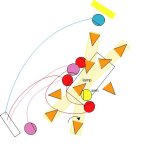
From this one scene, we can see a style that Spielberg frequently uses.
For example, he favours using a Pivot Object. The overhead shows two light yellow paths for a series of cameras that move progressively closer. The lamp acts as a pivot point at the intersection for the two paths. He does this in Raiders with the globe on Indy's classroom desk.
Additionally, Spielberg likes to use a panning-external shot to open a scene and establish geography. This is marked by the camera with the black arrow. What's interesting is how economical he is. He uses this spot as a starting point for the progressively closer shots of Brody.
Thirdly, I love how the Close Up camera, facing the arm, is out on its own. It's that Spielberg 'payoff' shot. I notice that Spielberg will move from the panning-external shot, to an internal shot, cut to a payoff shot, then return to the internal shot, before going external again. This shows why he had Hooper establish a new LOA: to setup an internal shot. Although not technically an internal shot, he has a new angle established so he can cut to the arm-payoff, then return to the setup for a reaction, before returning to the external by having Hooper walk back.
I can count dozens of times that Spielberg does this: Raiders when Indy is panned to the mouth of the cave, goes to a close of him talking to Satipo, then payoff CU filling a sandbag before returning to the internal and eventual external reverse in the cave; Close encounters's opening scene with the zig zagging jeep, followed by approaching UN inspectors, going to internal POV of the local police, before returning to the internal and eventual dolly back to external of the entire group.
It's pretty handy looking at Spielberg's rules of thumb. Here's almost the same Autopsy Room blocking for another single room scene: Raiders, in the Map Room.
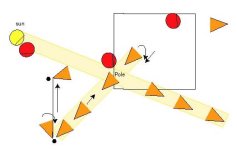
Thank you John for sparking a conversation that's more on directing and less on technical operations. (maybe start a thread on Spielberg's blocking templates?)
For those who've used the Hollywood Camera Work DVD's, there's an additional way to reverse engineer Spielberg's scene. By taking the same scene edits, and blocking overhead, we see how Spielberg answers some questions regarding the craft of camera placement:
From this one scene, we can see a style that Spielberg frequently uses.
For example, he favours using a Pivot Object. The overhead shows two light yellow paths for a series of cameras that move progressively closer. The lamp acts as a pivot point at the intersection for the two paths. He does this in Raiders with the globe on Indy's classroom desk.
Additionally, Spielberg likes to use a panning-external shot to open a scene and establish geography. This is marked by the camera with the black arrow. What's interesting is how economical he is. He uses this spot as a starting point for the progressively closer shots of Brody.
Thirdly, I love how the Close Up camera, facing the arm, is out on its own. It's that Spielberg 'payoff' shot. I notice that Spielberg will move from the panning-external shot, to an internal shot, cut to a payoff shot, then return to the internal shot, before going external again. This shows why he had Hooper establish a new LOA: to setup an internal shot. Although not technically an internal shot, he has a new angle established so he can cut to the arm-payoff, then return to the setup for a reaction, before returning to the external by having Hooper walk back.
I can count dozens of times that Spielberg does this: Raiders when Indy is panned to the mouth of the cave, goes to a close of him talking to Satipo, then payoff CU filling a sandbag before returning to the internal and eventual external reverse in the cave; Close encounters's opening scene with the zig zagging jeep, followed by approaching UN inspectors, going to internal POV of the local police, before returning to the internal and eventual dolly back to external of the entire group.
It's pretty handy looking at Spielberg's rules of thumb. Here's almost the same Autopsy Room blocking for another single room scene: Raiders, in the Map Room.
Thank you John for sparking a conversation that's more on directing and less on technical operations. (maybe start a thread on Spielberg's blocking templates?)
Last edited: