Color correcting for lights: I shot a color chart, now what?

BrownCowVideo

Active member
Greetings Lighting Gurus:

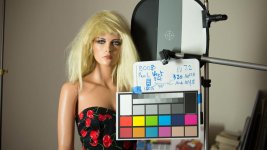
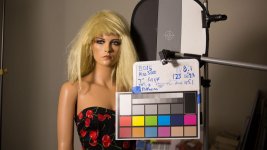
I took the advice of the high-end professional DP's that recommend shooting a color chart with one's camera and lighting in order to achieve proper white balance and color rendition. I have done that for two lights that I have, a biax flo light and an LED array fixture... since I believe that neither light has optimum color rendition/CRI right out of the box. Now that I have raw photos as well as some footage, is there a common procedural technique to determine each light's deficiencies and adjust for them?

I would also like to use my cameras' WB Shift function to create a custom profile for each light, similar to what gelling the fixture would achieve. My guess is that the flo needs some minus green and the LED... something.

Thanks, in advance, for any help you can give me!

Brian Brown
BrownCow Productions
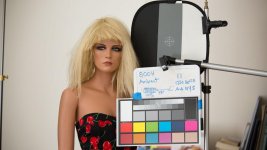
 

Attachments

  • ambient_light.jpg
    ambient_light.jpg
    51.9 KB · Views: 0
  • flo_light.jpg
    flo_light.jpg
    56.4 KB · Views: 0
  • LED_light.jpg
    LED_light.jpg
    54.3 KB · Views: 0
I'll tell you my method.
First have a good monitor to look at. Then you want some light sources whose color temperature is reliable.
For 3200 - A tungstun 3200 fixture is genrally a reliable source for color. Put your chart and someone's face or your mannequin in front of the Tungstun and balance your camera so it looks good. Then take your LED or Flourescent light sources and gel them till they match the tungsten.

For 5600 - You could simply put some CTB in front of the tungstun lamp and then do the same with your LED and Flourescent lights. You could also test it against a known source like a Diva Light or a regular kinoflo.

The problem with all 5600 sources is that none are completely reliable. Diva's especially tend to be off a bit as do HMI's. Personal;ly I find this method superior to trying to figure ourt stuff from a chart, because you can set your camera's balance anywhere. Even your presets are not reliable. By matching to a reliable tungstun source you are eliminating any magenta or green bias in the camera.

Generally you will want 1/8 or 1/4 minus green on the LED or Flo's, and additional fractional CTO or CTB . Then stick to the same brand of gels - I prefer Lee and find it pretty reliable.
 
Once you start setting up W/B for one light, you can't do a shoot with both of them together. You need to balance the lights, not the camera.

I shoot raw stills with my DSLR of my color chart but focus on the grays. Open the raw image with no changes to color temp or other settings, just 5200k.

Eyedropper the grays. The RGB numbers should be within a few points, like 85/85/85.

77/84/77 would be too green (it's R-G-B, red-green blue). I actually play with the "photo filter" adjustment layer. Magenta at 12% really does function like a 1/8 minus green, and eyedroppering the layer will show the changes the adjustment layer makes.

Scope out your color and re-test with your best guess gels. Dial it in until your grays are within a couple points of each other, then note on the fixture or globe boxes what they need.

For instance, my 400 watt HID softlight (aquarium parts & bright as hell) takes 1/2 CTO - it's 6500k with no green spike. My Alzo bulb & ballast need 1/8 minus green. My chinese biax stuff is yellow-ish - it actually needs magenta (or 1/4 CTB and 1/8 minus green).

Your video camera adds whatever color profiling stuff it's set for your footage, so do these tests with raw stills. Then double check with footage. The idea is to get every fixture as close to the same color as possible.

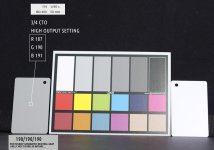
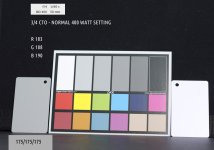
Here's a still from messing with the process… I added a box of pure neutral gray for visual reference.

hid-ho.jpg
 

Attachments

  • hid-400.jpg
    hid-400.jpg
    97.7 KB · Views: 0
Michael, I applaud your precision, though frankly there's no way I'd be able to put that much time and energy into it. So far my cheap and dirty method has been working and I'm very particular about color. I do try to avoid mixing units on a face when I can though.
One thing to be aware of is that different cameras may react to the green spike differently so you may balance a light perfectly for one camera and find its different for another. Also gelling these weird lights for 3200 is different that 5600 or anything in-between. Ultimately you need a good monitor and watch what you're getting.
 
These are wonderful suggestions! I was hoping to avoid gelling my flo lights and using some WB trickery in the camera... but I suspect that gelling provides a more consistent output.

I'm actually able to get some quick color-correction results with my DSLR (a Canon 5D Mk III), but my Canon C100 is another beast altogether... with its dizzying Color Matrix adjustments! Time to head over to that forum.

Thanks again for the help,
Brian
 
Michael, I applaud your precision, though frankly there's no way I'd be able to put that much time and energy into it.

I've done four fixtures in less than an hour. I have about 5 various biax flo units, duals and quads - I just did one and then checked the results on all of them. All my Alzo HID stuff is the same, and I checked a couple big spiral flos that I don't use that often. HMIs generally just need some 1/4 CTO. Really isn't that big of a deal, but knowing exactly what gels your daylight stuff needs is pretty priceless. My clients can be pretty picky though, esp. the bigger brand stuff where the packaging designer is looking at edits. Really can't be winging it on that stuff.

This is all for color precision and having a starting point. I have a lot of those unbleached china balls that are a warm beige, or bouncing off unbleached muslin for warmth. But at least everything that gets affected by things like that can start out the same, and I don't need to tear a whole setup down when i want to add a flo to an HID.
 
Back
Top