Clipping via house mix to camera. Need help

Then what setup do you recommend I have? How do I connect into all the microphones, guitars etc without the main mixer that's there? I just cant' bring my own microphones. Having singers hold two mics is a stupid.

Depends on the gig. What I was doing was patching in to the direct outs of the main mixer so I was getting the pre-fader feed from all of their mics, plus some that I ran. We were recording the the main speaker, his translator (English) another three on stage for other people, and four simultaneous translations to other languages, and doing crash mixes of each translation.

We spent a fair amount of time in advance, a good choice since it took the venue three tries to get a board with working direct outs! I wasn't coming in as an outsider (to the event) but was to the venue.

I cary a LOT of adapters and iso boxes and cables. For this gig I was only running a couple of "audience mics", everything else was direct outs. I wouldn't have done the job if I had to bring a ton of mics and all the cabling, they didn't have a budget for that and I don't own enough for what they needed.

But it all starts from the end. They needed to be able to burn DVD's of the talks to sell during the multi day event. So we needed to have all the tracks separate to do the mixes the various DVD's needed. For most concerts I have recorded I set up a pair of mics and do a stereo recording, because that is what I will be delivering.

Depending on what you need to deliver none of what I do may apply.
 
I have done a ton of this stuff for corporate work, and there is no single formula for success. I try to get as many sources as possible. I usually shoot with 3 cameras so I have 6 tracks to work with. Having plenty of XLR cable is a must, and I will often use a radio mic if the cable run is too complicated. My wide shot, (back of the hall) will have a shotgun that usually provides a surprisingly good sound of "whats' in the hall". I'll put the radio receiver in the other channel on that wide camera with the mic up near the PA which gives a cleaner recording of the mix. Camera 2 I put near the sound board and take a mono feed from the board in one line in channel. Be sure to carry a selection of pads. They are cheap and can save your life. Most PA speakers have an XLR out on the back. That goes into channel 2 on that camera, set to line in. If it's a speaker rather than music, I put a radio lav on the main speaker, as I've often gotten all the other stuff set up and working and then the CEO get's on the podium and can't figure out how to turn on the mic, or it starts to feed back, so he puts down the mic and just walks into the crowd and does a "man of people" schtick, the worst first sentence in any speech in the world is when the CEO says "I don't need a mic" and steps off the stage. That still leaves me an open channel on camera 3, so I usually just have the on camera mic pointed at the stage and the level on auto. If there's a podium with a gooseneck mic I will often just tape a small lav on the gooseneck mic and run an XLR or radio. If the house is using a radio, there are only 3 legal bandwidths in the US. I purposely bought me 3 packs, one in each of the bandwidths and can often set my receiver to the same frequency as the house mic and receive the house mic directly. This sounds great for the speaker, but gets you little room noise (applause) and CEO's love the hear the thunderous applause of the minions at the end. My point being, you need to cover any live event 6 ways from Sunday, there by improving your odds when things go to hell, and they will. Don't bother with stereo, I've never had a custom care whether the sound track is stereo as long as it comes out of both speakers they are happy. You can call this a "shotgun" strategy, but every time I've worked this kind of event it's a different problem. It requires that you be creative and adaptable.
 
Last edited:
Two of my favorite gadgets for interfacing to venue systems are:

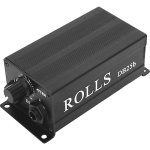
1) Rolls DB25b Direct Box. A small, sensibly-priced, relatively rugged box that provides both isolation AND continuously-variable attenuation to accommodate a nearly infinite range of signal levels. Converts whatever signal level you can get into proper, low-impedance, balanced mic-level which can be sent 100s of feet through ordinary XLR mic cable.

428706000000000-00-500x500.jpg
http://www.rolls.com/product.php?pid=DB25b

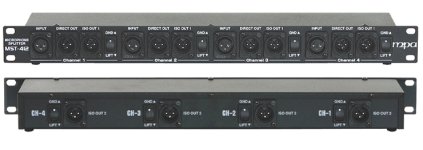
2) EWI MST-412 4 Channel, 3 way, transformer isolated XLR splitter. Allows you to "split" the signal from up to four microphones so you can do your own "recording mix" which is almost NEVER the same as the "reinforcement mix" being created by the FOH operator. Nice big transformers for good low-frequency response and low distortion. Complete magnetic isolation from the venue system. Ground-lift switches for the outputs to manage ground-loop problems, etc. Again, sensibly-priced.

mst412_1.jpg
http://www.audiopile.net/MST-412-A

And I have hundreds of feet of XLR cable. I make my own cables with wire and connectors from Redco.com XLR is one of the easiest kinds of connectors to learn how to solder to. And also a bag full of connector adapters, adapter cables, jumper cables, patch cables, etc.
 

Attachments

  • DB25b_Large.jpg
    DB25b_Large.jpg
    48.5 KB · Views: 0
"If the house is using a radio, there are only 3 legal bandwidths in the US. I purposely bought me 3 packs, one in each of the bandwidths and can often set my receiver to the same frequency as the house mic and receive the house mic directly."
- I'm not aware of the 'three 3 legal bandwidths' the OP is talking about, though many blocks in the spectrum are 'illegal' to use.. for instance the 700 Mhz range and soon the 600 Mhz. range (in the US). If the house wireless system is from a different manufacturer, this is really not a good idea.. even if one can tune the exact same frequency, the systems NR noise reduction system and tone squelch would be different among other variables. The newer digital Ghz systems from Rode, AT Sennheiser and others can only transmit/receiver to one same frequency system at a time, so that wouldn't work at all.
+1, the Rolls DB25b passive DI is a real problem solver. Around $30 USD. Less for the 1st generation DB25 Matchbox (if still made), which didn't the mounting brackets or the variable pad, it did have a 0/20/40dB attenuation switch though.
 
... If the house is using a radio, there are only 3 legal bandwidths in the US.
Please provide an authoritative source for this claim. It does not sound correct as stated.

I purposely bought me 3 packs, one in each of the bandwidths and can often set my receiver to the same frequency as the house mic and receive the house mic directly.
This has a virtually zero chance of success. Many (most?, all?) brands of wireless kits use different modulation and companding and encoding techniques. Even different models of the same brand running on the same frequency channel are not interoperable. This is bad advice judging by personal experience as well as the vast preponderance of evidence from people on this and other similar forums. Not recommended.

Furthermore, as old-technology analog wireless kits die off and are replaced by modern digital technology, the wireless connections will be 1-to-1 negotiated links (like WiFi or cell phones) rather than old-school "broadcast" technology where the transmitter can send out a signal that can be received by any number of receivers.
 
Last edited:
Quote Originally Posted by ric8138 View Post
> If the house is using a radio, there are only 3 legal bandwidths in the US.
Please provide an authoritative source for this claim. It does not sound correct as stated.

Ric can clarify, but my guess is he's talking about the frequency groups that Sennheiser uses in their Evolution G3 wireless. So in the US, they sell A, B, and G groups... Remember, they used to sell C groups the US, but those were in the 700MHz range that's now illegal to use. Not the same as the block systems Lectro and Zaxcom use (and are moving away from).

But while we've lost access to a chuck of spectrum (700MHz band a few years ago, 600MHz band and 554MHz+ probably with a few years), there's still some spectrum left for wireless mics... Ya, it's getting more crowded...

I broke out my old VHF (169-172 MHz) wireless (Lectro 187) and that was uncrowded...though I don't want to depend on a fixed-frequency system these days. I'm mainly on Block 24 and 22, though still have a couple Block 26 systems...I can usually find slots to use all these in the SF Bay Area and on the road. But my next purchases will be systems that cover at least three old-school Lectro blocks...and preferably more. Probably something from Lectro or Zax. And I still need to get my Part 74 license...

More good (though not rose-colored) info here:
https://www.fcc.gov/general/wireless-microphones-0
 
FWIW, I've read that Sennheiser has added (or is adding) frequency block option A1 (470-516 MHz) to the USA Evolution G3 series wireless line.

I hear ya Jim, I had kept one of my Lectro 185 sets (193.950 MHz) from years past for sentimental value. Most of the lettering on the transmitter has been worn away. Last time I used it was on a 2013 movie, more as a prop than anything else, but I sent sound to an ISO track anyway, and post used it from what I understand. I power it up occasionally to see if it still works.
 
Would I be correct in thinking that the 2.5ghz band (wifi) uses spread spectrum? It is the only way I can think of that thousands of devices could use the same band without interfering with each other.
 
They do inerfere - in fact, I've been running a theatre rack full of them with rock solid performance for three years now, but I will not be buying any more. Not because they suffer from interference - because they cause it - BIG time. Now everyone has wifi connected phones, wifi connected lighting and sound devices, wifi is just full!

I've just completed an event where there is a 7 piece orchestra in the pit 16 radio channels and multi-channel stems being used for playback - and the desk output was excellent. Mainly because the eq and processing for the PA was done outside of the desk (a digital yamaha) and every single sound source was miked. The mix was amazingly good and all the radios perforemed 100%. Think back a week or two and my own tribute band played a nice venue - I took a multitrack from the digital desk onto my mac, but recorded desk output to USB for listening to on the way home. Dreadful. all four vocals, balanced nicely. No guitar because it was simply too loud in the room, and very weak drums because they too were loud. Very unbalanced - and had it gone to the video people, they'd have been unhappy. Every event is different.
 
I think the sennheiser AVX system uses the 1.9ghz band so is generally away from all the other ones that are closer to wifi, I seem to remember them saying this is the DECT phone allocated frequency band so it less busy.

I was very impressed with it when I was on a training course at the factory as it allocates it's frequency to any free one automatically.

As for interfacing options this AV one from ART is useful as it will even take speaker level feeds: http://artproaudio.com/active_di/product/av_direct/

or the cleanbox could be an option: http://artproaudio.com/isolators/product/cleanbox_pro/
 
Regarding the distortion, Canon has designed their audio inputs so that you can overload the preamps without seeing digital clipping on the audio meters. If you have to turn down the pots much below about halfway in order to keep the meters from clipping, you are probably also overloading the preamps and you are going to hear distortion in the recorded audio. It's best to test your camera audio inputs ahead of time to see how much attenuation of the inputs is safe before distortion occurs. For example, the C100 will never see digital clipping if the pots are turned below about 4.5 out of 10. I can get a line level signal to never get above -10 on the meters while the inputs are set to mic level just by turning the pots down to about 3. Of course, all I am recording is a distorted mess for audio.
 
Ric can clarify, but my guess is he's talking about the frequency groups that Sennheiser uses in their Evolution G3 wireless.

Yes, I am wrong. I do regularly use my Senn G3's to receive Shure wireless transmitters and it sounds fine. 90% of the house systems I've run into are Shure, it's like IBM, no one ever got fired for buying Shure. I should not, however, have assumed that the Senn-Shure connection was universal, but then, what is? I apologize. My point is that even with a well thought out strategy, usually the "talent" manages to screw it up, so a number of approaches, some of which may overlap, some of which may not be the "best practice" technically, may end up sounding the best when you get back home and listen. Again, I apologize for speaking authoritatively without all the facts.
 
No big deal, I think. We're all just blind guys describing one part of the elephant. My goal is to just avoid the tail end...

My point is that even with a well thought out strategy, usually the "talent" manages to screw it up, so a number of approaches, some of which may overlap, some of which may not be the "best practice" technically, may end up sounding the best when you get back home and listen.

Ya, that's a big part of audio work. I'm a decent mixer, but my three main talents are (1) not being a total jerk and (2) anticipating and fixing problems ASAP and (3) remembering my favorite aphorism:

Good judgment come from experience
Experience comes from bad judgment.
 
Back
Top