CineD Databases

cyvideo

Veteran
It's interesting to see CineD's new pages on Camera, Lens Coverage and Lens Databases. Some interesting reading there for the idle mind. The fact that for dynamic range one of Sony's cheaper FF mirrorless offerings sits comfortably amongst a bunch of cameras that most would consider being some of the picks of the dedicated Cine camera world today.

Chris Young

https://www.cined.com/databases/
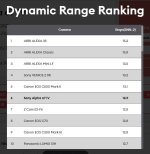
CideD Dynamic Range cameras.jpg
 
Does any of this camera gunk mean much. Say this so y might have great dr but be rolling shutter horror.. like im finding my r6 to be.

also these wege charts.. do they mention retention of colour fidelity?

why is arri good without really good figured.. is there a mesurable factor regularly missed?
 
From their article on their testing of the Alexa 35:

The waveform plot of our Xyla21 chart shows an astonishing 16 stops above the noise floor...

A solid 17th stop inside the noise floor as well as an 18th and 19th stop are visible as well. We are close to the limit of our 21-stop Xyla21 chart!

I watched part of their YouTube video last night(fell asleep, I was up early yesterday morning) and they said they were actually worried about being able to clip the first white patch of the chart, which is apparently necessary to test the dynamic range/latitude.
 
Ive just realised why those xyla chart tests are so duff

the output we all evaluate should be an rgb scope ..then colour shifts would become apparent or early clipping of a specific channel
 
do they mention retention of colour fidelity?

why is arri good without really good figured.. is there a mesurable factor regularly missed?

With regard to the real-world impact of rolling shutter. IMOH, the whole rolling shutter argument is overdone to death. There have been many great projects shot on cameras with higher rolling shutter figures than the A7iv. Such as some great videos shot on Panasonic's S1H which has a rolling shutter of 29.7ms (CineD) with its 24MP sensor as opposed to the A7iv's 26.8ms (CineD) from its 33MP sensor. For me added dynamic range is far more of an important attribute to creating good-looking images than rolling shutter issues in 99% of shooting scenarios. For a real-world example of A7iv rolling shutter, you only have to have a look at Jacques Crafford's BTS where there are many traversing verticals and panning shots where if the rolling shutter was a real issue it would raise its head, Plainly it wasn't a problem. And when asked about it he said it wasn't.

https://www.youtube.com/watch?v=swO48eA1jAU

BTW the A7iv rolling shutter in 4K 50/60p crop is 13ms which is better than that of the good old diehard FS7. In crop it still delivers a decent 4.6K downsample. Better than most 12MP S35 sensors. I'm primarily using the A7iv as a B camera, Most of the time in 50p as most of my lenses are S35 or APSC. If I need to use it specifically in FF with primes for shallower DOF interviews, I'm more than happy to do so. The rolling shutter has never been an issue in those situations. Interestingly I'm being asked less for super shallow DOF these days as that is a look that is now becoming a bit 'passe' for a lot of producers. What is apparent in the following example is the dynamic range of the A7iv camera and its ability to encompass a pretty wide contrast ranges. Far more important for me in my work. Though the dynamic range increase does start to introduce other issues in post in really wide dynamic range shots. I am finding that the greater range of graduations from the shadows to the extreme highlights being offered by these cameras is causing issues if using LUTs of less than 65-point grids. Even then 65 point LUTs are sometimes not enough to handle extreme dynamic ranges.

Regarding your questions re ARRI's images. To really understand why ARRI has the 'look' it does one has to understand how ARRI handle Luma and Chroma separately with their own patented proprietary processing which none of the other manufacturers has been able to emulate without stepping on ARRI's toes.

Way back in 2013 Art Adams did a pretty good nuts and bolts explanation as to what ARRI was doing differently from most of the Japanese camera manufacturers. A couple of his observations from his testing.

"This is what I seem to see with Alexa’s Rec 709 mode in comparison to the F55 in hypergamma mode. Sony’s F55 saturates colors until they clip and fail, whereas Alexa saturates colors to the point that film would, and no more."

"The biggest difference beyond basic colorimetry, is that Alexa limits color saturation in highlights: when the luma portion of the video signal passes 40% or so (middle gray) the color saturation freezes in place: color only gets brighter, not more saturated. This is a big part of why film looks like film, and colorists have known for years that one of the tricks to making video “filmic” is to desaturate highlights."

https://www.dvinfo.net/article/acqui...s_sgamut3.html

He even goes on to explain if you are using Resolve how to emulate the ARRI look. Check out his pages below. He even makes LUTs available to reflect this. I've been using his manual grading technique for some years now. Additional work but for extreme dynamic range shots make it well worth the extra time

https://www.dvinfo.net/article/post/making-the-sony-f55-look-filmic-with-resolve-9.html

Chris Young
 
I like the a7iv. I just used it on a shoot instead of the fs7 for near-macro slider shots. IBIS and greater sensitivity were the main considerations.

But I think I notice the rolling shutter effect on some laterally-moving shots of text on paper. It's not enough that most other people would notice, but the motion isn't as clean as with the a7siii/fx3. This is in 4k/60 crop mode
 
i wasnt mentioning specifically the sa7iv (although aybe one should in a good way) I was suggesting my beleif that the big cine cameras are better than the numbers (or these numbers) might suggest.

maybe not! there is some debate in my organisation if carrying a built c200 is worth it over the naked r5 and r6

but then my last roject - project - all about vehicles - showed the r6 while having good colour/dr was pretty flawed on the jello front.

as for colour roll off.. if one used rgb scopes on the step chart it might become very obvious where the differences are.
 
I’m one of those people that is “sensitive”(notice it and it irks the hell out of me) to rolling shutter. I shoot a lot of sports/sports doc stuff and as such, I’m around two of the biggest rolling shutter deficiencies/tales: flashes and fast camera movements. The global shutter is the biggest reason I went with the F55 over the much less expensive F5, years ago. But as my Amira is more or less my A cam, now, flash banding is something that I have to deal with/tolerate on occasion. I guess it’s the trade off for the beautiful images that come out of it almost effortlessly. It’d be interesting to know if the next sensor(10 years from now, lol), the “ALEV V” could be built with the performance/DR of the new ALEV IV with global shutter (Sacrificing another theoretical gain in DR for global shutter).
 
The global shutter is the biggest reason I went with the F55 over the much less expensive F5, years ago. But as my Amira is more or less my A cam, now, flash banding is something that I have to deal with/tolerate on occasion.

That's where I found the FBR (Flash Band Reduce) setting on a lot of the Sony ENG cameras was a big help when shooting pressers and red carpet-type scenarios. Catalyst Browse also has Flash Band Reduction settings which can be useful. One thing I used a lot when shooting corporate material in offices etc was the synchro scan shutter on many of the Sony camcorders to avoid the rolling scan on PC monitors. Quite a number of times I've had to drop using an A7 when PC monitors were in shot. Having to revert back to an ENG cam to grab those screenshots. Thankfully now I don't have to do that with the A7iv with it having both an anti-flicker and a variable shutter. Makes it very easy to dial out flickering lighting and monitor screen banding, This variable shutter was one of my reasons for going with the A7iv as it is a function I use often. You can in fact use both shutter settings in the A7iv together as explained in the manual:

"The impact of flickering can be reduced by using [Anti-flicker Shoot.] and [Var. Shutter] together even in a shooting environment where both 100 Hz/120 Hz flickering and higher-frequency flickering occur. In this case, first set [Anti-flicker Shoot.] and [Var. Shutter] to [On], and then adjust the shutter speed with [Var. Shutter Set.] before shooting images."

Chris Young
 
I’m one of those people that is “sensitive”(notice it and it irks the hell out of me) to rolling shutter. I shoot a lot of sports/sports doc stuff and as such, I’m around two of the biggest rolling shutter deficiencies/tales: flashes and fast camera movements.

Flashes and fast movement has never bothered me and I never notice skewed straight lines, like in every RS demonstration on the planet moving the camera from side to side.

I can't stand it with pans which are meant to be slow but are just a little too fast. For example in most Netflix shows, an establishing shot with an ambitious sweep over a nice landscape. I can't focus on anything during the movement and it feels like your eyes have gone blurry. People react differently to RS but IMO the recent trend of establishing shots covering a lot more ground needs to be treated more carefully. As a viewer I shouldn't ever have to look away from the TV for non-story reasons.

that sounds like your basic rule about panning speed. which is also the reason some people (james cameron lately, I've heard?) are pushing for higher frame rate playback. I see the reasoning... but I'm partial to 24. anyway, they ought to observe the rule
 
that sounds like your basic rule about panning speed. which is also the reason some people (james cameron lately, I've heard?) are pushing for higher frame rate playback. I see the reasoning... but I'm partial to 24. anyway, they ought to observe the rule

What about an on screen tool that takes RS into consideration, just like waveform, zebras etc? Sounds like a nightmare!
 
Last edited:
Flashes and fast movement has never bothered me and I never notice skewed straight lines, like in every RS demonstration on the planet moving the camera from side to side.

I can't stand it with pans which are meant to be slow but are just a little too fast. For example in most Netflix shows, an establishing shot with an ambitious sweep over a nice landscape. I can't focus on anything during the movement and it feels like your eyes have gone blurry. People react differently to RS but IMO the recent trend of establishing shots covering a lot more ground needs to be treated more carefully. As a viewer I shouldn't ever have to look away from the TV for non-story reasons.

Skew and object distortion aren’t usually the big offenders, at least with decent modern dedicated video/Cine cameras. Flash banding is, though. It’s like F’n nails on a chalkboard to me.

The judder, though, is usually just people not adhering to pan speed rules. I’m a fan, too, of the nice big, wide, beautiful establishing shot. Let me take it in and appreciate it and get a sense of where I “am”.
 
What about an on screen tool that takes RS into consideration, just like waveform, zebras etc? Sounds like a nightmare!

Something like that could probably be implemented, since so many cameras have motion sensors built into them, nowadays. I guess you really just then need the frame rate, shutter speed and lens focal length, which is trivial today. The only hang-up would/could be older lenses that don’t transmit data, but you could get around that by simply allowing the focal length to be entered in manually to the “tool”.
 
I think a rolling shutter tool would probably take the form of a warning that appears on screen if it's detected, just like "flicker" appears on mirrorless cameras now. I doubt this will happen or that it's really necessary, though.

Re:global shutter, it seems tricky because rolling shutters seem advantageous in every other way. Saw this article today about sony sensors:

these are the advantages of rolling shutter CMOS sensors over global shutter CMOS sensors:
  • Lower noise level
  • Better sensitivity
  • Better dynamic range
  • Better overall image quality
And this is the advantage of global shutter CMOS sensors over rolling shutter CMOS sensors:
  • Better high-speed capturing (no distortion)
https://ymcinema.com/2022/08/23/sony-large-format-cmos-sensors-global-shutter-vs-rolling-shutter/
 
I think a rolling shutter tool would probably take the form of a warning that appears on screen if it's detected, just like "flicker" appears on mirrorless cameras now. I doubt this will happen or that it's really necessary, though.

Re:global shutter, it seems tricky because rolling shutters seem advantageous in every other way. Saw this article today about sony sensors:
[/LIST]
https://ymcinema.com/2022/08/23/sony...lling-shutter/

And yet they chose to have global shutter on what was one of their flagship cameras. And their flagship ENG camera has a global shutter CMOS.
 
Last edited:
What about an on screen tool that takes RS into consideration, just like waveform, zebras etc? Sounds like a nightmare!

I wasn't paying enough attention. I thought you were talking about a tool to avoid judder caused by movement not matching "pan speed" rules.
 
And yet they chose to have global shutter on what was one of their flagship cameras. And their flagship ENG camera has a global shutter CMOS.

that article mentions that they might be able to overcome the disadvantages, but at great expense. so, there you go
 
I wasn't paying enough attention. I thought you were talking about a tool to avoid judder caused by movement not matching "pan speed" rules.

You're right, we were on the same page. I guess it'd only need to be a blinking light in a corner or maybe a very light translucent colour overlay where certain colours represent if you're following the rule like green good, orange is pushing it, red is audience headache.

We always talk about panning too quickly, is it the same for tilting? Could fast pans with CMOS sensors in a 9x16 orientation (tilting the sensor) be a poor person's global shutter? Probably not, but would be cool if that worked.

I know my example is for an object moving too fast rather than the camera moving too fast but check the vertical to horizontal transition (timestamped link) https://www.youtube.com/watch?v=dNVtMmLlnoE&t=120s
 
This is sensor/technology-independent, no? Isn't it just about how much image is skipped in between frames that creates the judder effect? I think that RED had a Magic Mount or Motion Mount or something that would automatically increase shutter angle to increase blur when you panned quickly, and use eND to compensate for the exposure increase. Unless I'm imagining things
 
Back
Top