Chromatic Aberration

And optics experts (or hardknocks-training) people have some CA advice?

I'd really love some sort of over-the-lens solution that could give me aberration, preferably with a non-distorted center area.

I shot a bunch of jewelry once, through some crazy heads-up display projector lens from a fighter cockpit. The glass was about 2" thick; but this was only good for macro shooting (and since it had no way to mount, I ended up dropping it and shattering the damn thing.)

Any ideas? I know theoretically what causes CA - problem is we've been fighting it for a century. I love the look.

And yes, I know it can be done in AE with filters, but it never looks as pretty as the real thing.

This shot was with that lens; the soft DOF hides a lot of the CA, but man, it can be so pretty.
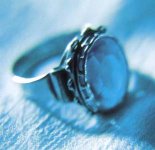
ring_big.jpg
 
It's not just CA that gives that dreamy look; coma and spherical aberration, abundant in cheap lenses with only one or two elements, also come into play.

Stacking multiple close-up lenses (diopters) can give the effect, although of course, only at macro distances.

Or you might try a Lensbaby (www.lensbaby.com) or the SLR Magic "toy lens" sold for the MFT mount.

- Greg
 
CA dreamy? , I'll trust your opinion :)

CA is caused when the lens bends different frequencies of color to slightly different degrees. It's noticeable the most in high contrast areas, and it's not always the same color, depending on how it is misalignment the which light frequencies. I guess either a cheap and misaligned lens would possibly do it, or a very slight prism of sorts. Not sure where to find that. My first instinct would be to get some sort of odd lens, just one element, say from an overhead projector, a broken lens or something... just one convex or concave piece of glass and just shoot through it.

Or shoot CP.2's wide open... I kid, I kid!


What effect are you looking to achieve with CA? Because this is what it looks like, nothing more:

chroma-aberration-300x247.jpg
 
Last edited:
CA is caused when the lens bends different frequencies of color to slightly different degrees. It's noticeable the most in high contrast areas, and it's not always the same color, depending on how it is misalignment the which light frequencies.

Yep, I find that very cool for abstract or artsy stuff; where the image begins to split apart at the sides of the frame.

That would be interesting to test, two lens elements that cancel each other's magnifications but add some interest.

Yeah, I know it sounds weird, but I've been experimenting with some "art" photography, using old polaroid 100 cameras, and I just bought a super 8 camera to mess with motion stuff; thinking of shooting some fashion with the super 8, and scanning frames - using it as a stills camera in a sense.

I just finished a huge CG music video which is crazy and over the top, but I go through phases where I'm looking for more organic stuff... and god, I'm finding that I really miss FILM - it's much more of a "partnership" with light and chemistry than the "I am in complete control" sense of digital.

You have to get your inspiration wherever you can when you wear your creative (vs. technical) hat. That stuff really makes me a happy little kid again.
 
In the movie 'The assassination of Jesse James etc" cinematographer Roger Deakins used a number of techniques to get interesting CA shots, including using custom lenses with the front elements removed, shooting through handmade glass and so on. The effects were really beautiful in that movie. He talks about it here (and this will lead on to other examples where lensbabies have been used in other films etc):

http://www.rogerdeakins.com/forum2/...ns&sid=c41e3b4f0a3258f10fc7ca6276326eb6#p3454

http://www.rogerdeakins.com/forum2/...on&sid=b277fddb652f67096ec6f7092ec1b5cd#p2852
 
Last edited:
Coatings minimize reflections so removing those would be useful for adding flare and decreasing contrast. In lens design positive and negative lenses using glass of different refractive indices are combined to allow colors to focus at a common point. So an easy way to get chromatic aberrations would be to use a simple lens with one element of a single refractive index, like a magnifying glass. You might also look at something like a diffraction grating. I'll bet slices of a grating in the light path might produce interesting color effects, e.g. glue to a cheap filter. Check with Edmund Scientific for those.
 
Back
Top