Cheap source for CFL's? Specifically looking for extra compact, extra high wattage

Im looking to replace the halogen modeling bulbs in my White Lightning X1600's with high output CFL's. I figure it will run cooler this way and I will actually be about to use the lights for video ( Officially they take up to 250w, which is a huge CFL). I also like the ability to dim the light built into the unit, and that I can double up my photo lights for video.

Now, onto my main question: Whats a good source for quality, cheap, CFLs? Im specifically looking for one set of bulbs that are ultra high output (say 250w + , I think the WL can likely take a 300w bulb if its rated to 250w).

I also want another set of ultra compact CFL's to replace the stock modeling bulb but still be able to attach the carry case cover. For this second set I would need a CFL about a maximum of 5 inches long

Finally, can I use existing photo modifiers with these lights for continous use? I know CFL's run cooler than their halogen counterparts, so Im thinking I wont need video specific items. Im particularly interested in using the new silver PLM for video, as well as my beauty dish.
 
I'd check eBay - I got some 45 watt spirals (Steve Kaiser's store I think) for china balls, but they're equivalent to under 200 watts tungsten. More like 150 or so.

I also got some of the big long deals that are close to 500 watt equivalent, but they're huge - I don't know if you'll find anything comparable.

I shoot speedotron for stills which use 250 watt bayonet bulbs; I did a lot of jewelry shooting on tungsten using just the model lights and my existing strobe grids & softboxes - those were probably shutter speeds in the 1/4 second range though. 250 watts for video is not widely useful, good for things like hair or fill - throw in a softbox and it's almost gone though.

If your model lights are standard household base, you could try the Alzo HID set - like $180 for a ballast and bulb, about 800 watt equivalent. Pulls much much less wattage. Alzo told me the heat level is similar to a 200 watt lamp. You would need to wire your model light leads to go through the ballast. A pricey setup for sure; I'm about to rebuild an old theatrical fresnel with the alzo.

Honestly, I don't think you'll get any useable wattage for video with a small spiral in a softbox; maybe for fill or something, I use the 45 watters in chinas as subtle fill, just to raise my lower-mids a bit to kill noise, and then I crush it back down in post.

I've never been concerned with heat in my modeling lamps - the strobe puts out a blast of heat. If you have an investment in softboxes, you could look into the Alzo 800's, decent HIDs with available speed rings - Alzo tells me their temp is fine for strobe-level softboxes (vs. the heavy hot-light boxes). I love grids and have been able to adapt some speedo grids to my fresnels, but haven't found anything as pretty as the 11" speedo reflector with a grid.
 
Im looking to replace the halogen modeling bulbs in my White Lightning X1600's with high output CFL's. ... Im specifically looking for one set of bulbs that are ultra high output (say 250w + , I think the WL can likely take a 300w bulb if its rated to 250w).

When sizing a high output CFL for your White Lightning, you have to take into account is that the 120V versions of high output CFL bulbs have a power factor of .5. Since overlooking the power factor of high output CFLs in this case could lead to the head overheating, I would like to take this opportunity to explain it in detail and show how it effects Kawasaki Guy’s sizing of a high output CFL for his strobe head.

If we look at the technical specifications for a representative 200 watt 8u CFL bulb below (available at http://www.maxlite.com/PDFs/FocusSheets/HighMax.pdf), we find that with a power factor of .5 the bulb in fact draws 3.3 Amps. The difference between the actual current drawn by the bulb (3.3A) and the 1.66A one would think a 200W bulb should draw using Ohm’s Law (W=VxA), is the difference between what is called “Apparent Power” and “True Power.”

200w8uCF_bulb_spec.jpg

Specifications for Maxlite 200W 8u CFL Bulbs ​

If, in this case, you were to measure the current (using a Amp Meter) and voltage (using a Volt Meter) traveling through the cable supplying the CFL bulb and multiply them according to Ohm’s Law (VxA= W) you would get the “apparent power” of the bulb (120V x 3.3A = 396W). But, if you were to instead, use a wattmeter to measure the actual amount of energy being converted into real work (light) by the ballast of the CFL bulb you would get the “true power” of the bulb which in this case is specified by the manufacturer as 200W. The ratio of “true power” to “apparent power” is called the “power factor” of the bulb.

A favorite analogy electricians like to use to explain power factor is that if apparent power is a glass of beer, power factor is the foam that prevents you from filling the glass all the way up with beer. When lights with a low power factor are used, the distribution system must be sized to supply the apparent power (beer plus foam), even though only the true power (beer) counts. What accounts for this discrepancy between Apparent Power and True Power?

To understand the power factor of a CFL bulb, and its’ effect on the power supply, it is helpful to compare it to an incandescent bulb. An incandescent light is a simple resistive load. The high resistance of its tungsten filament creates heat until the filament glows - creating light. As we see in the oscilloscope shot below, of a 25W incandescent bulb operating on grid power, the current is always proportional to the voltage (current is represented on the scope as the voltage drop on a 1 Ohm resistor.)

Incan_Waveform.jpeg

Current and Voltage Waveform of a ACEC 25W Incandescent bulb ​

If the applied voltage is sinusoidal, the current generated is also sinusoidal. That is, the current increases proportionately as the voltage increases and decreases proportionately as the voltage decreases. Since the peak of the voltage corresponds to the peak in current, the voltage and current are also in phase and so have a unity power factor (Power Factor of 1.)

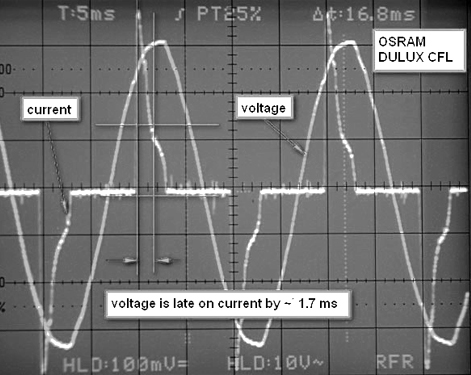
The voltage and current waveforms below of a CFL bulb operating on grid power is very different from that of the incandescent light above. The most noticeable difference is that the current, generated by the CFL bulb, no longer proportionately follows the nice smooth sinusoidal voltage waveform supplied to it by the power grid. Rather, it has been distorted by electrical components in the ballast of the CFL bulb so that it instead consists of sharp spikes in power that quickly drop off over a short duration. A second distinguishing characteristic is that the peak of the voltage no longer corresponds to the peak in current. The current now “leads” the voltage by 1.7 micro seconds. The voltage and current are no longer in phase as in the case of an incandescent bulb, but instead exhibits what we call a leading power factor.

CFL_Waveform.jpg

Current and Voltage Waveform of a Brelight 25W CFL Bulb​

The distorted current waveform and leading power factor exhibited here is caused by components in the electronic ballast which use only portions of the voltage waveform, draw current in quick bursts, and then return the unused portions as harmonic currents that stack on top of one another, creating harmonic distortion that can have severe adverse effects on other equipment operating on the same power. When the power is supplied by a conventional generator, these harmonic currents can also lead to severe distortion of the voltage waveform in the power distribution system (see below for more details.) Finally, the fast rise time of these harmonic currents can cause Radio Frequency Interference (RFI) problems.

Table_THD_Flo_Ballasts.jpg

For this reason, on their website Lowell warns about their compact fluorescent (CFL) fixture, the Lowel Ego, that: “The lamps may cause interference with radios, cordless phones, televisions, and remote controls. If interference occurs, move this product away from the device or move to a different outlet” (http://www.lowel.com/ego/lamp_info.html.) While self ballasted CFLs generate the most severe harmonics, all electronic ballasts (both fluorescent and HMI) generate harmonic currents (see table below.) Besides possible RFI problems, you need to be concerned about current harmonic distortion producing voltage distortion when powering CFL, Kinos, and HMIs from generator power.
CFL_FlatTop_Waveform.jpg

The pulsed current consumed by electronic ballasts produce voltage distortion in the form of flat- topping.​

For example, the power waveform above is typical of what results from the operation of a 2500W load consisting of non-Power Factor Corrected electronic Kino & HMI ballasts on a conventional portable generator (a Honda EX5500 with a Barber Coleman Governor.) Since the voltage waveform distortion exhibited here can adversely effect other equipment operating on the same power, the generation of harmonic currents by electronic HMI & Fluorescent ballasts should be eliminated whenever possible.

For information on how to mitigate the problems caused by harmonic currents, I would suggest you read an article I wrote on the use of portable generators in motion picture production. Harry Box, author of “The Set Lighting Technician’s Handbook” has cited my article in the just released Fourth Edition of the handbook. In addition, he has established a link to it from the companion website for the Fourth Edition of the Handbook, called “Box Book Extras.”

BoxBookForumLinkGenSetMed.jpg

If you haven't yet read the article, or looked at it in a while, it is worth reading. I have greatly expanded it to be the definitive resource on portable power generation for motion picture production. Of the article Harry Box states:

"Great work!... this is the kind of thing I think very few technician's ever get to see, and as a result many people have absolutely no idea why things stop working."

"Following the prescriptions contained in this article enables the operation of bigger lights, or more smaller lights, on portable generators than has ever been possible before."​

The “Box Book Extras,” site is also worth checking out because it includes other source material used for the handbook, articles by Harry Box published in other periodicals, related websites, a list of production oriented i-phone apps, as well as more in depth discussion of topics touched upon in the handbook. You can log onto the Box Book Extras site at http://booksite.focalpress.com/box/setlighting/ with our pass-code "setlighting." Use this link for my news letter article on the use of portable gas generators in motion picture production.

Guy Holt, Gaffer, SceenLight & Grip, Lighting and Grip Rental in Boston.
 
Back
Top