Cheap lavaliers for the Tascam DR-40

...
HOWEVER there are products that you can plug into an XLR input with 24-48V phantom power and they provide propler 5~10V "plug-in power" via the 3.5mm input jack....
Another product that will do this is the "Eumel" from Ambient. They make a variety of models taking an XLR with phantom and providing plug-in power to lavs that are wired for a variety of wireless transmitter connections. http://www.ambient.de/en/products/ambient-recording/mic-power-supply/emp.html
 
As near as anyone can tell (absent ANY significant description on the Rode website! :angry:) the Rode VXLR adapter does NOT provide "plug-in power" via the 3.5mm input jack.

HOWEVER there are products that you can plug into an XLR input with 24-48V phantom power and they provide propler 5~10V "plug-in power" via the 3.5mm input jack. For example:
http://www.naiant.com/naiant/inlinedevices.html "PFA" at the bottom of the page.

So can you use Phantom Power from the DR-40 using the 1/4 plugs or is it just through XLR?
Otherwise to get the Rode Lavalier to work I'd have to spend more on the Micon adapter.
 
This quote from page 22 of the Tascam manual suggests phantom power is supplied to both.

"Confirm that phantom power is OFF before connecting a line level device to a EXT MIC/LINE IN jack."
 
So can you use Phantom Power from the DR-40 using the 1/4 plugs or is it just through XLR?
Otherwise to get the Rode Lavalier to work I'd have to spend more on the Micon adapter.
The manual seems ambiguous but a 1/4" plug and a multimeter will tell you in a matter of minutes. Insert the plug into the jack, turn phantom on, and measure the voltage between the tip or the ring connectors and the sleeve. If it's supplied to the 1/4 jack both the tip and ring should be +48v with respect to the sleeve but zero with respect to each other. Even if phantom is on the 1/4 jack you'll still need the appropriate Micon adapter though - sending full 48 volt phantom to the lav will probably fry the capsule. Lav power is only about 5 volts.
 
Last edited:
I'm feeling increasingly sorry for buying the DR-40...

- Firstly I can't believe they simply didn't build in plug-in power as a feature. All the lower spec Tascams have it. I now need to spend more on an adapter such as the Naiant. Does anyone know if there's something similar made in UK?
- Secondly, if I go for the Rode Lavalier, I'll have to spend more cash on the Micon adapter.

So I'm getting "taxed" either way.

@Inveresk: You were right all the way. The Micronic option just seems the best at the moment as that comes terminated in XLR and takes Phantom Power. Waiting for your opinion and then I'll probably just get that.
 
I'm feeling increasingly sorry for buying the DR-40...

- Firstly I can't believe they simply didn't build in plug-in power as a feature. All the lower spec Tascams have it.
Where would they put it? "Plug-in power" implies that you have a stereo 3.5mm mic input connector. The Tascam DR-40 is aimed at a more professional level where people use XLR microphones that use P48 phantom power. Now, if you bought a low-end audio recorder with a 3.5mm stereo input connector that didn't have plug-in power, THEN you would have something to complain about. Many lower-end camcorders qualify for this complaint. Your DR-40 does not qualify for this complaint.

I now need to spend more on an adapter such as the Naiant.
Does anyone know if there's something similar made in UK?
- Secondly, if I go for the Rode Lavalier, I'll have to spend more cash on the Micon adapter.

So I'm getting "taxed" either way.
No, you bought a professional-level (XLR) recorder and you want to use an amateur-level (3.5mm) microphone with it.

IMHO, the Rode mic is the perfect answer for both. You can get (whenever you need it) an output connector to match XLR (with P48 phantom power) or a 3.5mm connector (for plug-in power), or several other kinds of connectors for other uses. and the cables are field-replacable for when it breaks at the microphone end. That would be a very expensive replacement with any other lav microphone. And note carefully that the Rode Micon output connector options are almost ALL less expensive than buying a separate kludgy adapter for each different kind of gear.

So can you use Phantom Power from the DR-40 using the 1/4 plugs or is it just through XLR?

It is not clear whether the DR-40 provides phantom power on the 1/4 inch plug. But the question seems moot as I don't see how that applies to your situation. If you try to use a simple 3.5mm to 1/4 inch adapter and turn on phantom power, you will most assuredly fry your plug-in power microphone.

Otherwise to get the Rode Lavalier to work I'd have to spend more on the Micon adapter.
The Rode lav mic comes without ANY output connector, so you can choose the one you need and not have to buy something else that you have to then get an adapter for. That seems like an ADVANTAGE to me.
 
I'm feeling increasingly sorry for buying the DR-40...

Don't try and do everything with one recorder, each recorder has pros and cons...

For lav mic recording I use the Olympus LS7 recorder as a "body pack", which can be tucked into a pocket or clipped to a person's belt.

It's a tiny digital recorder that supplies power to your lav mic, and will run for 30+ hours on two AAA batteries.

Olympus LS-7 : $120 at B&H Photo
 
Both the Tascam DR40 and the DR100 are now no longer available at B&H although they're still on the Tascam web site. Any rumours about new models replacing these two?
 
No, you bought a professional-level (XLR) recorder and you want to use an amateur-level (3.5mm) microphone with it.

The Zoom H4n has a separate 3.5mm plug-in power input. That recorder is not any less professional than mine. I bought the DR-40 because it was the cheapest 4 track recorder out there.
Also quite a few of the mics listed in this thread are plug-in power mics, including GiantSquid ones I think, so not necessary all amateur-level mics.

The Rode lav mic comes without ANY output connector, so you can choose the one you need and not have to buy something else that you have to then get an adapter for. That seems like an ADVANTAGE to me.

Ups, fair enough. I didn't realise that you can choose the termination at the point of purchase. Thanks for pointing this Rich.
 
Last edited:
Either way, I want to take this opportunity to thank everyone who contributed to this thread so far. Personally I learned a ton of stuff over the past few days. My head hasn't hurt as much in a long time trying to understand all this stuff and I'm sure I've only just scratched the surface.

I also realise that most of those on this forum are real pros and I think their patience to share their knowledge with newbies like me its commendable.

Thank you.
 
Last edited:
I took delivery of the Micron XLR phantom power lavalier and have given it a quick trial. Works fine with the DR40 but I have to test battery life under phantom power. I have the additional Tascam battery pack so hope it will be reasonable.

Quality is nice to my ear but I'm far removed from being other than a novice, one whose hearing is suffering the same ravages that time has wrought on other parts of my anatomy.

I'll post a trial shortly but it won't be scientific, just a quick and simple sound sample.
 
Last edited:


I bought this today: http://www.askdirect.co.uk/Digital-...medium=GoogleShopping&utm_campaign=googlebase ....

.... would the ATR-3350 (which has it's own power box) work using that Rode converter? [\QUOTE]


I was interested in this question, as I have a pair of ATR-3350s that presently aren't useable on my DR-40. Similarly, I can only use one of them on my Beachtek DXA-SLR, which has a single mono 3.5mm port (but dual XLRs).

So I just tried out a this Rode VXLR ... and unfortunately it doesn't work properly with the ATR-3350! Fully inserted, there is no signal.

But, tantalizingly, it DOES work fine if I only insert the 3.5mm male mic connector halfway into the Rode's 3.5mm female port.

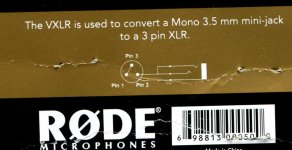
This suggests that a rewiring the Rode's pins would provide a solution. I've attached a scan of the Rode's pin-out -- does anyone with more understanding than I have any thoughts on this? Unfortunately, the Rode seems relatively bomb-proof and unlikely to be easily disassembled - but maybe there's a DIY solution waiting down at RadioShack?

VXLR_wiring.jpg
 
The Rode adapter should be working fine with ATR-3350. You see in the schematic posted for the VXLR that the tip and ring connectors are connected together inside the adapter and both feed XLR pin 2. The mic has a "stereo" 1/8 plug and it too has an internal connection between the tip and ring connectors of the plug so the mono mic signal would go to both the left and right channels in the recording device. Plugging the mic into the VXLR would put the mic's signal on pin 2 of the XLR side, which is just where it ought to go. You might have a damaged adapter - one of the drawbacks of the 3.5mm connection is that they are physically fragile and easily damaged.
 
Last edited:
Steve, thanks for the reply. Actually, the ATR-3350 lavalier terminates in a "mono" 3.5 plug, not a stereo one. So I'm guessing that's the problem ... the Rode adapter is expecting a stereo plug.

I doubt that its a fault with the 3.5mm connector, as both ATR-3350s behave identically - i.e., no signal when fully inserted into the adapter, good signal when pulled out a few mm.
Interesting. I was looking at the AT website and they state in the specs for the ATR-3350 that its cable is terminated with a 3.5mm "dual mono" plug designed to put the signal on both the left and right channels when plugged into a stereo mic input jack. I would expect that to mean it has a TRS "stereo" plug with tip and ring shorted together. But looking closer at the picture however it does indeed look like it is a mono TS plug. If that is what it really is, it could happen that when it is pushed all the way into the jack, the tip is connecting to the jack's tip connector as it should but the jack's ring connector is touching the plug's sleeve. It should be touching the tip just under the insulating ring, but if the insulating ring on the plug's shaft is too close to the end, the connector will touch the sleeve instead. Since the sleeve is ground and the tip and ring are connected together inside the Rode adapter, this would effectively short the tip to ground and kill the signal. I'd be tempted to replace the plug on the mic cable with a proper TRS plug, either shorting the tip to the ring inside the plug a la the Rode Videomic or just leaving the ring unconnected.
 
Last edited:
No one mentionned it yet, but the Azden EX-503 (even if it's not one of the favorite brand around) gives decent sound and it's quite cheap. Plus, it requires plug-in power (what *every portable recorder can do) so there's no need of battery check.
I've done a quick video demonstrating it, recorded directly with a Canon T2i (so no big audio setup) and simply normalized in post:
 
...quite a few of the mics listed in this thread are plug-in power mics, including GiantSquid ones I think, so not necessary all amateur-level mics.

"Plug-in power" microphones are not considered "professional". Their main problem is that they are not balanced, and much more susceptible to ambient interference. For that reason, professional mics use balanced/XLR connections which, by design, use P48 phantom power.

To be sure some "plug-in power" microphones are used by professionals for specialty applications. For example, they are useful for "destructive" applications where they can be written off as expendable.
 
Back
Top