

Michael Carter
Veteran
I've been meaning to do this for a while - semi-scientific testing of some affordable daylight sources.
I've been a fan of biax fluorescents for some time, which I own in duals and quads.
I also have 3 of those "alzo 800" open faced lights, claimed to be the equivalent of an 800-watt tungsten fixture, but 5300k. I also have one of their ballast and bulb combos which is really handy - I've even converted a 6" fresnel for it. People give the Alzo's a lot of hate - they're cold-restrike (but Richard at Cool Lights sells cold-strike HID's, right?) However, the Alzo lights themselves don't meet Richard's level of workmanship. The barn doors are a poor, rattling design, and the locking screws can fail, needing some loctite red - but picking them up used, they're a bargain. The restrike time is usually 3 - 4 minutes; warmup is about the same.
At $170, the Alzo bulb-ballast Combo beats Richard's bulb/ballast price more than two-to-one - different globes however. The Alzo setup may be preferable for some, as the bulb is the standard edison screw, great for Chinas and homebrew rigs. Richard's lamp is, however, much smaller, and likely great for special rigs that need a smaller size. And we all know how picky Richard is about CRI and quality. Both pull about 150 watts.
Like all HID lamps, the Alzo bulbs are double sheathed, the outer glass being frosted white - so even open-faced, they have some inherent softness. Richard's would be a better call for a fresnel conversion.
Lately I've also been using those huge-tube fluorescent bulbs in the 80-watt flavor, for things like China balls. Claimed to be a 250 watt equivalent. I've used them the most for green screens.
So, what's what with cheap daylight, at least the stuff I own? I'm always telling posters here to "test, test, test"...
The two "bulb" solutions - Alzo and 80-watt-flo - went in a light head that takes a 36x48 soft box. Inner baffle removed as these are each a bit soft out of the gate. I put the biax dual the same distance from the subject, but used a Matthews silk. (In all fairness, the silk I used was likely a quarter stop or so thinner than the softbox face).
SUBJECT: Black, white and gray color balance cards on black foamcore. About 18" from the softbox face.
CONTROL: I also tested a 500 watt tungsten globe in the softbox. But shooting with daylight balance, you get a nutty histogram and my exposure could have been a little hot.
EXPOSURE: With the varying outputs, I set exposure by histogram, based on the whites. I got each exposure's histogram as close to clipping white as possible without going over. With white balance set to daylight, on a Nikon D7000 with a 2.8 lens at 1/60th, 400 ISO.
RESULTS:
Below the photo I have some color rendering numbers, so scroll down.
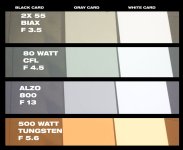
LIGHT OUTPUT FROM LOW TO HIGH:
Twin Biax: F3.5
CFL 80: F4.5
500 Tungsten: F5.6 (No CTB, just raw light)
Alzo - a (comparatively) whopping F13
COLOR:
I blurred the white and gray areas to average the pixels. I used CMYK readings from Photoshop - CMYK gives (me at least) a clearer picture of color balance and possible filtration solutions.
Twin Biax:
CMYK white: 1 1 3 0
CMYK gray: 15 12 26 0
Noticeable yellow shift. A mild violet or magenta would help here.
CFL 80:
CMYK white: 2 1 1 0
CMYK gray: 20 8 19 0
Yellow in the highs, green mids. Minus green could help, though this is a better result than an old-school green flo. I've used these with a light rose on faces and it rendered nicely.
500 Tungsten: F5.6 (No CTB, just raw light - had I shot this tungsten balanced, I suspect I'd be closer to f8 or so...)
Alzo:
CMYK white: 2 1 0 0
CMYK gray: 18 13 12 0
A bit blue, but seems like a better balance overall than the contenders. And visually, it looks more pleasing that the competition. I'd say Alzo's 800 watt claim isn't hype.
Hope that helps as you hunt for cheap daylight.
I've been a fan of biax fluorescents for some time, which I own in duals and quads.
I also have 3 of those "alzo 800" open faced lights, claimed to be the equivalent of an 800-watt tungsten fixture, but 5300k. I also have one of their ballast and bulb combos which is really handy - I've even converted a 6" fresnel for it. People give the Alzo's a lot of hate - they're cold-restrike (but Richard at Cool Lights sells cold-strike HID's, right?) However, the Alzo lights themselves don't meet Richard's level of workmanship. The barn doors are a poor, rattling design, and the locking screws can fail, needing some loctite red - but picking them up used, they're a bargain. The restrike time is usually 3 - 4 minutes; warmup is about the same.
At $170, the Alzo bulb-ballast Combo beats Richard's bulb/ballast price more than two-to-one - different globes however. The Alzo setup may be preferable for some, as the bulb is the standard edison screw, great for Chinas and homebrew rigs. Richard's lamp is, however, much smaller, and likely great for special rigs that need a smaller size. And we all know how picky Richard is about CRI and quality. Both pull about 150 watts.
Like all HID lamps, the Alzo bulbs are double sheathed, the outer glass being frosted white - so even open-faced, they have some inherent softness. Richard's would be a better call for a fresnel conversion.
Lately I've also been using those huge-tube fluorescent bulbs in the 80-watt flavor, for things like China balls. Claimed to be a 250 watt equivalent. I've used them the most for green screens.
So, what's what with cheap daylight, at least the stuff I own? I'm always telling posters here to "test, test, test"...
The two "bulb" solutions - Alzo and 80-watt-flo - went in a light head that takes a 36x48 soft box. Inner baffle removed as these are each a bit soft out of the gate. I put the biax dual the same distance from the subject, but used a Matthews silk. (In all fairness, the silk I used was likely a quarter stop or so thinner than the softbox face).
SUBJECT: Black, white and gray color balance cards on black foamcore. About 18" from the softbox face.
CONTROL: I also tested a 500 watt tungsten globe in the softbox. But shooting with daylight balance, you get a nutty histogram and my exposure could have been a little hot.
EXPOSURE: With the varying outputs, I set exposure by histogram, based on the whites. I got each exposure's histogram as close to clipping white as possible without going over. With white balance set to daylight, on a Nikon D7000 with a 2.8 lens at 1/60th, 400 ISO.
RESULTS:
Below the photo I have some color rendering numbers, so scroll down.
LIGHT OUTPUT FROM LOW TO HIGH:
Twin Biax: F3.5
CFL 80: F4.5
500 Tungsten: F5.6 (No CTB, just raw light)
Alzo - a (comparatively) whopping F13
COLOR:
I blurred the white and gray areas to average the pixels. I used CMYK readings from Photoshop - CMYK gives (me at least) a clearer picture of color balance and possible filtration solutions.
Twin Biax:
CMYK white: 1 1 3 0
CMYK gray: 15 12 26 0
Noticeable yellow shift. A mild violet or magenta would help here.
CFL 80:
CMYK white: 2 1 1 0
CMYK gray: 20 8 19 0
Yellow in the highs, green mids. Minus green could help, though this is a better result than an old-school green flo. I've used these with a light rose on faces and it rendered nicely.
500 Tungsten: F5.6 (No CTB, just raw light - had I shot this tungsten balanced, I suspect I'd be closer to f8 or so...)
Alzo:
CMYK white: 2 1 0 0
CMYK gray: 18 13 12 0
A bit blue, but seems like a better balance overall than the contenders. And visually, it looks more pleasing that the competition. I'd say Alzo's 800 watt claim isn't hype.
Hope that helps as you hunt for cheap daylight.


