Cards for the DVX200?

Xoomtell

Well-known member
Hi

Are about to pull the trigger on the DVX200. I have allways used Sandisk Extreme Pro for my cameras. But what about the Lexar Professional 1000? Would the Lexar Professional 1000 128GB be OK to use with the DVX200? Is there a sizelimit for the DVX200? It is allmost half the price of the Sandisk Extreme Pro 95 MB/sec...and the Lexar says 150 MB/sec...

Thx in advance.

/Morten
 
I have had good luck with the Transcend 128GB..You can sometimes get them on Amazon for $50.00. I have never had any issues with them. By the way, you can use the cheaper Transcends if you are not recording in 4k
 
None of the claims like "90x" or "150x" mean anything as far as the camera is concerned. What you need is a UHS-3 card. That is all the camera is looking for. If one card claims 900x and says it is UHS-1, and another card claims "4x" but it is UHS-3, by all means get that second card.
 
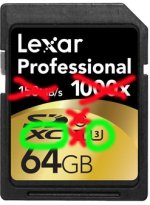
UHS-card.jpg

They say a picture is worth a thousand words... I normally take the "thousand words" approach, but in this case, here's a picture. I've crossed out all the stuff that the camera doesn't care about, and highlighted the two factors that are important: the fact that it's an SDXC card, and the "U3" logo of the "3" inside a "U".

Technically you can record on an SDHC card, but I highly recommend SDXC instead; SDHC cards will split up your files every two to four minutes, which can be profoundly annoying in post. SDXC cards will make a contiguous file for 48 gigabytes, which is vastly more useful.

As for the "150X" and UHS-II vs. UHS-I, those are typically referring to how fast you can read the card off when you plug it into a computer. The camera doesn't care about that,, it only cares about MINIMUM SUSTAINED WRITE SPEED, which is what the "3 inside a U" designates. But a UHS-II card could potentially be read out faster than a UHS-I card, so that may come into play in post.
 
Thank you once again. Very instructive indeed!
I guess the splitting-files-up-thing was exactly what I experienced yesterday, when I tried the DVX200 for about ½ hour. I had a hard time to get the camera record on the card I brought with me (A Sandisk Extreme Pro 95 m/sec - which I realized was only U-1). So I did only get two small files on the card - both in 1080 50P and I did not have time to get into the menu etc. I literally un-boxed the camera in the shop, so it was completely new.
Not a very good way to test anything I guess, but I did get an idea of how the camera was behaving. Felt familiar - like my old HMC 151 - just a bit heavier. I liked it...
Now I am really excited to see how the firmware update will make the image better from the DVX200. I´m not really excited or convinced about the image quality yet, but I might be after the firmware update. Really hope to see some tests with the new firmware applied on Youtube/Vimeo next week. If possible - how will you describe the changes in image quality after the firmware update is applied? Is it a dramatic change or is just a subtle change? After having used HMC151 for years, changed to DLR and GH3 I miss the feeling of a "real" videocamera in my hands - with all onboard.

Thanks again - you have been very helpful!

:)
Morten
 
The most dramatic change in image quality will come from people developing scene files for the camera. It is extremely "paintable"; those who put in the effort will be able to tailor the image to exactly what they want.

The out-of-the-box look won't be that different, although the texture on the images will be much nicer and cleaner, I'm very happy with that change. Color accuracy will be better, and people will be able to easier match it to other professional cameras. But as for out-of-the-box, it won't be dramatically different -- it will still need being "painted", just like footage gets "graded". Same process, just that one happens in-camera and the other happens in post.
 
That sounds really great. That is what I wanted to hear :-)
I did a lot tweaking scenefiles with my hmc151 (from your very nice book) and after some time I learned how to get the best out of the camera and did most color and sharpening in post.
Is it possible to save and load scenefiles in the dvx200? I got the impression there is only six scenefiles and one has to change everyone with no save to card option? Can not wait for the first tests to show up - hopefully monday.
 
Last edited:
You can definitely save them to the memory card. You can save packages of six scene files, just like the HMC150 could. You can save eight packages per card.
 
Last question about cards. Would t be posible to recod ij the best resolution and bitrate the camera internally can offer with the Lexar 1000x U3 card? Fx 1080 50P 200Mbps?
 
OK. Thx.
Lexar has just announced a new 128 GB U3 UHS-II with 2000X - (300 MB/sec). Do you think I should wait for that or could I get same results with Lexar 128 GB U3 UHS-I 1000x (150 Mb/s) card? The later is half the price....But if the 2000x card is the best to use (I am thinking of the 300 Mb/sec and the demand for fastest speed for 4K etc.)...???
 
Again, "2000X" and "1000x" and "300MB/sec" and "150 MMb/s" mean nothing whatsoever as far as the camera is concerned. Those are all marketing terms, and they are meant to imply that the card can perform "as much as" or "up to" 300MB/sec. It doesn't mean it WILL perform at 300MB/sec.

The only stat that matters whatsoever to the DVX200 (or, really, any camera) is what the MINIMUM SUSTAINED WRITE SPEED is... read speed doesn't matter at all, write speed is what counts. And the "2000x" is talking about what the maximum potential speed might be in some particular circumstance, but that is, again, utterly irrelevant -- what is important is what the MINIMUM, SUSTAINED write speed is. The speed at which the card will not go below.

And the statistic that tells you that is the U3.

Now, with all that said, a UHS-II card should potentially be able to be faster than a UHS-I card. But if the camera doesn't use that potential speed, what good is it? For camera purposes, none. But for offload speed, if you have the right hardware, you could offload cards faster.

So I would say for the same price, I'd rather have two 128BGB UHS-I U3 cards, than one 128GB UHS-II U3 card.
 
I had to sent back these sd cards: 64GB SDXC Samsung Pro Plus 95MB .Class 10 UHS-I U3. They are incompatible
, although the specs are matching Scandisk extreme pro cards.
 
Hey Gang, I got a few of these PNY Elite Performance 128 GB High Speed SDXC Class 10 UHS-I, U3 up to 95 MB/Sec Flash Card (P-SDX128U395-GE) https://www.amazon.com/dp/B00WWBCQEI/ref=cm_sw_r_cp_awd_BwjdxbXGK2JKW. Which clearly state u3 however when I put the card on he camera or states incompatible card, check speed error. They seem to record and work fine but the error alone is enough to keep me wonder whether or not I want to use these on a shoot. In have four of them and they all show the same thing. Am I missing something or does the dvx just want panasonic cards?

Thoughts?
 
I have Lexar U3 UHS-I 128GB. I had a few problems in dual codec where it just stopped recording suddenly. I was also shooting simultaneous rec in 50p UHD and the cards stopped. It's fine if you're shooting B-Roll, but if it's an event or an ENG situation, you don't want to miss your money shot because of a dinky card. Now I know people have said that it doesn't matter, but if you look at the maximum write speed of your card in MB/s (B&H lists them) and then think about how much leeway your camera needs as a base, constant speed in any given format, you might want to go up to UHS-II. I realised that my cards were enough, but if you push too far and try to record in dual, simul or heavy framerates like 50p, you can wind up with the damn thing stopping. So, better to be safe than sorry, I've ordered a 2 pack from B&H of UHS-II cards.
 
I have a DVX200 on order and should receive it in a few days. Has anyone tried a 256 gig SD card in one yet? Is there a limit to the size of the SD card?
Thanks
Bob
 
Back
Top