Canon's Upcoming RF cinema camera rumored specs

Jamie,

Thanks for your input.

You are right, it really depends on what I use it for.
I am thinking more toward using my c200 in run and gun style shooting situation. And, I can totally see C70 being clear winner in that section.

The dilemma I have is,

I do own sigma art lens lineups including art 18-35. Reason being that I am also Sony shooter and I share Sigma lenses on both my Canon and Sony gear via mc11.

When C70 is taking RF mount natively, I just can’t predict how my sigmas will behave on the new EF to RF adaptor, considering Canon will only optimize their own glasses for a good reason.

Also, my Sigma 18-35 will be basically unusable for it is EF-S lens.

If the value of the C200 is going to drop, I would like to sell it while it still holds its value.

Raw is not the first priority for me. I am bit suspicious on how well compressed file from C70 can be edited though.

I will think about it little bit more.

Again, thanks for your response.
 
EF-S only applies to Canon's lenses.

18-35mm is just an APS-C lens and would work with the camera with a non-speedboosting adapter. (And even with the adapter it would probably clear most of the vignetting at 35mm.)
 
Hi, great discussion here!

I just would like to ask for some inputs from everyone in this forum.
I actually just purchased C200, used. I knew something new was coming and the moment I saw C70 being announced, I actually almost fell for it and preorder one.

Then I had to rethink just a bit after reading so many feedbacks for C70 announcement on the internet, including this thread.

Do you think the value of C200 will rapidly go down because of C70?

I think C200 is still superior over C70 in certain area.

1. It has internal Raw recording capability
2. Built in EVF
3. Fullsize XLR as opposed to the mini XLR and awkward audio control dial position of C70
4. Bigger and more professional looking body as opposed to mirrorles style body of C70
5. According to Newsshooter, DGO sensor capability is valid only if you are using frame rates under 30P
6. Intra codec only until 30P. Over 30P, it can only record long GOP format.

And, I read on the article below that C70 and C300 MK III are unlikely to get RAW output updates for they use the same DGO sensor and outputting RAW output is very complicated on the DGO sensor.

https://www.diyphotography.net/this...in-output-works-on-the-new-eos-c70-4k-camera/

Any insight into whether I should sell C200 to get C70 would be much appreciated.

Thanks in advance!

I have owned and shot with the C200 a LOT over the past few years.

1. Client perception - C70 looks lkike a hobbyist toy, C200, especially rigged out, looks more like a professional camera. Of course I guess you could rig out the C70 too but general corporate client perception of the C200 appearance will be better.
2. Cinema RAW Light is great, pretty easy to work with for a RAW format. Do you need it? Tough to say. If you do mostly corporate, no. If you do agency work, green screen or shoot documentaries in highly difficult, variable circumstances, CRL gives more
of a safety net if you screw up exposure, it's that simple. if you shoot mainly shoot polite, nicely lit, interiors, don't bother with RAW. If you are documenting something challenging like standing on the deck of pitching boat in heavy seas with the sky, sun
and water constantly changing with insane variations in lighting, Cinema RAW Light rocks.
3. The sensor in the C70 is clearly more advanced, lower noise and better dynamic range than the one in the C200. But all of those tests where they show the noise patterns at 6 stops under and 5 stops over? You have to be a pretty incompetent shooter to ever end
up there. Even with my documentary in the ocean, I was rarely more than 2-3 stops over and if you are six stops under, you should be lighting the scene. So while those tests show more capability if you screw up, don't screw up that bad and the C200 sensor
looks amazing, very Arri-like if you have good glass and know how to light well.
4. Mini XLRs are not as good as full sized. SDI out on the C200 is invaluable to many of us. The HDMI connection is just a lousy, terrible consumer connection. If your workflow doesn't dictate SDI, great but many of us NEED SDI.
5. Having the EVF, once again, for shooting outdoor in difficult circumstances, is really handy. It actually works well when shooting cradled, which I do sometimes.

In the end, you should buy or keep whichever camera best suits your use case. For me, 100% that is the C200. For you, might be the C70, just depends on how you shoot, who you shoot for and under which circumstances. I wouldn't mind owning the C70,
but it probably wouldn't cut very well with the C200 as they are differenct sensors. For me, I am eagerly awaiting the C200 price reductions, I might pick up one or two more them for three camera shoots. C70, I will probably skip, not because it isn't a sweet little
camera, it is, but C200 would make me more money. And I am in this business to make money, not collect cameras. ;-)
 
Last edited:
Oh, really?

I did not know EF-S labeling is applicable only to Canon lenses.

Glad to know I can still use that glass on C70 when I purchase one.

Hmm, decision making time...
 
Yeah, it's their own line/marketing to sell those lenses for their APS-C DSLRs.

The mount includes some sort of mechanism preventing them from being mounted on their FF EF DSLRs so they don't damage the mirror.

Other APS-C lenses are just APS-C/S35 (and there's no mirror to hit on cinema cameras).
 
But you can mount EF-S lenses on FF cameras and on speedboosters. And, as you mentioned with the Sigma 18-35 at 35mm, sometimes they can cover FF. My Tokina 11-16 covers FF at 16 and maybe at 15, and it does it with less distortion than any 16-35mm lenses (unlike at 11mm where it has horrible distortion and would vignette massively on FF).
 
You can't mount EF-S lenses on Canon's full-frame DSLRs without taking the tab off the EF-S lenses.

But you can mount other APS-C lenses on FF cameras.
 
As I mentioned, EF-S only applies to Canon.

Your 11-16 is an APS-C lens with an EF mount.

There's a lot of confusion with this over the years because people think their ASP-C lenses have an EF-S mount because they may be marketed for APS-C cameras but all of those lenses have EF mounts, which is why they work on Canon's FF cameras.

EF-S only applies to Canon lenses. Those will not mount on a Canon FF camera. They literally won't fit because Canon designed them to protect people from damaging their cameras based on how they made the lens mount and how far back it protrudes.
 
Thank you for the clarification. I'm raking my brain, but I don't think I own any Canon APS-C lenses (only Tamron and Tokina), so that must be why I never encountered the issue
 
Really? Why? The camera won't give you an image? I've mounted my 11-16 on the 5Dmk3

and to further clarify, taking the tab off of an EF-s lens so that it mounts on a speedbooster or Canon full frame DSLR is possible as Norbro said(I have a 17-55mm Ef-s mounted on my pocket4k via MB speedbooster as I type this), but it also exposes the electronics/internals of the lens on the mount end in a way that is less than ideal. It is a very easy, very functional hack, but a hack nonetheless. There are videos on YouTube that will show you what it looks like in practice.

The thing is, there are very few Canon mid-range zooms with stabilization, thus the reason why the 17-55mm 2.8 has been so popular for doc shooters on C-series cameras. All of which keeps bringing me back to my broken record mantra: We need a midrange fast-ish zoom that has good mechanical handling for manual focus AND stabilization. Something like the Canon 18-80, but faster and with a bit of compromised zoom range...17-55 is fine. Or, think of the Fujinon MK lens but with stabilization. That would be the ultimate solo shooter doc lens.
 
Last edited:
Hi, great discussion here!

I just would like to ask for some inputs from everyone in this forum.
I actually just purchased C200, used. I knew something new was coming and the moment I saw C70 being announced, I actually almost fell for it and preorder one.

Then I had to rethink just a bit after reading so many feedbacks for C70 announcement on the internet, including this thread.

Do you think the value of C200 will rapidly go down because of C70?

I think C200 is still superior over C70 in certain area.

1. It has internal Raw recording capability
2. Built in EVF
3. Fullsize XLR as opposed to the mini XLR and awkward audio control dial position of C70
4. Bigger and more professional looking body as opposed to mirrorles style body of C70
5. According to Newsshooter, DGO sensor capability is valid only if you are using frame rates under 30P
6. Intra codec only until 30P. Over 30P, it can only record long GOP format.

And, I read on the article below that C70 and C300 MK III are unlikely to get RAW output updates for they use the same DGO sensor and outputting RAW output is very complicated on the DGO sensor.

https://www.diyphotography.net/this...in-output-works-on-the-new-eos-c70-4k-camera/

Any insight into whether I should sell C200 to get C70 would be much appreciated.

Thanks in advance!

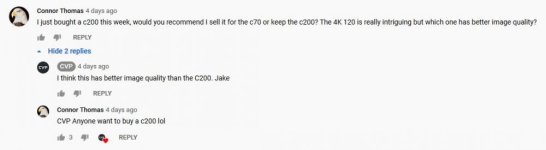
I'm in a similar situation. I had all but decided on the C200 right before this camera was officially announced, since it is probably the best priced built out RAW capable cinema camera (at least I think so). For several years, it's been ingrained into my brain that RAW = superior image quality, that was the primary reason why I was looking at getting a camera that could shoot RAW. But after reading several posts on here and reading these early reviews for the C70, apparently that's not the case? The guy from CVP video even claimed in the video's comments that the image quality from the C70 is better than the C200's. Having flexibility with the image in post is certainly useful, but I personally put image quality at a much higher priority. I need to wait until more people have used the C70 (and the C200, preferably) and can confirm whether or not this claim about the IQ is actually true. If it is, then the C70 might be the better camera for me. I prefer how more built out the C200 is, but coming from shooting video with a DSLR for so long, the transition to the C70 might not be so bad. Either that, or wait to see if there will be a C200 Mark II with this new DGO sensor.

Capture.jpg
 
Are you only comparing them in Canon's world? Because for some people Canon's RAW does indeed have a slight edge over its XF-AVC (specifically in post), but how many would notice?

Personally, I would expect the C70 (with its specs) to have better image quality because it's 3 years newer. Also, it's not always an apples-to-apples comparison. The 1080p RAW from a Blackmagic is very soft compared to modern day 4K offerings, even 8-bit.

OTOH, thousands of movies were shot with Alexa's ProRes and they look better than anything Canon has ever offered so it's of course not true if you're asking in general.

IMO, it's much more important to have a camera that has a variety of features that make your experience better versus a slight improvement in IQ.
 
I only think it is worth changing cameras when you have specific reason.

C200 is a fine camera.

But maybe its too heavy or you are after 120 or something ??

Personally i tried the C200 and found the EVF made for a solid shooting position that worked in full sun.
 
I think the design and other feature differences will be more noticeable than any IQ difference. Because both cameras produce great images.

I think that the C70 will have more DR in XAVC. But against CRL? Dunno.

People say that the C300mk3 (and thus C70) sensor is sharper than the C200 sensor. So the C70 may have a detail advantage.

I think the colors from C200 RAW look stellar, and there's a very wide latitude for missing exposure. But the C70 colors should look great, too.

Personally, I would buy the C70 over the C200 just due to RF mount and the ability to speed-boost full-frame lenses. But that's because I use photo lenses due to price (and AF), and the best photo lenses in the price tier are full-frame. and there are more full-frame options. If you're using super-35 cinema lenses, that advantage evaporates.

Body design/handling, built-in EVF, audio controls placement... I try to do mental wargames where I imagine using potential gear purchases on a shoot, or replaying a recent shoot but if I had the gear I'm thinking of buying, how would it have gone differently?

Now, I'm considering what E mount lenses I may want for my A7SIII, and the last wedding I shot, I was thinking about what the perfect cameras/lenses combination would be as I went throughout the day.

I think you need to game out your shooting scenarios. Would you ever use 4K120p? Does anyone ask you for 10-bit XAVC? Would you be happy shooting a 1Gbps codec? Etc.

The good news is: I promise you you'll be happy with either camera's IQ.
 
^ As far as E mount lenses go, if you don't have the Tamron 28-75 you should check it out. I use it on my A7III and it's fast and sharp with a short MFD...
 
^ As far as E mount lenses go, if you don't have the Tamron 28-75 you should check it out. I use it on my A7III and it's fast and sharp with a short MFD...

I got the sigma 24-70. Going to 24mm was a big part of it but I considered the tamron as well.

Now I need to determine if it's the only e mount lens I need. It may well be since the A7SIII will probably live on the gimbal, so a different camera would be doing tripod/70-200 work.

But if I got more e-mount lenses, right now I'm leaning towards samyang 18mm and either sigma 70-200, tamron 70-180, or tamron 28-200. There are a lot of considerations in play. I'm going to wait and feel out what I'm missing or if I'm not.
 
For several years, it's been ingrained into my brain that RAW = superior image quality, that was the primary reason why I was looking at getting a camera that could shoot RAW. But after reading several posts on here and reading these early reviews for the C70, apparently that's not the case?

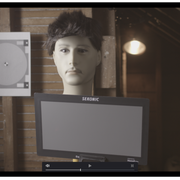
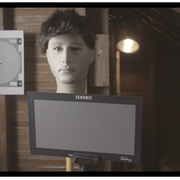
It's hard to say for sure at this point. I'm looking forward to seeing some side-by-side comparisons as the YouTube camera review channels get their hands on them. But what I can say that even when carefully exposed, I find the noise level at ISO 800 when shooting CRL on the C200 more than what I would be comfortable delivering to a client. Your mileage my vary. For some on this forum, it's an acceptable level of noise:


ISO 200 (gray card exposed to 35%)


ISO 800 (gray card exposed to 35%)​

(Make sure to load full resolution previews).

I have preordered the C70 because with C200 footage, I have to build in time to run all 800+ ISO clips through Neat Video. This is fine when the footage isn't needed right away but it isn't an option on jobs where the client wants to download the footage at the end of the shoot. I am hopeful that the C70 will be much cleaner. From the footage I've seen, and Ollie Kenchington's posted files from the camera, it is.

Are your clients really that noise averse or are YOU that noise averse? Just curious. I see the slight noise level difference on the C200 between shooting at ISO 200-320 versus the 800 but it's pretty minimal in the real world. You like what you like but I find most image issues that crop up on boards are because the shooter has issues, real or imagined, with various image parameters,
I have just rarely found clients to notice or see anything unless it's really prominent. This has carried into remote live streams where we will have someone using their crappy iPhone 5 on a hideously bad wireless connection and we are getting an ultra low bit rate at perhaps 2-3 fps and the client will remark, "Yeah, it was little choppy", when in reality
it looked horrifically bad, like an abstract moving slide show, not even video. We always laugh about that, "Wow, that was 'a little choppy'? I couldn't imagine having to run massive amounts of footage through Neat Video, it's such a render pig.

For me, it's been exceedingly rare that clients ever say anything other than, "Wow, that looks good" as long as I did my part and lit things well. I have only had one client ever say anything about RAW and that was for shooting green screen, where they loved how much better tha final key looked compared
to previous shoots where we hadnt shot RAW. I'm sure its depedent on what type production you do but our clients are rarely very discerning unless something looks really bad.
 
Last edited:
Yeah, I find most people are actually pretty easy to please. As long as the picture is "clear" and "bright" (as they say), and the sound is good, you're 90% there.

It's only some of the "artists" in charge whom take themselves and their video production jobs way too seriously that like things done a very certain way and/or may find issues with various randomness.
 
Back
Top